Below the fold are some hints for this weekend’s Wall Street Journal variety puzzle, a Rows Garden by Patrick Berry. As usual, they’re set in white text so you can click and drag over one hint without seeing the rest. After you’re done with this, stop over for Sunday brunch with more puzzle links.
Saturday, March 15, 2014

Friday, March 14, 2014
Broadcast Network (Puzzle No. 3,317)

Link to puzzle: http://www.thenation.com/article/178790/puzzle-no-3317
Degree of difficulty (by standards of this weekly puzzle): easy to moderate, and very consistent.
Hozom’s comment: “Chez Henri,” in which Hot realizes his dream of opening a Bay Area cryptic restaurant. Reviewer’s note: the groaning you hear isn’t just from the large portions!
I think the best way to describe the new Wordplay puzzle magazine from Penny Press is to compare it to a
television channel. In the 1960s,
TV for most people was the three major networks. Cable TV was mainly for people who wanted better reception
or not to have to fuss with an antenna.
The networks showed a little bit of everything: Laugh-in, a college
football game on Saturday afternoon, soap operas mid-day, and the evening news. Then we started seeing new and more
focused channels: ESPN, HBO, MTV.
Today there are channels for everything from home remodeling to Tejano
music to game show reruns.
So it is with puzzles.
Thirty years ago, we had the newspaper crossword plus some syndicated
variety puzzle like Jumble or a cryptogram. If you wanted variety, there were print magazines at the
supermarket checkout lane. For
harder puzzles, there were magazines and books at bookstores.
Then came the internet, which has been fabulous for us
solvers. We can congregate at
sites for our favorite types of puzzles, and constructors have a place to go to
seek out an audience. Now we’re
getting into app world and push content; we don’t ever have to go without our
preferred puzzles.
Penny Press is the broadcast company that’s trying to thrive
in the 500 channel age. Checkout
lane magazines of easy crosswords and word searches are their bread and butter,
and they’re the dominant player in that market. But they also do specialty puzzles: The Other Doctor
Mitchell is an avid consumer of their logic puzzles.
Wordplay fits the Penny Press model to a T. They understand solvers, and that they
derive satisfaction from finishing puzzles and feeling they’re smarter because
they’re able to get the right answers.
So they tend to stay away from difficult puzzles or ones that are
intimidating at the beginning, just like the other editors who have to publish
for a broader market, like Mike Shenk with the WSJ weekend puzzles.
What that means is that the variety and cryptic crosswords
in Wordplay are interspersed among other quick word games of the type Willz is
good at coming up with. Those are
good for a quick two or three-minute break from whatever else you’re doing, or
to pick up and solve while you’re waiting in line for something. Nathan’s Pathfinder is probably the
hardest puzzle in the magazine.
Another benchmark: the Fraser Simpson cryptic is easier than
his Globe and Mail puzzles, and is in pure US cluing form rather than the
part-British approach of his weekly puzzles. (The other cryptic in the magazine is by Jeffrey Harris.)
Other names you’ll recognize (most but not all the puzzles
are credited) include Patrick Berry, Brendan Emmett Quigley, Foggy Brume, and
Mark Halpin. There are also some
new constructors working in forms you’ll recognize, like a Rows Garden by Joon Pahk. Anthologies like this one
are valuable for giving these people some cash and a wider audience for their
puzzles. Kudos to Will Shortz for
convincing the big names to join the cast and for recognizing some emerging
talent.
The presentation is like other Penny Press magazines:
comfortably-sized grids on good quality newsprint paper. Since it’s newsprint, you will have to
choose pen or pencil carefully, and it won’t take too much erasing. Games
Magazine is better in this department.
There are about 60 puzzles in a 64-page magazine for $3.99 ($18.97 for an annual subscription: 6 issues per year). For the whole thing, that’s a good
value, but if you see the word games and logic art pages as filler, less so.
So like the people who watch military history 24/7, solvers
who want just variety crosswords will change the channel. Those whose idea of variety extends
more broadly will be satisfied but not thrilled with this magazine. But that’s OK since those are fairly
small slivers of the population.
Like the big TV networks, Penny Press is trying to build an audience out
of people who are just tuning in to whatever is on now plus those who are
looking for a particular show to meet their interest.
For the typical reader of this blog, it’s worth having a
copy of Wordplay. It’ll be ideal
for airplane trips or on the nightstand for when you want a light and fairly
easy diversion. If you discover
some new favorites, and constructors get a breakout from it, even better.
Penny Press says the best place to find Wordplay will be at larger bookstores, but to make sure you get your copy, subscribe.
Monday, March 10, 2014
Sled hockey (Solution No. 3,316)
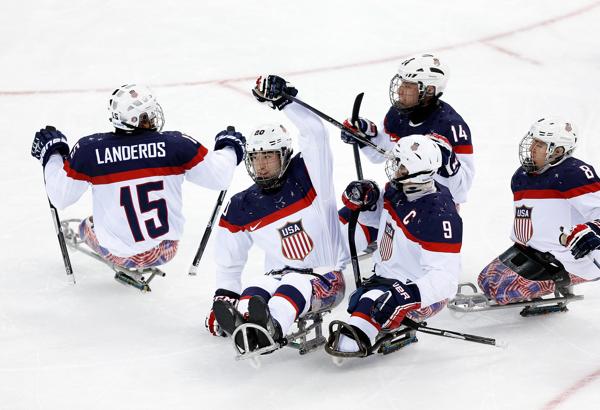 |
| Team USA: sled hockey in Sochi |
Sled hockey is gaining popularity, in large part I think because it maintains all the character of the game, from the flashy stickhandling of the top centers to the dirty work done in the corners to the goalies complaining to the referee that they had the puck covered before it went in the net.
The players carry two sticks, each with a blade at one end for shooting and passing the puck, and a set of spikes on the other end for propelling themselves around the rink. The players must have excellent upper body strength for skating, and core strength to bend and reach the puck. Those are the same assets you need for checking, so the guys don’t shy away from the physical part of the game. On the sleds, it’s like a cross between the NHL and NASCAR.
The officials for sled hockey are able-bodied, so they can retrieve the puck and get in between the players for face-offs. From the ref’s perspective (I’d love to work a few sled games), it’s a lot like regular hockey. Almost all the penalties are the same, though there’s an additional violation called “teeing” which is hitting another player with the front of your sled. I had to look that up after I saw a signal I’d never seen before. Congratulations to Johnathan Morrison, Derek Berkebile, and Brian Frerichs for getting the call to represent our officiating program at the international level.
Game 3 against Russia is tomorrow morning, then semifinals Thursday and (we hope) the gold medal game at noon Saturday. Check your local listings and support our guys.
Solution to The Nation cryptic crossword No. 3,316
Link to puzzle: http://www.thenation.com/article/178672/puzzle-no-3316
Legend: “*” anagram; “~” sounds like; “<“ letters
reversed; “( )” letters inserted; “_” or lower case: letters deleted; “†”
explicit in the clue, “^” first or last letter or letters, “{“ relocated letter
or letters; “§” heteronym, “¶” letter bank
Across
1a
|
E(XC)LUDE
|
ELUDE (“skirt”) containing (“covering”) XC (“90”)
|
5a
|
*A(CC)EPT
|
CC (“send a copy”) contained in (“in”) *TAPE (anagram
indicated by “snarled”)
|
8a
|
*FIG(U)RE
|
*GRIEF (anagram indicated by “unbridled”) containing
(“about”) ^U^nlucky (first letter indicated by “hint of”)
|
9a
|
HAS H (M)ARK
|
HAS (“fools”) + HARK (“pay attention”) containing (“to
grasp”) ^M^agic (first letter indicated by “source”)
|
10a
|
THAT CHER
|
THAT (†) + CHER (“multitalented entertainer”)
|
11a
|
~MYS ELF
|
~MICE (“computer devices,” homophone indicated by “by
ear”) + ELF (“toy maker”)
Since I had the M I was trying to make “Mattel” work.
|
12a
|
*UTTERANCES
|
*NUTS CREATE (anagram indicated by “mixed”)
|
14a
|
<_VEEP<
|
<PEEV_e_< (“annoyance,” reversal indicated by
“brought about,” omission of last letter indicated by “the bulk of”)
|
15a
|
AV IS
|
AV (“audiovisual”) + IS (“plays”)
|
17a
|
B(O(OK)K)EEPER
|
BEEPER (“pager”) containing (“ringing”) OK (“yes”)
contained in (“in”) OK (“Oklahoma”)
That’s a rare one: a double container where both
containeds are the same.
|
20a
|
~PENCIL
|
~PENCE’L (homophone indicated by “when speaking”)
|
22a
|
GR(EAT) APE
|
NOSH (“eat”) contained in (“inside of”) GRAPE
(“fruit”)
|
23a
|
*INTEGERS
|
*STEERING (anagram indicated by “wheels”)
|
24a
|
CHAN EL
|
EL (“train”) following (“in pursuit of”) CHAN
(“Chinese detective”)
|
25a
|
<E MER GE<
|
<EG (“say”) + REM (“a type of sleep”) + tranc^E^
(last letter indicated by “ultimately”)< (reversal of the whole thing
indicated by “facing west”)
|
26a
|
*ORPHEUS
|
*SHORE UP (anagram indicated by “unsteady”)
|
Down
1a
|
*EPI THE T
|
*PIE (anagram indicated by “minced”) + THE (†) +
^T^able (first letter indicated by “top”)
|
2d
|
COUNT(L)ESS
|
COUNTESS (“noblewoman”) containing (“welcomes”)
^L^adies (first letter indicated by “initially”)
|
3d
|
*URET HR A
|
*TRUE (anagram indicated by “mixup”)
Excellent twist in the definition.
|
4d
|
*ETHER
|
*THREE (anagram indicated by “out of whack”)
|
5d
|
ASS(UM)ES
|
ASSES (“idiots”) containing (“suppressing”) UM
(“hesitation”
|
6d
|
_CAMUS_
|
pere_C AMUS_es (hidden word indicated by “excerpt
from”)
|
7d
|
PAR O LEE
|
LEE (“general”) follows (“supporting”) PAR
(“standard”) + O (“zero”)
|
13d
|
_CEO_
|
fa_CE O_ff (hidden word indicated by “captivates”)
Could also have been ACE, which is fine since you
usually need to make a three letter entry harder some way.
|
14d
|
*VIENTIANE
|
*NATIVE IN (anagram indicated by “disoriented”)
|
16d
|
VI(<ETNA<)M
|
VIM (“energy”) containing (“stocks”) <ANTE< (†,
reversal indicated by “up”)
|
17d
|
BE(LIE V)E
|
LIE (“story”) + V (“victory”) contained in
(“interrupts”) VIE (“contest”)
|
18d
|
<K(NEE_)CAP<
|
<PACK< (“bundle,” reversal indicated by “up”)
containing NEE_d_ (“requisite,” omission of last letter indicated by
“nearly”)
|
19d
|
E}X{PRESS
|
E{M}PRESS (“ruler,” replacement of M (“second place”)
with X indicated by “99 percent loss” (changing M (1,000) to X (10)))
|
21d
|
<~CHEER<
|
<~REACH<
|
22d
|
*G(US)TO
|
*GOT (anagram indicated by “drunk”) containing
(“internalizing”) US (“American”)
|
Saturday, March 8, 2014
Dumping a coach (Sunday brunch: March 9, 2014)

There’s a popular opinion that referees are out to get coaches, but aside from a few ego cases, most of us are trying to keep the coaches and players in the game. Part of it is for the good of the players and the game, but there’s also a selfish reason: it’s a pain in the tail to dump a coach. Most immediately, it risks turning the rest of the team and the spectators against you and your partner, and then after the game it’s just a boatload of paperwork and hassle. (continued below the puzzles)
I don’t think I made note of this month’s Harper’s puzzle. It’s called Gremlins, and after a couple of relatively easy puzzles from Maltby, we get a tough one again. Each and every clue has an alteration, and each and every answer has an alteration.
By comparison, the acrosses in the Kevin Wald Academy Awards puzzle are all normal, which made it considerably less difficult than his puzzles usually are.
Straight cryptics? We have a trio: Hex in the National Post, Fraser Simpson in the Globe and Mail, and LizR’s Brit cryptic, in order of difficulty. Some nice clues in the Simpson and LizR puzzles so if you don’t usually attempt them, consider a try this week. Even if you don’t get all the way through (I often can’t), they’re enjoyable.
The New York Times variety puzzle (behind the paywall) is an acrostic by Hex. Hex also have their weekly straight cryptic in the National Post while Fraser Simpson constructs for the Globe and Mail.
We also have an acrostic (by Mike Shenk) in the Wall Street Journal (Java and printable versions). It was easy, perhaps because there was so much repetition. I got several letters of a key word in one place, and some different letters in another, and nailed that word, which quickly led to the neighboring words and the rest of the puzzle. A lesson there for constructors.
Elsewhere in the puzzle world, Puzzazz released an update to their app this week, and it’s a big one. You can now solve any .puz or ipuz in the app, if the author provides the download link.
(back to hockey below the fold)
Thursday, March 6, 2014
Not merely hobgoblins (Puzzle No. 3,316)
Link to puzzle: http://www.thenation.com/article/178672/puzzle-no-3316
Last week’s Word Salad post was titled “Hobgoblins,” an allusion to the adage that “consistency is the hobgoblin of little minds.” (I see it was attributed to Emerson) In their post, Hot and Trazom defended themselves and other constructors from solvers who might have an unrealistic expectation for all the clues or answers in a themed puzzle fitting into the theme. I agree with Hot and Trazom. Not even Kevin Wald or Patrick Berry can do that (though they come close). But such consistency is something to strive for, and I think it is reasonable for solvers to expect that the puzzles they work follow the explicit (Ximenean) or implicit (see Hot and Trazom’s blog posts) rules of clue construction.
Starting in on Cryptic All-Stars last week, I found it’s a nice batch of moderate-difficulty variety cryptics, but there’ve been some clues to make me cringe. These two in particular stood out to me:
11d Money traveling west with bachelor invested in flower.
<A(B)LOOM< MOOLA (“money,” reversal indicated by “traveling west”) containing (“with ... invested”) B (“bachelor”)
The problem is that indicator. It would be nice clear indicator for an across, but the clue is a down!
Then, 11a Sense of rhythm employed by Ponti, Mingus
_TI MING_ pon_TI MING_us (hidden word indicated by “employed by”)
The problem there is that I had a jazz program on the campus radio station when I was in school (I can still identify some players by ear), and I happen to know that the French violinist’s name is spelled Jean-Luc Ponty.
I don’t think I’m being small-minded by disagreeing with those clues.
Hozom’s comment: “Tourney Time,” in which Hot and
Trazom report that they'll be missing this year's American Crossword Puzzle Tournament but encourage you to go.
They make the good point that you can meet and talk to many of your favorite
(and less favored) constructors while you're there.
Themework: A variety of “numbers” in the clues.
Difficulty (by standards of this weekly puzzle): Starts easy in the upper left, and gets
harder as you work your way around.
Last week’s Word Salad post was titled “Hobgoblins,” an allusion to the adage that “consistency is the hobgoblin of little minds.” (I see it was attributed to Emerson) In their post, Hot and Trazom defended themselves and other constructors from solvers who might have an unrealistic expectation for all the clues or answers in a themed puzzle fitting into the theme. I agree with Hot and Trazom. Not even Kevin Wald or Patrick Berry can do that (though they come close). But such consistency is something to strive for, and I think it is reasonable for solvers to expect that the puzzles they work follow the explicit (Ximenean) or implicit (see Hot and Trazom’s blog posts) rules of clue construction.
Starting in on Cryptic All-Stars last week, I found it’s a nice batch of moderate-difficulty variety cryptics, but there’ve been some clues to make me cringe. These two in particular stood out to me:
11d Money traveling west with bachelor invested in flower.
<A(B)LOOM< MOOLA (“money,” reversal indicated by “traveling west”) containing (“with ... invested”) B (“bachelor”)
The problem is that indicator. It would be nice clear indicator for an across, but the clue is a down!
Then, 11a Sense of rhythm employed by Ponti, Mingus
_TI MING_ pon_TI MING_us (hidden word indicated by “employed by”)
The problem there is that I had a jazz program on the campus radio station when I was in school (I can still identify some players by ear), and I happen to know that the French violinist’s name is spelled Jean-Luc Ponty.
I don’t think I’m being small-minded by disagreeing with those clues.
Monday, March 3, 2014
In and out (Sunday brunch: March 2, 2014)
When I skated out for my game last Sunday, I saw that the rink staff had put out the crummy old practice goals instead of the better ones they usually use for games. They did it again yesterday.
About five minutes into the game, that became important. I was down on the goal line, there was a shot, and the next thing I saw was the puck rebounding off the end boards. I looked back and the white team was turning away like they were celebrating a goal. I thought: “Get back in the game—keep playing until the whistle.”
Eventually, we had a stoppage and the coach yelled that the puck had gone in the goal. I replied that I saw the puck on the back boards, so it was no goal, but I’d check the net anyway. Sure enough, there was a hole on the bottom, opposite where I was standing and just big enough for a puck to get through. So I went back to the coach and said I couldn’t reverse the call since I didn’t see the puck go through the goal. I added that this was his team’s rink, and if he still had a beef, he should take it to the rink employees and not to me or my partner.
Fortunately for me, it was the net my partner checked before the game, and not my net. I suspect that he’ll be a little more careful when checking next time.
This week we get a balance of trade in cryptic crosswords between the USA and Canada. Whereas American constructors Hex have a puzzle every weekend in Canada’s National Post, Canadian constructors publishing in America are less common. But this week, American solvers get a Canadian puzzle in the New York Times courtesy of Fraser Simpson. Simpson also sets the weekly cryptic (available in Java and PDF) in the Globe and Mail: Canada’s other national paper (nominally published in Toronto). The Times puzzle is hard, like Simpson’s Globe and Mail puzzles, but it’s closer to a strict American style of cluing whereas the Globe and Mail puzzles are more relaxed like British puzzles. By that I mean that some of Simpson’s clues don’t fit the formula of “definition, wordplay, and nothing else.”
The Wall Street Journal has a treat from Patrick Berry called “Belt Line.” (PDF here) It involves intersecting loops of words and naturally (since it’s from Patrick) the unchecked letters of the grid give us a quote. It’s another hard one by Journal standards, so I posted a hint grid as well as the solution. The hint grid post also has some tactical suggestions in case you don’t know how to get started.
Sunday, March 2, 2014
New York TImes solution: March 2, 2014
Below the fold is the solution to the cryptic crossword in today’s New York Times.
Want more from Fraser Simpson? Stick around for Sunday brunch!
Want more from Fraser Simpson? Stick around for Sunday brunch!
Subscribe to:
Posts (Atom)