Didn’t realize until Thursday that last week’s was a double issue of The Nation, and then I’ve been preoccupied with researching and writing an evidence report on rehydration treatments for Ebola patients, so I owe you a cluing challenge and a back puzzle to work on.
In honor of tomorrow’s Sunday brunch topic, the cluing challenge is SNOWFALL. I can think of tons of ways to clue this, so multiple submissions are encouraged.
And the puzzle I’m solving and will annotate on Monday is No. 3,200.
See you at brunch tomorrow.
P.S. Happy Birthday to Liz today!
Saturday, November 22, 2014

Monday, November 17, 2014
Sanding both sides (Solution No. 3,345)
The solution and annotation to The Nation puzzle No. 3,345 is below
the fold.
Getting a smooth surface on a cryptic clue can be hard sometimes, as Hot and Trazom pointed out at Word Salad. Just think how hard it must be to get a clue to work two different ways and give two different answers—Kevin Wald accomplishes that in the second of his two new puzzles from last week. That’s a trick he specializes in: some of those special clues are very well camouflaged, I had to work backwards from the final message to find the last double clue. Hall of fame stuff.
Saturday, November 15, 2014
Hall of Fame (Sunday Brunch: November 16, 2014)
This weekend is the annual Hockey Hall of Fame induction in Toronto. Canton has its bronze busts, and Cooperstown its history, but the Hockey Hall of Fame is the best of all. It’s in a former bank building in downtown Toronto, and you walk into the bank vault to see the Stanley Cup. Unlike the HOFs for the other major sports, the Hockey Hall of Fame has welcomed great players and coaches from outside North America like legendary Soviet goalie Vladislav Tretiak, along with female champions like Cammi Granato. Referees and linesmen take their place alongside the players too, which obviously I agree with: no sport is more demanding on its officials than hockey.
This year’s class features Bill McCreary, who for a decade was the finest referee in the NHL (no offense to Kerry Fraser though). There’s no greater honor for an official than to be chosen for the seventh game of the Stanley Cup Finals, and McCreary got that call several times. Also in the class of 2014 is Sweden and NHL star Peter Forsberg. He had the same shoulder operation I had, the same week that I did, but the opposite side.
Some Hall of Fame constructors have puzzles for us this weekend: let’s start with Hex, who have an acrostic (spoiler alert) in the New York Times along with their weekly straight cryptic in the National Post.
Kevin Wald posted two new birthday cryptics this week. I managed to finish the first of them in one sitting, including the ending pieces—that doesn’t happen very often. Remarkable how Kevin can tie up so many loose ends in a puzzle so neatly.
Richard Maltby in the new Harper’s? I managed to finish that one pretty quickly too. Can’t say more because it’s a prize puzzle, but I’ll share some notes once the entry deadline passes. Meanwhile, Erica blogs the November puzzle at Tacky Harper’s Cryptic Clues.
Mike Shenk set the acrostic in this weekend’s Wall Street Journal, Stickler has his weekly Australian cryptic, and our friend Anonymous has the weekly Globe and Mail cryptic.
How about something different? If you solve sudokus, you should try Thursday’s Samurai Sudoku (hit the link and then select November 13--Evil). These puzzles are five interconnected grids, and when they’re on, they really have a lovely rhythm where you have to move from one grid to the other to get the missing answer. Once you figure out the logical key to the November 13 one, it goes down very smoothly.
This year’s class features Bill McCreary, who for a decade was the finest referee in the NHL (no offense to Kerry Fraser though). There’s no greater honor for an official than to be chosen for the seventh game of the Stanley Cup Finals, and McCreary got that call several times. Also in the class of 2014 is Sweden and NHL star Peter Forsberg. He had the same shoulder operation I had, the same week that I did, but the opposite side.
Some Hall of Fame constructors have puzzles for us this weekend: let’s start with Hex, who have an acrostic (spoiler alert) in the New York Times along with their weekly straight cryptic in the National Post.
Kevin Wald posted two new birthday cryptics this week. I managed to finish the first of them in one sitting, including the ending pieces—that doesn’t happen very often. Remarkable how Kevin can tie up so many loose ends in a puzzle so neatly.
Richard Maltby in the new Harper’s? I managed to finish that one pretty quickly too. Can’t say more because it’s a prize puzzle, but I’ll share some notes once the entry deadline passes. Meanwhile, Erica blogs the November puzzle at Tacky Harper’s Cryptic Clues.
Mike Shenk set the acrostic in this weekend’s Wall Street Journal, Stickler has his weekly Australian cryptic, and our friend Anonymous has the weekly Globe and Mail cryptic.
How about something different? If you solve sudokus, you should try Thursday’s Samurai Sudoku (hit the link and then select November 13--Evil). These puzzles are five interconnected grids, and when they’re on, they really have a lovely rhythm where you have to move from one grid to the other to get the missing answer. Once you figure out the logical key to the November 13 one, it goes down very smoothly.
Thursday, November 13, 2014
First impressions (Puzzle No. 3,345)
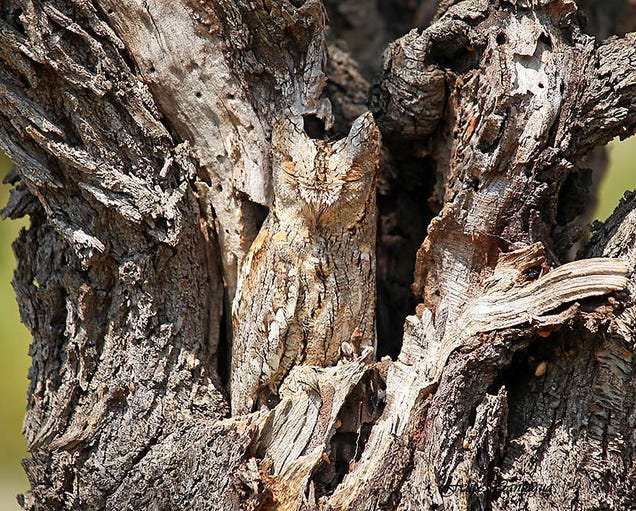 |
| Speaking of hidden in plain sight (Word Salad this week), can you see the owl here? More at Gizmodo. |
Related to that is the first impression you get from the topmost acrosses and the leftmost downs. They’re usually where solvers dig into a puzzle, and if they get those right off the bat (*), we feel the puzzle will be easy, and if those first answers are tough to get, we feel the puzzle will be hard.
So those first clues are another way that a diabolical constructor can mess with your mind. While it’s good form to have a fairly consistent range of difficulty among the clues (it’s what I refer too as a “smooth” solve), the firsts are the best place to adjust the perceived overall difficulty of the puzzle.
This week’s puzzle, at least for me, was one of those that started out harder than it finished. How about you?
Link to puzzle: http://www.thenation.com/article/190265/puzzle-no-3345
Degree of difficulty (by standards of this weekly puzzle): moderate, once I bypassed 1a and 1d
Hozom’s comment: Free Lunch, in which Hot and Trazom reply to critics who don’t like answer pieces appearing verbatim in the clue (these are the elements that I indicate with a †). My experience is they show up about twice a puzzle on average. Most of the time it’s necessary to make the clue read in a sensible fashion, but with a good misdirection that supposedly-easy bit can effectively camouflaged.
Weekly cluing challenge (at Word Salad): FREEBIE
Back with the solution Monday. Join us this weekend for Sunday brunch.
Monday, November 10, 2014
Train time (Solution No. 3,344)
The solution to The Nation puzzle no. 3,344 is below the fold.
I thought this week’s puzzle was not hard. The wordplay was around the usual level of difficulty, but there were fewer misdirections or other tricks. Since Hot was wondering how I appraise the degree of difficulty, maybe I should use the train trip as a reference.
Back in my first stint of taking the train to work, before I started solving cryptics, I often worked the puzzle from the daily newspaper on the ride home. Being on paper rather than a computer or a mobile device, there’s no handy timer. So I used the train as a timer. If I had the puzzle all done by Wayne Junction, it was easy. If it took a few more stops, it was moderate. And if I didn’t finish it by the time I got home, it was hard.
With the The Nation puzzle, I usually type up the annotation on the train Friday and/or Monday. Usually I can get almost but not quite half the puzzle (acrosses or downs) explained before I get to the city. This one I got into the last across before I had to get off Friday morning. I think that was farther than I ever got on a day the train wasn’t delayed.
I thought this week’s puzzle was not hard. The wordplay was around the usual level of difficulty, but there were fewer misdirections or other tricks. Since Hot was wondering how I appraise the degree of difficulty, maybe I should use the train trip as a reference.
Back in my first stint of taking the train to work, before I started solving cryptics, I often worked the puzzle from the daily newspaper on the ride home. Being on paper rather than a computer or a mobile device, there’s no handy timer. So I used the train as a timer. If I had the puzzle all done by Wayne Junction, it was easy. If it took a few more stops, it was moderate. And if I didn’t finish it by the time I got home, it was hard.
With the The Nation puzzle, I usually type up the annotation on the train Friday and/or Monday. Usually I can get almost but not quite half the puzzle (acrosses or downs) explained before I get to the city. This one I got into the last across before I had to get off Friday morning. I think that was farther than I ever got on a day the train wasn’t delayed.
Sunday, November 9, 2014
New York Times solution: Novembr 9, 2014
Difficulty-wise, this is about on a par with the National Post cryptics by Hex. Less inventive than the The Nation puzzles. Interestingly, the grid is the same that Silvestri used for his July NYT cryptic. I won’t complain about that.
Saturday, November 8, 2014
Warm spot (Sunday brunch: Nov. 9, 2014)
The rink where I had a came a couple of Sundays ago is one of the nicer places I skate. The ice is kept in good condition (they have a well-regarded figure skating club), the referees’s dressing room is spacious and even has a hot shower (so I can be presentable when I get to church), and the place is well-lit. I also like it because there’s an area near the blue line on the far boards where the ventilation system blows warm air. It must be misadjusted, because the warm air is supposed to be aimed at the bleachers, but I’m not going to complain.
The rink is not that cold otherwise (the one up north from me is very cold), but the warm spot still is a very comfortable place. It’s calming in a tense game, but it can also get my attention as I skate through and keep me alert in an easy game.
We haven’t had a new Kevin Wald puzzle in a while, so maybe it’s a good thing that the grid of “Many a Day” is pretty easy to fill (by standards of Uc’s puzzles, which are pretty darn hard).
The WSJ variety puzzle is a new type (right?) by Mike Shenk. It’s called “Alternation” and it reminded me of a Nathan Curtis puzzle. It’s probably easier to construct than a straight crossword, and quicker if not easier to solve. With that in mind, I posted a challenge grid as well as the usual solution and hints.
The New York Times has a cryptic this week: it’s by Richard Silvestri. Among the spoilers (read her post after you solve) Deb Amlen has a good description of the attraction of cryptics: “The reshaping of our train of thought is what makes cryptic crosswords so much fun.” She also informs us that the Times is preparing to make some of their cryptics available in their mobile app.
Regular weekly straight cryptics are found at the Stickler, the National Post, and the Globe and Mail. The Stickler was hard: I haven’t had time to solve the others yet since I need to be Mr. Mom this weekend (more precisely, to do figure skating and orchestra taxi service).
The rink is not that cold otherwise (the one up north from me is very cold), but the warm spot still is a very comfortable place. It’s calming in a tense game, but it can also get my attention as I skate through and keep me alert in an easy game.
We haven’t had a new Kevin Wald puzzle in a while, so maybe it’s a good thing that the grid of “Many a Day” is pretty easy to fill (by standards of Uc’s puzzles, which are pretty darn hard).
The WSJ variety puzzle is a new type (right?) by Mike Shenk. It’s called “Alternation” and it reminded me of a Nathan Curtis puzzle. It’s probably easier to construct than a straight crossword, and quicker if not easier to solve. With that in mind, I posted a challenge grid as well as the usual solution and hints.
The New York Times has a cryptic this week: it’s by Richard Silvestri. Among the spoilers (read her post after you solve) Deb Amlen has a good description of the attraction of cryptics: “The reshaping of our train of thought is what makes cryptic crosswords so much fun.” She also informs us that the Times is preparing to make some of their cryptics available in their mobile app.
Regular weekly straight cryptics are found at the Stickler, the National Post, and the Globe and Mail. The Stickler was hard: I haven’t had time to solve the others yet since I need to be Mr. Mom this weekend (more precisely, to do figure skating and orchestra taxi service).
Subscribe to:
Posts (Atom)