Showing posts with label Frank Lewis. Show all posts

Thursday, March 26, 2015

No wordplay (Solution No. 3,358)

The solution and annotation to The Nation puzzle No. 3,358 is below the fold.

The contrast between the cluing approaches of Hot/Trazom and Frank Lewis is really apparent in this puzzle.  If the Frank Lewis clues hadn’t been italicized, I probably would have been able to identify five or six of them.  The most obvious ones are clues like 1a and 25a, which lack the Ximinean construction of “a definition, wordplay, and nothing else.”  In most cases, Hot and Trazom hew pretty carefully to the Ximinean line. 

That’s not necessarily better or worse:  it’s different.  It takes a little more effort to make sure clues are neatly constructed, but it misses out on some of the associative possibilities that make you nod your head and smile when you figure out the answer. 

On the other hand, the British-style free association clues leave you grappling if you don’t see the clue phrase the same way the constructor does.  I find I have to rely more on intersecting letters, and often I need to see nearly all of them before the answer pops into my mind’s eye.  If you don’t have accessible answers crossing the clever ones, whole sections remain unsolved, and that’s where I think a lot of potential solvers give up on cryptics. 

Monday, March 23, 2015

Worth the Wait (Puzzle No. 3,358)


The 150th Anniversary number of The Nation is finally out, and Hot and Trazom found a unique way to mark the event.  They paid tribute to their predecessor, Frank Lewis, by including ten of his best clues in the puzzle.  Too bad they didn’t leave it as a second puzzle to the solver to figure out which clues were Lewis’s and which were Hozom’s.


Degree of difficulty (by standards of this weekly puzzle): hard—Frank Lewis was more liberal in his application of cryptic cluing standards.

Agility quotient: high (see above)

Hozom’s comment: “Envoi,” in which Hot and Trazom wrap up their work at Word Salad and hand the baton off to your humble servant. 

Cluing challenge (at Word Salad): ADIOS

Back with the solution Thursday. 

Monday, August 25, 2014

Peaches (Solution No. 581)

The solution to puzzle no. 581 from August 21, 1954 is below the fold

Thanks to a fortuitous combination of circumstances, we had some wonderful fresh and very ripe peaches to eat last week.  We have a little peach tree next to the shed.  It was put in about 15 years ago when we had the landscaping done (took down the ugly norway maple that the previous owners had “lollipopped” [in the words of the landscaper]--the weeping cherry that replaced it died in a hard winter a couple of years ago).  Turns out the tree isn’t in a particularly good place: the ground is too wet, but it’s survived.

Circumstance 1: Cold winter, late spring.  The spring warm-up was two or three weeks late and the garden is still a week or so behind where it usually is.

Circumstance 2: The town cut down the willow tree in the little park over our back fence.  There was a huge willow there—it was big enough to hold an entire flock of starlings (which if you’ve ever seen starlings you’ll understand).  The starlings have gone elsewhere, which means there are fewer birds pecking at the peaches before they’re ripe.  One year we tried bird netting but it didn’t stop the starlings.

Circumstance 3: Sabers and I came back from the family vacation early because he had select chorus “boot camp” at school.

As a result, I got to pick a bowl full of delicious, juicy peaches that were a perfect four or five bites big.

Saturday, August 23, 2014

Wayback machine (Puzzle No. 581)

Sherman, set the Wayback Machine to August 1954.  The armistice in Korea was holding, campaigns to vaccinate children against polio were underway, “Sh-Boom” by the Crew-Cuts was at the top of the charts, Raydoc was getting ready for his senior year of college at Ohio University, and my mother had just graduated from Indiana State.

Sixty years ago this week, The Nation published Crossword Puzzle No. 581.  In order to solve puzzles of this era, you have to take yourself back in time; sweep more recent events, songs, and books out of your mind; and think about what was going on then.  The key that unlocked this puzzle was an item that is obsolete now but would have been in many solvers’s desks in 1954.  Can you find it?

Link to puzzlehttps://drive.google.com/file/d/0B63FHswHWCruMFJBN1JNSVpRakU/

Degree of difficulty (compared to the current The Nation puzzles): Very hard

Hozom’s comment: No blog post this week—the magazine is on its summer schedule

Cluing challenge: posted here

Thursday, August 7, 2014

Picket fence (puzzle no. 1,111)

We have puzzle 3,333 coming up next week, so yesterday I posted 2,222 and today we get 1,111 (PDF formatted for printing here).  This was originally published in the June 21, 1965 issue of The Nation.

Since we solved another puzzle from this era a few weeks ago, this one looks a little less unfamiliar.  There’s less wordplay and more definition, with the playfulness worked into the definitions.  Solving it is closer to a mental pentathlon than to an exercise in clue decoding and solving.  

Back with the solution Monday.  Join us this weekend and every weekend for Sunday brunch, with more cryptics both simple and complex.

Wednesday, August 6, 2014

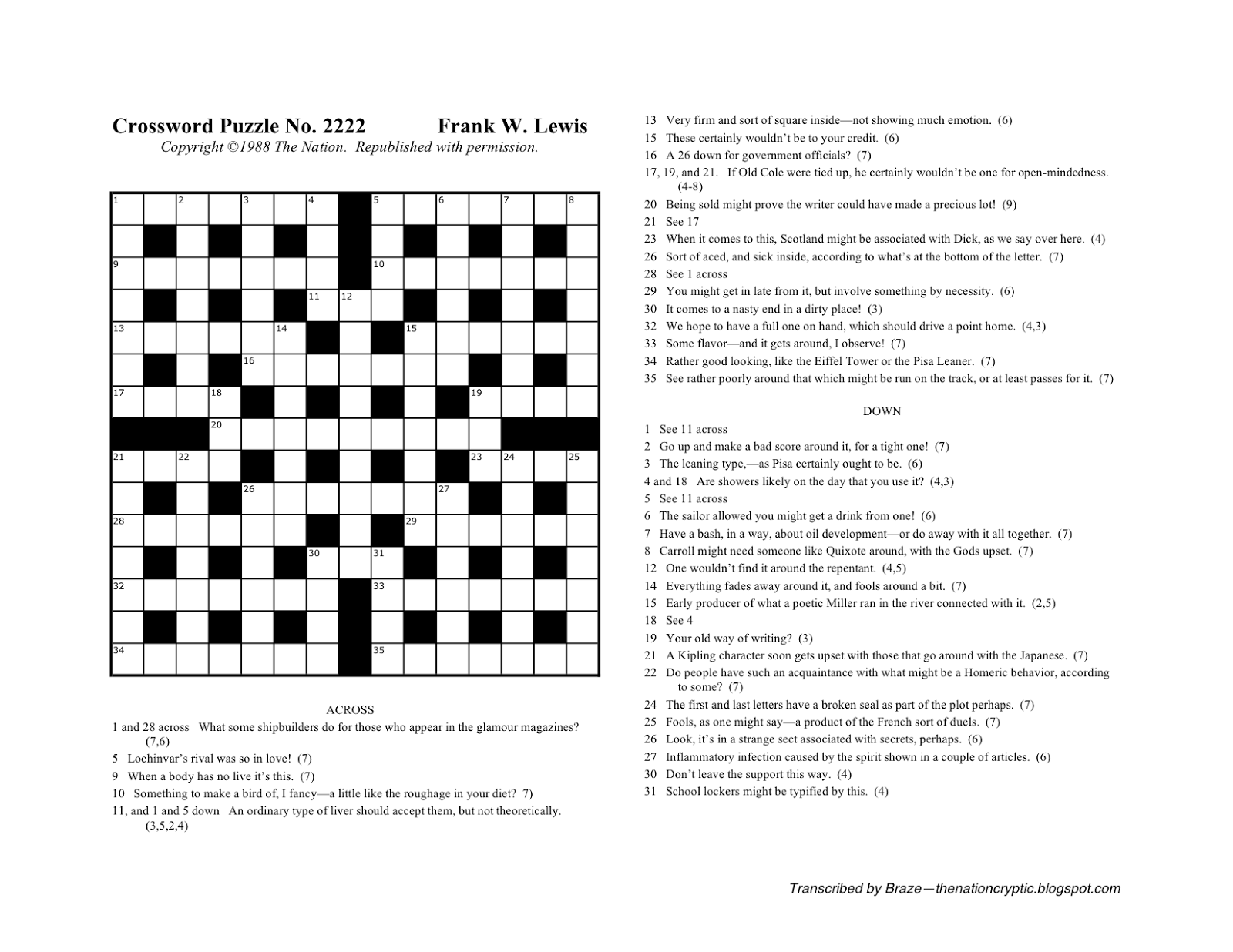
Plain black and white (Puzzle no. 2,222)

With the publication of The Nation puzzle no. 3,333 coming up, I went back to the microfilm for a twofer this week: 2,222 and 1,111.

Disappointingly, Frank Lewis did not make anything special out of these puzzles: I can’t detect any themes, though the grids are nice.

So here’s no. 2,222 (click for PDF file), which was originally published in 1988.  Back with no. 1,111 soon, and solutions for both on Monday.

Friday, July 18, 2014

Seeing a pattern? (solution no. 1,066)

The solution to The Nation puzzle no. 1,066 (from 50 years ago last week) is below the fold.

Boy that was tough.  I had to resort to the answer key six times there, but when a puzzle combines very obscure words with non-Ximenean cluing, it’s gonna be murder.  Much of the rest needed intersecting letters, and in a few cases I still don’t have a clue about what Frank Lewis was intending.  Can any of you figure them out?

On the other hand, I’ve found a Shakespeare reference in each of the Lewis puzzles we’ve tackled so far.  Was this a signature?


Thursday, July 10, 2014

Nat Hentoff (Puzzle No. 1,066)

July 6, 1964 puzzle courtesy of The Nation.
Click here for printable version.
As I was browsing through the 1964 reel of The Nation to find this puzzle, I spotted an article by jazz critic Nat Hentoff. I like jazz, and I’ve read one of Hentoff’s books and plenty of his columns—but not this one.  Here’s his June 22, 1964 lede.


Some weeks ago, Eric Dolphy, an explosively original jazz saxophonist and clarinetist, left for Europe as a sideman with a small combo.  He isn’t coming back.  I asked a musician friend of his why Dolphy had decided to become an expatriate.  “Nothing’s happening over here,” was the answer.  “If he has to scuffle over there, at least he’ll have a change of scenery.”

Dolphy and a few others excepted, the younger avant-garde jazz players remain, although their expectations are increasingly bleak.  Jazz was never a popular music; but by contrast with the present, there have been periods during which it made partial breakthroughs to a sizable public, thereby providing reasonably steady work for the uncompromising improvisers as well as for the popularizers.   

Fifty years later, Hentoff is still on the beat (pun intended).  Last week, his column, now in the Wall Street Journal, explains the thinking of his friend Charles Mingus:

Mingus never believed his music was "too difficult" for players of any age once they knew their instruments and were driven by his music to find themselves in it. As Mrs. Mingus wrote in her absorbing book, "Tonight at Noon: A Love Story," that I reread when I need to be lifted by both of them, Mingus used to holler to his musicians "Play yourself!"


Monday, June 30, 2014

Sleep of the dead (Solution No. 1,303)

The solution to the June 23, 1969 The Nation puzzle is below the fold

Man, it was good to finally be back in my own bed after two weeks on the road and that 4:15 am arrival.  It took two or three nights for the sleep deficit to get worked off, and with no orchestra or fencing anything else to take children to Saturday morning, I could leave the alarm off.  When I finally began to stir, it felt remarkable: my mind seemed completely powered down.  I imagine a lot of you solvers are also the type whose brains seem to be constantly humming.  It was quite refreshing to be the opposite for a while.

As for the Frank Lewis puzzle I posted last week, which you will recall was from 1969, I made a pretty good run at the top half and then got bogged down between some obscure answers and more single definitions than I was expecting.  I was over-thinking it and trying to find wordplay where it didn’t exist.  Maybe I should try and get my brain back into Saturday morning mode next time.

See you in 1964, two weeks from now.

Thursday, June 26, 2014

Microfilm (Puzzle No. 1,303)

[update: the original version of this post had the wrong grid: it’s fixed now]

How do you get your hands on more of these old The Nation cryptics?  There is an online digital archive of The Nation, going back all the way to its founding, but it’s text-only, so you won’t find the puzzle there.  Unless you have an uncle with boxes and boxes of magazines in his garage, it’s likely the only place is the microforms section of a university library (which I conveniently have three blocks from my office).
Microfilm: it's not just for Soviet spies!

If you went to college during the internet age, you probably have never used or even seen a microfilm reader.  But if you like crosswords, it’s a skill you should learn.  Old New York Times, New York magazine (Sondheim originals), the New Yorker (the wonderful 8 x 10s that helped get me hooked on cryptics), and more are all there for you to explore.

The latest microfilm readers work in conjunction with a computer, so you can scan pages right to disk or print them out.  That’s a lot more convenient than the photostatic copies that the microfilm reader made back when I was in college thirty-some years ago, though I missed the characteristic smell. The picture quality on the computer monitor is much better than the bluish (and often dirty) projection screen of the film reader.

At least you still have the sounds: the squeak of the reel drives, the whisshh of film sliding through the glass plates, and the flip-flip-flip-flip-flip if you weren’t careful to slow down and stop rewinding when the film got back to the beginning.  If you’ve never used a microfilm reader, why not try it today?   Pick a newspaper or magazine from the day you (or your parents) were born, or some big day in history.

But if you want to solve a 45-year-old cryptic first, here is The Nation puzzle no. 1,303 (below the fold).  Click on this link for a printable version.

Monday, June 16, 2014

Hotel bar (Puzzle No. 1,542)

Don’t forget the cluing challenge: hosted here the weeks The Nation isn’t published.

I’ve been on a business trip this weekend, and I used the train ride to type up the solution.  I’m in Washington at one of the quirky boutique hotels there instead of the main conference hotel.  Cheaper, nicer accommodations, and a nice martini on the house.  The other part I liked is that they have a couple of complimentary puzzles (“for the commute”) printed out.  Ordinary straight crosswords and sudoku, but their heart is in the right place.  Maybe someone should offer to be their puzzle curator, and offer some weekend novelties.

A forty-year-old cryptic would be too hard for the casual solvers, but it is definitely a novelty.  How did you do on it?  I had less difficulty with this one than with the last Frank Lewis puzzle we solved.  The wordplay is less complex than Hot and Trazom do, but some of the grid words and definitions are quite obscure.  However, Lewis knew to balance a tough word with an easier wordplay: see 13a for example.

The other thing I’m finding helpful in working these puzzles is to just let my mind loose and noodle around with phrases in the clue.  That let me get answers like 3d and 23a, which in turn helped with some of the intersecting words.  Between that and not panicking when I only parse out a single definition in the clue, I’m starting to get the hang of Lewis.  How about you?

Thursday, June 12, 2014

Forty years ago this week (Puzzle No. 1,542)

Ads that accompanied
the 1974 puzzle.
As I mentioned below, The Nation has been kind enough to grant permission for me to republish a selection of Frank Lewis puzzles, most if not all of which have never been available online before.

This is a great opportunity for all kinds of solvers.  The ones who complain that Hot and Trazom’s puzzles are too hard are going to get some real brain-busters.  Those of us in the middle are going to improve our solving skills and gain confidence.  And even if you don’t get more than just a few of the answers without looking at the solution, the amusement value of seeing Lewis’s wordplay is great.

So here we go!  Below the fold is the Frank Lewis cryptic published in The Nation 40 years ago this week: June 15, 1974.  Click here for a printable PDF version.

I’m going to transcribe these as they were published, typos and all (in this puzzle, some of the enumerations were missing, along with a cross-reference at 6 across, which is clued with 5 down).  Looking at the full page from the magazine, I’d guess at least some of that was for space reasons.

Cluing challenge: FRANK LEWIS

I am very happy to make two announcements this week: both made possible by our friends at The Nation.

First, I’ve been granted permission to republish a selection of Frank Lewis puzzles from The Nation, which we’ll do on the weeks this summer when The Nation does not publish, starting today.  So there’ll be a new puzzle for you each week: here or at thenation.com.  And for those of you who couldn’t get a copy of 1,634, I’ll post one here later on.

Second, on the off-weeks for The Nation and for Word Salad, the weekly cluing challenge (which has really picked up steam the last few weeks) is going to be hosted here(*).  So in honor of our summer study subject, your answer is FRANK LEWIS.  Bonus applause from your fellow solvers if you can work something from Frank’s life into your clue, or create a clue in Frank’s style.

*--separate posts so your clues and discussion of the old puzzle will be in separate threads.

Wednesday, June 4, 2014

The critics would have a field day (Solution No. 1,634)

Since there wasn’t a new issue of The Nation last week, we launched a summer-long look back through Frank Lewis’s puzzles, starting with the last one he constructed for the magazine, No. 1,634 in May of 1976.

I’m a little late with the post because it took a lot longer for me to get the solution.  I needed to look up the answers a couple of times, but they gave me enough other letters to allow me to solve some more of the clues.

It’s also a lot harder to write up the solution because of the clues that don’t fit the Ximenean rules: they go way beyond where Hot and Trazom consider the limits to be.  Part of it is the British influence; another is that Lewis didn’t have all the electronic tools today’s constructors and solvers take for granted, so the universe of conventional constructions of a word or phrase was more limited.

So there’s much more of a Puns and Anagrams feel to these puzzles, or at least the Puns part.  The best way to open your mind to them is to be prepared for a word association game.  So here goes...


Saturday, May 31, 2014

Frank’s Finale (Puzzle No. 1,634)

Summer is nearing, and The Nation is into its bi-weekly publication schedule.  This summer, we’ll use the off-weeks to go back to some Frank W. Lewis originals.

We’ll start with the last puzzle he constructed for The Nation, No. 1,634, which was first published in May 1976.  It’s very typical of the Lewis style: more British, with frequent cross-referencing within the puzzle and answers split across multiple lights. 

The solvers who complain about Hot and Trazom’s cluing will have even more to get upset about.  There are unindicated anagrams, word associations, and other things you might find in a Puns and Anagrams but break the strict Ximenean rules typical of North American cryptics.  Be aware of that as you work on the puzzle, and you’ll have a better chance of solving it.  

Add to that the sometimes-obscure words in the grid (remember these were all constructed without the aid of computers and the internet), and these are truly hard puzzles.  I struggled with them when I was first solving cryptics, and I still get stuck often today. 


Maybe you can do better; maybe not.  But we’ll try and use a summer’s worth of these puzzles to build up some new solving skills together.


Degree of difficulty (by standards of the current The Nation puzzle): very hard

Back with the solution and annotation Monday.