Showing posts with label Brendan Emmett Quigley. Show all posts

Sunday, July 27, 2014

Bruise (Sunday brunch: July 27, 2014)

I just got to a fencing exhibition in Allentown when I got a message from my assigner: can you skate two games tonight?  They were part of a charity event and not league, so I figured they wouldn’t be difficult.  Good chance to see what kind of shape I was in.

So I fenced in front of a lot of onlookers, won one bout, and didn’t look out of place. The event was outdoors: it wasn’t as hot as last year, but I was still sweating profusely under the mask. Lost in the quarterfinal as expected, got changed, and hustled home.  Then I had a whole 15 minutes to put down the fencing bag, grab the hockey bag and ref briefcase, make sure (twice) that my sports glasses were in the bag, and leave for the rink (with time enroute to grab something to eat).  When I got to the rink, I exchanged pleasantries with a group of players and wives/girlfriends tailgating in the parking lot, which had me looking forward to a nice friendly skate. 

Not so.  About five minutes in, we had our first scuffle of the night.  Several more ensued, each one more heated than the last.  The last three I managed to get in between the combatants before any punches were thrown, but my partner had had enough.  He called the two captains over to the referee’s crease and read them the riot act.  “You guys are acting like a bunch of five-year-olds arguing ‘he started it.’  This is a charity tournament: we’re here for something more important than the final score… and if we have to break up one more fight I’m calling the game and sending you home!”

That got us through the second period with no more incidents, and by the third, the players were too tired to fight.  They weren’t too tired to play though, and the white team took a 3-0 lead.  Halfway through the third, with the white team shorthanded, one of their good defensemen wound up a slap shot to clear the puck out of the zone.  Instead of aiming up the middle of the ice, he aimed for the boards, right where I was standing.  The puck hit me on the top of the hip, so hard it almost drew blood even though it hit me on the padded girdle I wear. 

Fortunately the second game was much more what we expected: C teams playing for fun and only one or two minor tussles.  I got a bag of ice from the snack bar and stuffed it under the girdle while I skated.  The bruise has been a beauty.  Sunday there was a red diamond with a white center where the puck hit, Monday and Tuesday it turned deep black and blue; a splotch about as big as your fist.  The end of the week was a rainbow of colors; who needs tattoos?  And today there’s still a puck-sized mark more violet than purple, with a knot where I was hit.

So far no pencils have suffered any injuries as I work my way through these puzzles:

Two acrostics this weekend: by Mike Shenk in the Wall Street Journal and by Hex in the New York Times (puzzle behind the paywall,  comments and spoilers at Wordplay).

Block cryptics in the Canadian papers: by Hex in the National Post (blogged by Falcon) and syndicated (Hot informs us it is not Fraser Simpson constructing these) in the Globe and Mail.  Easy and hard respectively.  

Catching up with Kevin Wald, I solved Bachelor Party this week: another example of his amazing ability to hide themes in clues as well as the grid.  

BEQ reminds us that Lollapuzzoola is going on two weeks from now in New York, but you are invited to play from home too.    The ever-useful BEQ also points us to an article in The Atlantic expressing concern about the future of crosswords in an age when fewer and fewer people read printed newspapers and magazines.  BEQ catches the irony of seeing this in a publication that is “covered in Emily Cox and Henry Rathvon's blood.”  

Saturday, January 11, 2014

Hawthorne effect (Sunday brunch: January 12, 2014)

An interesting juxtaposition of work and hockey this week.  I’ve been reviewing studies of devices that keep track of when doctors, nurses and other health care personnel wash their hands when entering and exiting a patient’s room.  Their impact is based on the Hawthorneeffect, also called observation bias.

If you have children, you know exactly what that’s all about.  They’re much more likely to obey you if you know they’re watching.  Of course it’s not just children who slack off if they think they’re not being watched.  I had a teenage partner for a squirt game (9 and 10 year olds) last Sunday morning.  Like a lot of teen refs, he’s still a player and sees refereeing as a way to earn some pocket money.  Skate around, blow the whistle when there’s a goal or an offsides or a penalty, pocket the check, save the real effort for practices and games. 

So he hung out in the middle two-thirds of the ice instead of getting down to the goal line to watch the play in the offensive zone.  He called one of the goals from up around the hashmark; fortunately the coaches weren’t the type to yell at us for being out of position, but I quietly got on his case at the next stoppage.  It didn’t really change him much though; all I can do in these situations is skate hard and set a good example.

The game ended uneventfully, and when I got back to the dressing room, I found our supervisor was there.  He’d come to watch the third period and check up on us.  He was pointing out to my partner all the times he was making calls from a bad angle or too far away, and I imagine he must have felt pretty bad on the ride home. 

I’m not immune to criticism, so it was good to have someone looking at my performance.  I was pleased that the main thing Monty wanted me to fix was my line-change routine: I was putting up my had twice when I should be doing it only once.  It’s a little thing, but better to have something of mine critiqued than to hear nothing bad and wonder if there are problems we just didn’t have time to talk about.


As for my partner, we’ll see if the experience will put a little more hustle in him at the times when nobody else is watching. 

Do you solve differently when nobody is watching?  Resort to Onelook or Google or the Anagram Server right away?

Double acrostic weekend.  Wonder what caused Mike Shenk to pick the quote he uses in the Wall Street Journal puzzle this weekend.  It’s seasonal, but a bit dark.  The Times puzzle is behind the paywall.  One good thing about the Times is that Deb Amlen usually gets some comments from the constructors of every puzzle and Hex usually have something good to say.

On the cryptic side, there’s the usual National Post puzzle by Hex, and LizR has a new Brit cryptic up.  Liz borrowed an interesting grid from Nutmeg: it has a ring of threes in the middle.  Usually constructors (especially British ones) cope with something like this by linking the threes with other answers; Liz made a mini-theme out of them, cluing them all in the same way.  Catch the original title of her post too, hidden in the URL.

Kevin Wald has posted his MIT Mystery Hunt warm-up.  This year’s hunt begins Friday at noon.  Some people participate without being on campus, and some teams will be willing to accept extra hunters who are looking for a team to participate with.  I think that his “Tripling Hither, Tripling Thither” is new too.

An interesting variety crossword this week too.  BEQ posted a “From A to Z” where you have to figure out the missing first letter of each clue, which in turn will tell you where some other answer will go.  A couple of bugs in it though.  Philip Morris hasn’t been making the product in answer 23 for years, and I can think of at least two possible answers that would fit in 7d.

Finally, if you’re looking for more puzzles, Will Johnson has updated his links page for 2014.  However, most of the cryptic links are to series that have stopped posting new puzzles.

Saturday, January 4, 2014

High definition (Sunday brunch: January 5, 2014)

A double Salchow by Bangle
Santa Claus brought a high-definition TV this year (we’re kind of slow on the uptake that way; I had a black and white set through most of grad school).  I’ve said that one of the great things of watching a hockey game in person is how much more detail of sound you hear: like players slapping a stick on the ice to get a teammate’s attention.

This is the visual equivalent.  You can see that the linesman in a World Junior Championship game is using an Acme whistle. Are you ready for your close-up?  Get out a nice sharp pencil and solve these:

I think the week’s highlight is the Marching Bands with cryptic clues that Tom Toce created for the accounting journal Contingencies, with a little help from his friends.

The Wall Street Journal has a Patrick Berry puzzle called “Jury Boxes.”  It’s one of the ones where a jigsaw of rectangles is intersected by clued rows.  I’ve posted the solution as well as the row enumerations as a hint (they can help you place those middle answers) elsewhere on the blog.

Hex are continuing to ring in the new year, with this week’s puzzle in the National Post, and Falcon is back for another year of blogging it.

The New York Times variety puzzle is a diagramless by Fred Piscop (behind the paywall).  Look for the solution here on Sunday afternoon, connectivity permitting (Sabers is going to be at his twice-postponed District 11 orchestra audition today).

A bouquet of roses for the gold medalist in your life?  Certainly—especially if she likes puzzles!  Aries has great news for us; he is bringing back his Rows Gardens, bi-weekly, on a subscription basis.  Sign up now: the sooner you do, the more puzzles you get.

BEQ used Boxing Day as a time to offer a year in review post.  Worth reading, and maybe solving some of the linked puzzles.

Puzzazz has an update out this week, and it’s a significant one.  They’ve set up a way to offer free puzzles like the ones you often see in .puz format.  It’s not discussed on their blog, but the info is at the app store for your particular device.   On top of that, they had an all-day improvisational construction festival, the results of which are posted for everyone to solve.

Saturday, November 2, 2013

Hold the whistle! (Sunday brunch: November 3, 2013)

We interrupt this treatise on whistles for an important message to all sports officials: HOLD THE CALL!

Many of the errors officials make happen because they anticipate a play happening and make the call too early.  We had two examples of this in the World Series just finished (hooray for the Sox!). 
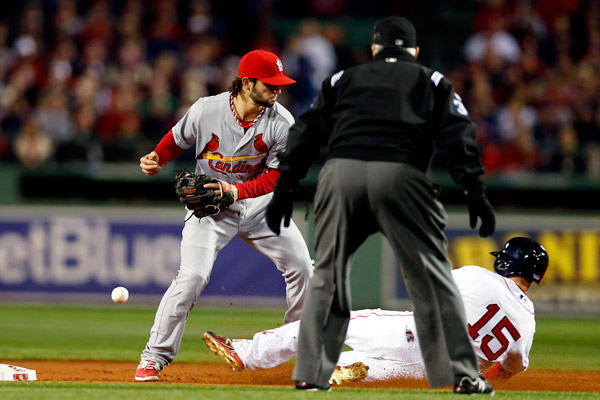
In Game 1, umpire Dana DeMuth called “out” on a force play at second base before he made sure that Cardinals shortstop Pete Kozma had actually caught the ball.  To his credit, when he saw the ball on the ground, he got help from his partners and crew chief John Hirschbeck overturned the call. 

To be polite, let’s say the post-game press conference was a well-scripted fiction.  DeMuth spun the situation with all his might to say that he saw the drop happening on the exchange (taking the ball out of the glove to throw it) instead of saying he made the call too early, and that he did the right thing by checking to see whether his partners saw it the same way.  Of course the most important thing is to get the call right, which they eventually did. 
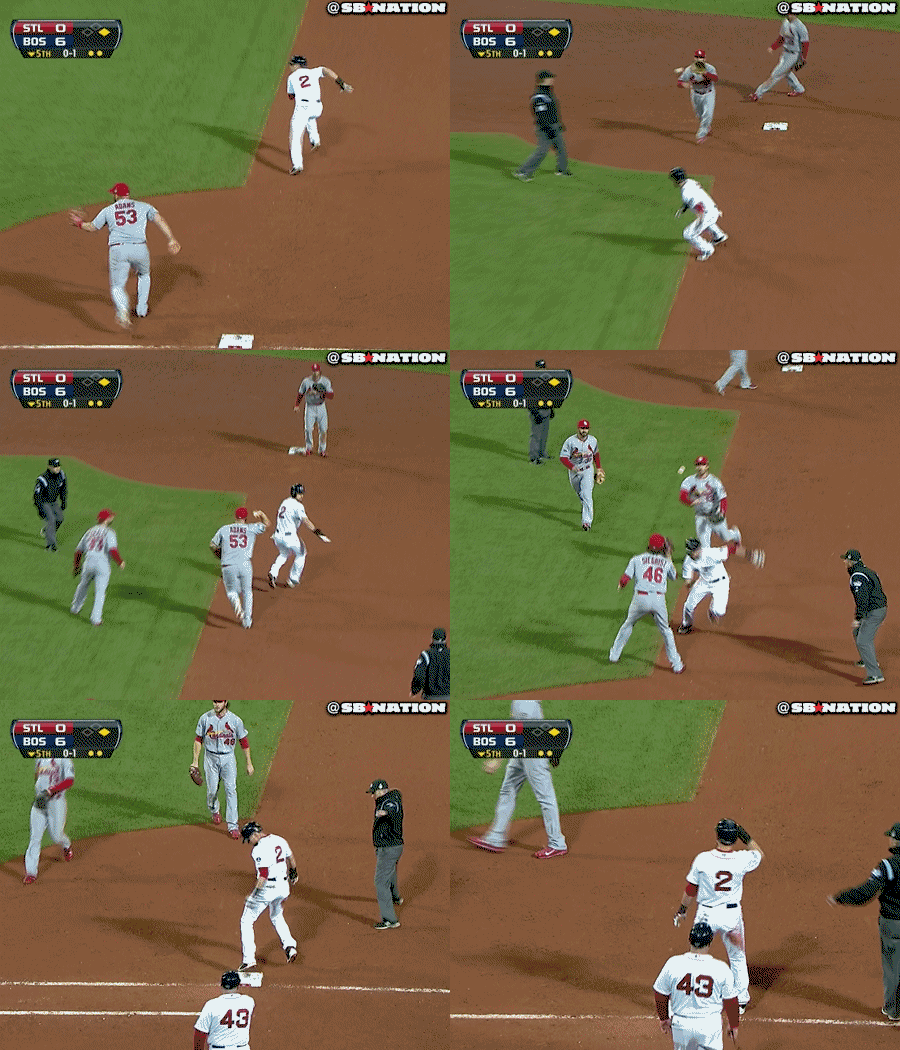
Then in the sixth and final game, I jumped up and started ranting at the TV when Hirschbeck rushed his “safe” call on the botched Cardinal rundown of Jacoby Ellsbury.  You’ll see on the replay that Hirschbeck made his call as soon as he saw the missed tag, and didn’t wait until Ellsbury got back to the base safely.

The official instructions to umpires are clear: “Do not come running with your arm up or down, denoting ‘out’ or ‘safe.’  Wait until the play is completed before making any arm motion.”  In this situation, the absence of an “out” call sufficiently communicates that there was no tag.

Holding the call is something I remind myself about every game.  What I lack in skating speed I try to make up for with situational awareness, which is the ability to identify and react to a situation as it develops.  Where situational awareness gets you in trouble is when unexpected things happen, like the shortstop dropping the ball or an attacker with the puck holding up at the blue line instead of bringing the puck over.  If you’ve wound up for a bang-bang offsides call when the puck is still on the blue line, you’ll look like a fool.

Like a lot of other things that happen in sports, there are life lessons there if you pay attention.  Making decisions in haste is the way to make more wrong decisions. No wrong decisions in the puzzle lineup this weekend, though.  

The Wall Street Journal has a real treat: “Choices”: a variety cryptic by Hex with a quite novel grid.  Be warned it’s harder than most weekend Journal puzzles, but worth your effort.  31a and 8d are pretty obscure: trust the wordplay.  The solution is posted elsewhere on the blog.

Hex also have their weekly straight cryptic in the National Post, solved and annotated for you by Falcon.  I heard half a theme in there about music; it would have been nice for Hex to theme more of the clues.

An uncommon straight bar cryptic is Tom Toce’s latest, published in the new issue of Contingencies.  “No Bells, No Whistles” would be the antithesis of the Mitchell Sunday, as I referee and The Other Doctor Mitchell rings in the handbell choir.  Note a minor printer’s error in that puzzle: there should be another bar immediately under the square numbered 27.

This weekend’s New York Times puzzle (behind the paywall) is an acrostic by Hex, and the monthly bonus puzzle for subscribers is also up: it’s a Fred Piscop puzzle for National Novel Writing Month.

And catching up with Kevin Wald, here’s another small puzzle of his: themed as usual.  Amazing how many puzzles he creates when there must be a lot of work going into each one.

Bonus puzzle: Rock fans should know that BEQ composed a straight crossword in memory of Lou Reed.

Nathan Curtis’s site had a few technical problems last weekend, but it’s working all right now.  No new puzzles yet though.  Xanthippe is feeling emboldened so she is busy creating another new one.

Sunday, July 14, 2013

Tour de France (Sunday brunch: July 14, 2013)

For many years July in our house means watching the Tour de France.  The recent doping scandals and revelations tarnish the individuals involved, but they don't detract from the drama of the event itself.

Once you get to know the event and some of the personalities, your enjoyment of the Tour increases exponentially.  There is a lot more to it than who will wear the yellow jersey in Paris: the effort of the leaders' teammates to set the pace, throw off opponents, and deliver their man to the finish; the opportunistic riders who go off in a breakaway and the tactical riding of the sprinters' teams to keep the break from getting too far ahead; and much more.

The scenery and the crowds also make the event.  There are many familiar faces: human (commentators Phil Liggett and Paul Sherwen; The Devil, who shows up during the mountain stages), and non-human (the familiar curves of Alpe d'Huez).

Today is one of two "queen stages" of the Tour: days expected to be the toughest and most decisive.  Today's stage finishes with the long lonely climb up Mont Ventoux, while Thursday the race climbs the Alpe not once but twice.  I'll bet fans are already camping out there today in order to get the best viewing points.  There'll be a quarter million lining the road there by Thursday, and they'll get a fabulous show.  Check your local listings, so you can be there in spirit.

As frequently happens, acrostics show up together this weekend.  The Wall Street Journal's acrostic (Java link) is by Mike Shenk.  Not many comments posted so far, but the majority note it is fairly difficult.  I don't think it had the polish of Hex's acrostics (of which there is one behind the New York Times paywall), but I liked the fill (aside from the one which obviously was the last one Shenk clued--J): a reggae artist, a backgammon game popular in the Navy, and a nice, happy pop song.

The new Harpers is out, with Richard Maltby's variety cryptic, but there are no recent posts over at Erica's blog.  She must be busy with her video directing.  Nathan Curtis also informs us he doesn't have much to say, but there is an Around the Bend puzzle for us this week.

There's a BEQ cryptic I missed last week (#553 if you're counting), and the regularly scheduled Hex cryptic in the National Post.  For the latter, a little French will help, but I think there's not enough there to call it a themed puzzle.

And hooray, hooray: Xanthippe is now offering printer-friendly versions of her (British) cryptics, starting with her Opus 10.  Go visit, solve, and comment.  Xanthippe is eager to improve her work, and she's blogging about the constructing experience as well as sharing her puzzles with us.  


Sunday, July 7, 2013

New York Times variety puzzle solution: July 7, 2013

Below the fold is the solution to this week's New York Times variety puzzle: Marching Bands by Brendan Emmett Quigley.  For your convenience, I've used colors to distinguish the two answers in each row, put in bars to separate the Band answers.

Now that you're done with this one, why not try one of the other interesting variety puzzles linked in this weekend's Sunday Brunch?  Then come back every weekend for more puzzles and commentary, and on Thursdays for the cryptic crosswords from The Nation.


Saturday, July 6, 2013

Variety (Sunday brunch: July 7, 2013)


Sabers at Nationals
This is a weekend for variety crosswords.  The Wall Street Journal has a Patrick Berry Beginnings and Ends puzzle.  I'll post the solution elsewhere on the blog, but you probably won't need it: the first commenters say it's easy.

The New York Times has a Marching Bands by BEQ behind the paywall.  Is this the first time they've run one of these? Definitely not the straitlaced puzzle selection of old.  Add your comments to those of Deb Amlen at Wordplay.

Update: I've added a hint grid below the fold.  If you're having trouble with the NYT puzzle, the hint grid shows where the band words start and end.

Puzzazz brings us the June installment of their Year of Puzzles: a bit late due to the NYT rollout there.  They promise to catch up with an extra puzzle this month.  The current installment is set in Washington DC.  The variety part?  Some of the clues are in the form of flags.

Of course there's also the weekly variety puzzle by Nathan Curtis: a Rows Garden this week.  Nathan says he's pretty happy with how this turned out.  Agree?  Drop a comment on the post

There's a new issue of Contingencies out: Tom Toce shares his first cryptic acrostic with us there.  Variety squared!  There may be some clues that the actuaries will get first, but I'll bet we cryptic fans will get the last laugh on that one.  There's a neat story about the quote: I'll share it Monday along with the solution to The Nation No. 3,288.

After all that, a straight block cryptic will feel like a change of pace.  Falcon is back and blogging the Hex cryptic in the National Post, with an air show theme this week.

And Xanthippe has her weekly cryptic for those of you who like the British style.  She says she's trying to hew more closely to the rules, so us American solvers might have more of a shot at it.  Unfortunately, there's not a printer-friendly version posted.  I've asked for one and will keep you apprised of progress.


Sunday, March 24, 2013

Some more words on four-letter words (Sunday brunch: March 23, 2013)

Read on: new puzzles at the bottom of the post!

A few months ago I commented on the subject of four-letter words: the type you aren’t supposed to say on television.  I didn’t intend to get back to the subject so soon, but some recent reading and puzzles deserve comment. 

In particular, the sports page of the Wall Street Journal (yes, they really do have a sports page, though they continue to hold the line against comics) had a feature on how broadcasters have to adjust their language when they move from the locker room to the microphone.  Dan Dakitch says he reads the newspaper out loud to himself for ten minutes before going on the air just to hear himself speak without swearing. 

And last week, the Journal had a feature on comedians who work clean, noting how many in the business know that obscenity can be a crutch to lean on to get the audience’s attention, but eventually its shock value wears off.  It takes more work to prepare a routine that doesn’t use the seven words George Carlin built his most famous routine on, but real talents like Jerry Seinfeld and Bill Cosby do so and you hardly realize it. 

As I said before, crossword constructing is largely a G-rated enterprise, with some notable exceptions like The Onion, which revels in double entendre and toilet humor.  Mainstream setters rarely go near the line, let alone over it.  When they do, it’s usually to facilitate a particularly clever or playful clue.  With the indirect way words are clued in cryptic crosswords, such opportunities present themselves regularly.  Hex had one in their variety cryptic this weekend at the Wall Street Journal (solution below the fold, hint grid posted previously).  The second “n” clue prompted titters from the commenters who got there first.  While the grins were fading, the solvers figured out that this puzzle is not as hard as you think 

Brendan Emmett Quigley also has an alter ego who works blue.  Very blue.  His Bawdy Crosswords are definitely in the "not safe for work" category, but they provide another dimension in constructing and solving.  Take "Tunnel of Love" for example (repeat warning: NSFW).  There's a visual double-entendre to the theme entries in that one as well as the wordplay.

Back to the usual weekend fare.  Hex is in the kitchen for us, and the National Post takes a peek at them while they're working.  The New York Times has a Hex acrostic (behind the paywall, Hex's comments and spoilers over at Wordplay).

And we have another chef and another course in our menu:  Nathan Curtis offers a tasty mix at Tortiseshell Puzzles.  His latest is a Rows Garden, which compares well to the Patrick Berry originals.  He also constructs cryptics, like "What Do You Do With a B.A. in English?"  Welcome, Nathan: we look forward to seeing more of your work every week.