Showing posts with label Tom Toce. Show all posts

Monday, July 13, 2015

Testing, 1, 2, 3 (Sunday brunch: July 12, 2015)

[Apologies for the late post: I got called for a fill-in referee job.]

The codes for each step of this ice dance
tell 
you what edge to be skating on:
LFO is 
left skate, forwards, outside edge
Congratulations to Bangle, who passed two figure skating tests yesterday.  When she resumed skating after her concussion last winter, she wasn’t cleared to do jumps and spins until well after she was fully recovered.  So instead, she worked on ice dance, which requires precise and strong skating skills more than the speed and power for jumps and spins.

Competition is one way of proving your skills, but skating also has a series of tests, where you aren’t competing against other skaters: you’re trying to skate well enough to earn a passing score from the judges.  The tests come in a series of levels: from pre-preliminary to senior for freestyle, and from pre-bronze to gold for ice dance (which for testing purposes does not have to be skated with a partner).  Each successive level has harder and harder required elements, and a higher standard of skating needed to pass.  In order to skate in competition at a particular level, you have to pass the corresponding test.

Since Bangle hadn’t done much dance before this season, she started with the beginning-level tests a couple of months ago, and has been racking up nice comments from the judges along the way.  On the right is the pattern for one of the bronze-level dances: the Fiesta Tango.  The lines show the pattern that should be traced on the ice, and numbered steps detail how each step should be skated.  Skate the pattern twice, and would be right back where you started: two times around and the dance is finished.  

Now test your mind against the weekend’s new puzzles.

Stickler is back from his winter R&R (it’s midwinter Down Under) and has two new puzzles: numbers 85 and 86.  Glad to see them!

Other weekly block cryptics are in the National Post and the Globe and Mail, as usual.  Falcon is getting his R&R (I think he’s in the lake country of Ontario, but he’s blogged the National Post for us.

Meanwhile, it’s time for a couple of periodic variety cryptics by Sondheim-inspired constructors: the Tom Toce puzzle in Contingencies and the Mark Halpin puzzle unveiled at a special event at the Arden Theater Company here in Philadelphia recognizing Sondheim.

The Wall Street Journal variety puzzle is Changing Directions by Patrick Berry.  Another one of those ones where getting a toehold is the hardest part, so I have a hint grid up for you as well as the solution.

The New York Times variety puzzle is a Hex acrostic, blogged (with spoilers) by Deb at Wordplay.

Sunday, June 7, 2015

Take-out (Sunday brunch: June 7, 2015)

Quick post to catch up.

Kevin Wald (I can’t spell Ucaoimhu) is back with a good medium difficulty variety cryptic he set for the Washington Post’s Post Hunt puzzle contest.  It’s called “Saturday? Unknown.”

We have a new Puns and Anagrams constructor in the New York Times today: Mark Diehl.  Deb Amlen interviews him at Wordplay (spoiler warning).  Deb also informs us that the P&A will now appear every 8 weeks, with Diehl and Mel Taub sharing construcing duties.  Meanwhile, Hex’s cryptics will appear in the NYT less frequently: every 8 weeks.

Speaking of new constructors, Tom Toce has a guest puzzling for him in Contingencies.  Jerry Levy didn’t crete a cryptic, but cryptic solvers will appreciate the kind of wordplay he uses.  Will Shortz would appreciate it too: maybe we’ll see Jerry’s byline in the Times.

The Wall Street Journal puzzle is a Rows Garden by Patrick Berry.  I found it easier than usual.  I’ll post hints for the WSJ and the NYT solution shortly.  If you enjoyed that, remember that Andrew Ries publishes a bi-weekly Rows Garden that’s every bit as good.  Subscribe at www.ariespuzzles.com.

Stickler is taking a winter break (remember he’s in Australia) for R&R.  Wish him well at www.australiancrosswords.com.au

Falcon reports that he weekly Hex cryptic in the National Post was on the stormy side.  I haven’t gotten to the Globe and Mail cryptic yet.

Sunday, December 7, 2014

Automatics (Sunday brunch: Dec. 7, 2014)

In our last episode, we learned why refs shouldn’t have rabbit ears.  Today we find out that most refs have one thing or another that will instantly draw a penalty if said to them.  If you have one of the growing number of female referees working your game (Hi, Kate!), you’d better not say anything about her gender, or anything sexual in nature.  Every lady partner I’ve had makes that an automatic.

Me, it’s my glasses.  During my playing days and early in my refereeing career, I wore contact lenses.  But as I got older, I found they dried my eyes out uncomfortably.  More importantly, my astigmatism has grown significantly worse, and the contacts didn’t correct for that.  So I got a pair of Rec-Specs, which  are special glasses made with an elastic strap that fits under a helmet. They had the added bonus of protecting my eyes from stray sticks and pucks in the days before they made us all wear visors.

They’re very effective, but they’re also quite obvious (and ugly, I’ll admit).  So inevitably, some wag who thinks he’s being original makes a remark about my glasses being fogged up or something like that when a call goes against his team.  That’s my automatic: two minutes for unsportsmanlike conduct.  I don’t care what the score is or whether you’ve been a perfect angel the rest of the game. Then once you’re in the penalty box, I’ll explain: “a referee who wears glasses is a referee who gets his eyes checked every season.”

Put on your solving glasses and have a go at this great variety of puzzles.  The New York Times has a diagramless by Paula Gamache (blogged by Deb Amlen–spoiler warning), while the Wall Street Journal has Patrick Berry’s Cigar Boxes.  Hints for both have been posted elsewhere on the blog.

Variety cryptics?  Two of those, and believe it or not, the one by Kevin Wald is easier.  Tom Toce created another of his three-dimensional puzzles.

Straight cryptics?  A pair of them too.  Hex in the National Post (as blogged by Falcon) and the regular syndicated puzzle from the Globe and Mail.

And variety solvers might enjoy Thursday's New York Times straight crossword (Wordplay link)–it’s not so straight after all.  

So with all that puzzling going on, it’s a good week for Stickler to take a week off and celebrate his daughter’s wedding.  We wish them many blissful years together.  

Saturday, July 5, 2014

Long weekend (Sunday brunch: July 6, 2014)

Joey has the right idea for
 a long, restful weekend
Early edition of Sunday brunch for this long weekend.  Good thing too, since there are plenty of new cryptics to keep you busy.  We start in the New York Times (behind the paywall).  Richard Silvestri is the constructor.  Look for the solution here.

North of the border, it was Canada Day Tuesday, but neither Fraser Simpson nor Hex marked the event with their weekend puzzles for the Globe and Mail and the National Post respectively.  And in case you missed it, there was a new The Nation cryptic (and a cluing challenge) Thursday.

Multiple variety cryptics too this weekend.  The change tracker I was using to follow Kevin Wald’s page doesn’t seem to have worked too well, so I missed a few recent puzzles.  I’ll post links over the next few weeks to catch up, starting with 6/28, which logically (of course Kevin does things logically) was posted last weekend.  Great puzzle, and not as difficult to finish as some of Kevin’s other cryptics.  Give it a try.

Tom Toce has his bi-monthly variety cryptic in Contingencies.  It’s a Double Trouble, where there are two grids and each clue is actually two clues, one for each grid.  You have to figure out which one. Note there are a couple of errors in the grids: there should be a bar to the left of square 19, so the enumeration of 17a is (5), and the square at the bottom left corner should be numbered 27.

In other puzzling pastimes, the Wall Street Journal has a Rows Garden by Patrick Berry.  Medium difficulty.  If you’re feeling creative, you can also add to the comment thread for the Friday non-puzzle.

Nathan Curtis is back!  He’s been preoccupied with BAPHL, which went off in Boston last weekend, so there hasn’t been time for any new puzzles.  With that done, he’s posted a new mini Rows Garden.

Saturday, March 15, 2014

What are you waiting for? (Sunday brunch: March 16, 2014)

The calendar says spring is supposed to begin next weekend, but I’ve still got snow in the yard and there’s another four inches predicted for tomorrow. Normally I like winter, but I think we’ve had enough already.  Worse still, there’s all the cleanup to do from the ice storm to do before I can get on with starting the garden for spring.  Maybe time to go back in where it’s warm and there are puzzles waiting.

The new Harper’s is out, and the latest Richard Maltby variety cryptic is a “Twofers” with two grids and run-together double clues.  You may have seen this kind of puzzle before (the inaugural issue of Wordplay had a triple version), but it’s a good concept worth doing again.  Interestingly, the April issue went online Wednesday March 12, but the deadline for solvers to submit for the prize (and the coveted note from Maltby) was the 14th, so you could have gotten away with copying the answer from the magazine.  Stay tuned for the next edition of Tacky Harpers Cryptic Clues (or maybe not, if the army of Chicago bedbugs has carried off Erica).

Like Mark Halpin, Tom Toce doesn’t do anything twice, but he bowed to popular demand and made another cryptic acrostic.  Short and sweet, though the people who typeset it forgot to put in the letters that tell what answer the letter in each box is from, so you have to scan through the puzzle to find the number when you work back from the grid.  Fortunately, I got a lot of the clues right off the bat, so I didn’t need to work backwards much.

Also in twos, block cryptics in major Canadian newspapers: Hex in the National Post (blogged by Falcon) and Fraser Simpson in the Globe and Mail (blogger wanted)

The Wall Street Journal weekend puzzle is a Rows Garden by Patrick Berry.  For once I got this one in a single sitting.  It was very gratifying to have one answer lead to another that led to the next on up the grid until the puzzle was finished.  For those of you who couldn’t make that nice chain, I have some hints posted.  And if you love Rows Gardens, Andrew Ries has a bi-weekly series available by subscription.

Also in the variety crossword department, BEQ’s puzzle no. 622 is a Marching Bands.  It was not easy, and it’s intended to whet your appetite for his upcoming book of Marching Bands.  Brendan’s post also includes a recap from the ACPT.

In the Times (behind the paywall) is a Will Shortz word puzzle called Two For One.

Finally, Foggy Brume has posted issue 48 of PandA magazine as a free sampler.  Register to see and download the issue.  PandA is a subscription e-mag that contains a new extravaganza each issue (six times a year).  Not for the faint of heart or mind, but if you think you’re up for the challenge, give it a try.


Saturday, January 4, 2014

High definition (Sunday brunch: January 5, 2014)

A double Salchow by Bangle
Santa Claus brought a high-definition TV this year (we’re kind of slow on the uptake that way; I had a black and white set through most of grad school).  I’ve said that one of the great things of watching a hockey game in person is how much more detail of sound you hear: like players slapping a stick on the ice to get a teammate’s attention.

This is the visual equivalent.  You can see that the linesman in a World Junior Championship game is using an Acme whistle. Are you ready for your close-up?  Get out a nice sharp pencil and solve these:

I think the week’s highlight is the Marching Bands with cryptic clues that Tom Toce created for the accounting journal Contingencies, with a little help from his friends.

The Wall Street Journal has a Patrick Berry puzzle called “Jury Boxes.”  It’s one of the ones where a jigsaw of rectangles is intersected by clued rows.  I’ve posted the solution as well as the row enumerations as a hint (they can help you place those middle answers) elsewhere on the blog.

Hex are continuing to ring in the new year, with this week’s puzzle in the National Post, and Falcon is back for another year of blogging it.

The New York Times variety puzzle is a diagramless by Fred Piscop (behind the paywall).  Look for the solution here on Sunday afternoon, connectivity permitting (Sabers is going to be at his twice-postponed District 11 orchestra audition today).

A bouquet of roses for the gold medalist in your life?  Certainly—especially if she likes puzzles!  Aries has great news for us; he is bringing back his Rows Gardens, bi-weekly, on a subscription basis.  Sign up now: the sooner you do, the more puzzles you get.

BEQ used Boxing Day as a time to offer a year in review post.  Worth reading, and maybe solving some of the linked puzzles.

Puzzazz has an update out this week, and it’s a significant one.  They’ve set up a way to offer free puzzles like the ones you often see in .puz format.  It’s not discussed on their blog, but the info is at the app store for your particular device.   On top of that, they had an all-day improvisational construction festival, the results of which are posted for everyone to solve.

Saturday, November 2, 2013

Hold the whistle! (Sunday brunch: November 3, 2013)

We interrupt this treatise on whistles for an important message to all sports officials: HOLD THE CALL!

Many of the errors officials make happen because they anticipate a play happening and make the call too early.  We had two examples of this in the World Series just finished (hooray for the Sox!). 
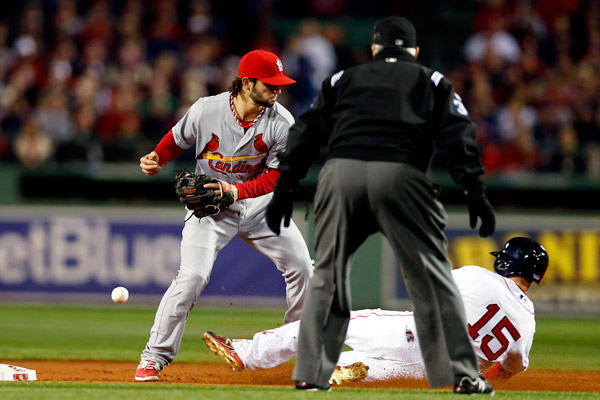
In Game 1, umpire Dana DeMuth called “out” on a force play at second base before he made sure that Cardinals shortstop Pete Kozma had actually caught the ball.  To his credit, when he saw the ball on the ground, he got help from his partners and crew chief John Hirschbeck overturned the call. 

To be polite, let’s say the post-game press conference was a well-scripted fiction.  DeMuth spun the situation with all his might to say that he saw the drop happening on the exchange (taking the ball out of the glove to throw it) instead of saying he made the call too early, and that he did the right thing by checking to see whether his partners saw it the same way.  Of course the most important thing is to get the call right, which they eventually did. 
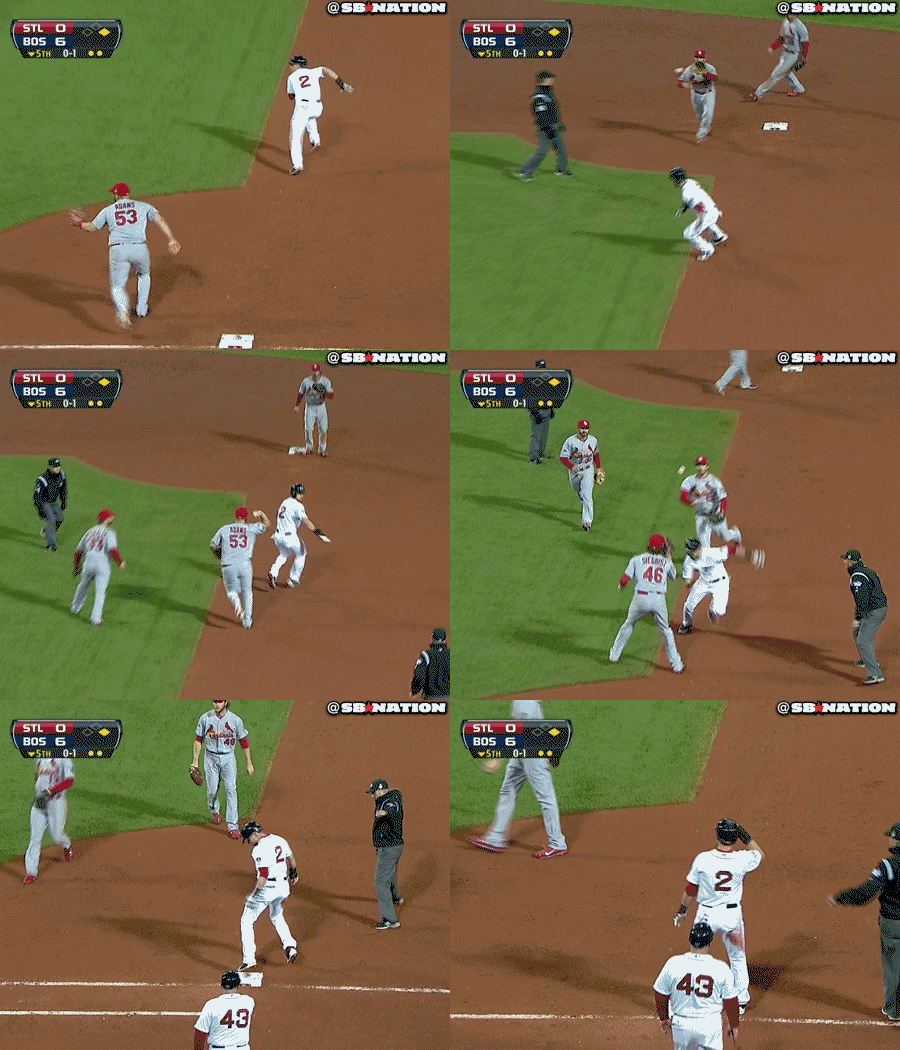
Then in the sixth and final game, I jumped up and started ranting at the TV when Hirschbeck rushed his “safe” call on the botched Cardinal rundown of Jacoby Ellsbury.  You’ll see on the replay that Hirschbeck made his call as soon as he saw the missed tag, and didn’t wait until Ellsbury got back to the base safely.

The official instructions to umpires are clear: “Do not come running with your arm up or down, denoting ‘out’ or ‘safe.’  Wait until the play is completed before making any arm motion.”  In this situation, the absence of an “out” call sufficiently communicates that there was no tag.

Holding the call is something I remind myself about every game.  What I lack in skating speed I try to make up for with situational awareness, which is the ability to identify and react to a situation as it develops.  Where situational awareness gets you in trouble is when unexpected things happen, like the shortstop dropping the ball or an attacker with the puck holding up at the blue line instead of bringing the puck over.  If you’ve wound up for a bang-bang offsides call when the puck is still on the blue line, you’ll look like a fool.

Like a lot of other things that happen in sports, there are life lessons there if you pay attention.  Making decisions in haste is the way to make more wrong decisions. No wrong decisions in the puzzle lineup this weekend, though.  

The Wall Street Journal has a real treat: “Choices”: a variety cryptic by Hex with a quite novel grid.  Be warned it’s harder than most weekend Journal puzzles, but worth your effort.  31a and 8d are pretty obscure: trust the wordplay.  The solution is posted elsewhere on the blog.

Hex also have their weekly straight cryptic in the National Post, solved and annotated for you by Falcon.  I heard half a theme in there about music; it would have been nice for Hex to theme more of the clues.

An uncommon straight bar cryptic is Tom Toce’s latest, published in the new issue of Contingencies.  “No Bells, No Whistles” would be the antithesis of the Mitchell Sunday, as I referee and The Other Doctor Mitchell rings in the handbell choir.  Note a minor printer’s error in that puzzle: there should be another bar immediately under the square numbered 27.

This weekend’s New York Times puzzle (behind the paywall) is an acrostic by Hex, and the monthly bonus puzzle for subscribers is also up: it’s a Fred Piscop puzzle for National Novel Writing Month.

And catching up with Kevin Wald, here’s another small puzzle of his: themed as usual.  Amazing how many puzzles he creates when there must be a lot of work going into each one.

Bonus puzzle: Rock fans should know that BEQ composed a straight crossword in memory of Lou Reed.

Nathan Curtis’s site had a few technical problems last weekend, but it’s working all right now.  No new puzzles yet though.  Xanthippe is feeling emboldened so she is busy creating another new one.

Saturday, September 7, 2013

Bad Reichenhall (Sunday brunch: September 8, 2013)

City Hall
Sabers has been taking German since he started junior high, and the teachers here have an exchange student program each summer.  The exchange is with a school in Bad Reichenhall: a Bavarian town in the very far southeast of Germany, not far from Salzburg, Austria.

One thing I learned is that Bad Reichenhall is the “Salt City” of Bavaria, so I mentioned my home town of Syracuse and shared my salt potato recipe with our guest Tobi.  Meanwhile, Tobi has been attending school with Sabers, doing some sightseeing, and getting a taste of what life is like for an American high schooler.

So the next few posts will intersperse some culture and scenery with the puzzling.

The Wall Street Journal has a variety cryptic by Hex called “Alphabet Soup.”  Like some of their other WSJ puzzles, this is not as hard as it looks, so be sure to give it a try.  If you can’t figure out where to start, I’ve posted some hints elsewhere on the blog.
The Bavarian Alps

Hex’s straight cryptic in the National Post is blogged remotely by Falcon.  There’s no thumbnail in the post, but the link works.  Harder than usual.  There’s some name-checking going on too.

The New York Times has a Hex acrostic this week (behind the paywall).  Subscribers also have their monthly bonus puzzle from Fred Piscop.

The new issue of Contingencies is out, and rather than a cryptic, Tom Toce has an anagram puzzle in it.

Xanthippe has aimed for a little more polish in her British cryptic titled “Marge lets Norah see Sharon’s telegram (So many dynamos!)”.

Nathan Curtis’s weekly puzzle is a Snake Charmer.  Nice bonus in that Nathan is also sharing some observations with us from the constructor’s perspective.

Saturday, July 6, 2013

Variety (Sunday brunch: July 7, 2013)


Sabers at Nationals
This is a weekend for variety crosswords.  The Wall Street Journal has a Patrick Berry Beginnings and Ends puzzle.  I'll post the solution elsewhere on the blog, but you probably won't need it: the first commenters say it's easy.

The New York Times has a Marching Bands by BEQ behind the paywall.  Is this the first time they've run one of these? Definitely not the straitlaced puzzle selection of old.  Add your comments to those of Deb Amlen at Wordplay.

Update: I've added a hint grid below the fold.  If you're having trouble with the NYT puzzle, the hint grid shows where the band words start and end.

Puzzazz brings us the June installment of their Year of Puzzles: a bit late due to the NYT rollout there.  They promise to catch up with an extra puzzle this month.  The current installment is set in Washington DC.  The variety part?  Some of the clues are in the form of flags.

Of course there's also the weekly variety puzzle by Nathan Curtis: a Rows Garden this week.  Nathan says he's pretty happy with how this turned out.  Agree?  Drop a comment on the post

There's a new issue of Contingencies out: Tom Toce shares his first cryptic acrostic with us there.  Variety squared!  There may be some clues that the actuaries will get first, but I'll bet we cryptic fans will get the last laugh on that one.  There's a neat story about the quote: I'll share it Monday along with the solution to The Nation No. 3,288.

After all that, a straight block cryptic will feel like a change of pace.  Falcon is back and blogging the Hex cryptic in the National Post, with an air show theme this week.

And Xanthippe has her weekly cryptic for those of you who like the British style.  She says she's trying to hew more closely to the rules, so us American solvers might have more of a shot at it.  Unfortunately, there's not a printer-friendly version posted.  I've asked for one and will keep you apprised of progress.


Thursday, May 9, 2013

When a cryptic is not a crossword (Puzzle No. 3,283)

Tom Toce's "Golf"
Continuing a week devoted to Tom Toce's puzzles, I solved the 2010s, and one of them was called "Golf."  Like the others, it was not too difficult, yet quite creative.  But it didn't have a grid: not a grid of squares, and not an arrangement of hexagons or triangles or a spiral either.  There were 18 sets of lines on a "scorecard" and a theme answer to be derived from one column, so at least there was something connecting the answers to each other.

I imagine this might bother some of the purists: those of you who find comfort and security in knowing the rules of cryptic crosswords.  Others get their kicks marveling at grids where words are knit together so as to be almost watertight (they worship Patrick Berry).

Is ignoring the "cross word" requirement of a crossword a constructor's copout or is it a fun change of pace?  Is a non-gridded a line you don't want constructors to cross, or would you rather let the standards be loose enough to make room for creative ideas?  Leave a comment so the constructors who read the blog will know what the sense of the solving community is.

This week we definitely have a theme to the The Nation puzzle, as 27a will tell you.  Work the other acrosses first though and see if you can figure out the theme without the hint.  If you can, go brag over at Word Salad.

Link to puzzlehttp://www.thenation.com/article/174217/puzzle-no-3283

Degree of difficulty (by standards of this weekly puzzle): mostly easy, part of the SE is hard though

Hozom's comment: Mixing It Up Even More, in which Hot and Trazom explain what a compound anagram clue is.  It's a clue where there may be some extra words breaking up the anagram fodder.  We have one of those in this week's puzzle: to avoid a spoiler, the clue with the compound anagram is in white text: drag the cursor over this --->  (13d) <---  to see which one.

Solution and full annotation posted Monday.  Join us this weekend for Sunday Brunch: there's a new Mark Halpin to solve.

Tuesday, May 7, 2013

Editing (Solution No. 3,282)


Over the weekend I solved several more of Tom Toce's puzzles (see last weekend's Sunday brunch).  I'll share some observations from the experience this week.  First, there were sometimes errors in the grids like a number in the wrong place, or errors in the instructions, such as a count of the number of proper nouns or other non-standard entries.  There were also some clues which weren't quite right.

What I realized was that Toce is a pretty creative constructor (he admits he's partial to unusual grids): he  just needs a good editor.  He's got test solvers who catch the big errors and make suggestions for improvements, but that's not the same as editing.  A good puzzle editor picks at all the details and spruces up clues as necessary.  From what I've read, Will Shortz as an editor is more inclined to change constructors' clues, particularly when editing the New York Times crossword.  

As long as the editor respects the constructor's style, it doesn't matter to me whether an editor is heavy-handed or just makes gentle suggestions, but it can be jarring to read an article written in two distinct voices.  Maybe Toce can assemble a collection of puzzles to sell through Puzzazz.  If he does, he'd be wise to engage Hot and Trazom (who edited the NPL cryptic collection) or some other editor to go over his puzzles first.  

On to the solution of this week's The Nation cryptic.     

Themework:  I don't know if Hot and Trazom intended it this way, but they paid tribute to the solvers in 1a, 19a, 28a.

Difficulty (by standards of this weekly puzzle):  Moderate

Political content:  Not 18a! 

Musical content: 10a

Solution and annotation below the fold.