I spent my lunchtime last Friday on the New York Times straight crossword. Typical Friday construction, showing off a stack of three fifteens at the top and bottom. But wait—there’s something unexpected in the top right corner: a “16.” This puzzle is 16 by 15 instead of 15 by 15. Besides giving David Steinberg a chance to use a half dozen answers that haven’t been seen in the puzzle before, it got me thinking about how convention has given us 15 by 15 weekday crosswords and block cryptics, along with 21 by 21 Sunday puzzles. The consistent size might have been something newspaper publishers called for: once they laid out the diversions page (puzzles often appeared on the same page as the comics), it would be the same every day with no additional work necessary on their part. And with an odd number of squares on each side, it’s easier for constructors to apply the conventional rotation symmetry, or even 90° symmetry. 15 by 15 has the same kind of natural “fit” as 90 feet between bases on a baseball diamond.
There’s a little less convention in bar cryptics, though 12 by 12 is the most common (it works out to be pretty close to the 15 by 15 block in number of letters to fill in). They don’t even have to be square. Mark Halpin might be the constructor who’s dispensed with convention most often, but plenty of other constructors have felt free to make unusual grids.
Link to puzzle: http://www.thenation.com/article/206345/puzzle-no-3362
Degree of difficulty (by standards of this weekly puzzle): easy, even easier than last week
Agility factor: mild
This week’s cluing challenge: FIFTEEN
Showing posts with label straight crossword. Show all posts
Showing posts with label straight crossword. Show all posts
Thursday, May 7, 2015

Thursday, April 30, 2015
What attracts you to a puzzle? (Puzzle No. 3,361)
I don’t think I’m giving anything away by telling you there’s a theme in this week’s The Nation cryptic. It’s pretty well executed. I also solved the New York Times puzzle today.
I don’t feel a habitual need to do the Times puzzle, but if I get my hands on a copy (which I did while I was on my morning walk) and the puzzle looks interesting, I'll give it a go. Usually, “interesting” means some kind of theme or bonus, or an unusual grid or some other gimmick. There are enough straight crosswords out there that a constructor needs to catch your eye to have you solve his or her puzzle and not someone else’s.
There are probably others whose habits are the inverse of mine: they have a daily straight crossword they solve habitually, and variety puzzles won’t get solved unless there’s something attractive about them.
What kind of puzzles jump up and say “Solve me!” to you? Share your comments and maybe some of those constructors will see your comment and give you more of them!
Link to puzzle: http://www.thenation.com/article/205577/puzzle-no-3161
Degree of difficulty (by standards of this weekly puzzle): easy
Agility factor: low to moderate. Clues were driven by the theme, so there weren’t the usual opportunities to be playful.
Back with the solution on Monday. In the meantime, how about cluing the word ATTRACT? Share your clues in the comment section.
I don’t feel a habitual need to do the Times puzzle, but if I get my hands on a copy (which I did while I was on my morning walk) and the puzzle looks interesting, I'll give it a go. Usually, “interesting” means some kind of theme or bonus, or an unusual grid or some other gimmick. There are enough straight crosswords out there that a constructor needs to catch your eye to have you solve his or her puzzle and not someone else’s.
There are probably others whose habits are the inverse of mine: they have a daily straight crossword they solve habitually, and variety puzzles won’t get solved unless there’s something attractive about them.
What kind of puzzles jump up and say “Solve me!” to you? Share your comments and maybe some of those constructors will see your comment and give you more of them!
Link to puzzle: http://www.thenation.com/article/205577/puzzle-no-3161
Degree of difficulty (by standards of this weekly puzzle): easy
Agility factor: low to moderate. Clues were driven by the theme, so there weren’t the usual opportunities to be playful.
Back with the solution on Monday. In the meantime, how about cluing the word ATTRACT? Share your clues in the comment section.
Sunday, December 28, 2014
Under the weather (Sunday brunch: December 28, 2014)
I’m down with a cold today: let’s get straight to the links.
Māyā sends us a couple of Boxing Day gifts from New Zealand: one with a Dr. Who theme. She also posted another cryptic earlier in the week. From the Aussie side of the Tasman (Sydney, to be precise) comes the weekly Stickler.
North of the border, Hex make a topical reference in their National Post cryptic. There’s also the weekly Globe and Mail puzzle.
Hex also set a variety cryptic for the Wall Street Journal, continuing editor Mike Shenk’s trend towards slightly harder puzzles. The puzzle is called Twenty-Six Out, since one letter of the alphabet has been taken away from each row and column. Solution and hints are posted elsewhere on the blog. And the regular Hex acrostic is in the New York Times: Deb Amlen at Wordplay (spoiler warning) enjoyed the new words in it.
You might want to get ready for the new year by signing up for one of the subscription puzzle series My favorite is the biweekly Rows Garden by Andrew Ries. He’s thoughtful enough to set each puzzle up with four levels of difficulty (withholding enumerations and cluing the blooms in random order).
I usually leave the straight crosswords to other bloggers, but I’ll make an exception for this puzzle by Andy Kravis with audio clues.
Māyā sends us a couple of Boxing Day gifts from New Zealand: one with a Dr. Who theme. She also posted another cryptic earlier in the week. From the Aussie side of the Tasman (Sydney, to be precise) comes the weekly Stickler.
North of the border, Hex make a topical reference in their National Post cryptic. There’s also the weekly Globe and Mail puzzle.
Hex also set a variety cryptic for the Wall Street Journal, continuing editor Mike Shenk’s trend towards slightly harder puzzles. The puzzle is called Twenty-Six Out, since one letter of the alphabet has been taken away from each row and column. Solution and hints are posted elsewhere on the blog. And the regular Hex acrostic is in the New York Times: Deb Amlen at Wordplay (spoiler warning) enjoyed the new words in it.
You might want to get ready for the new year by signing up for one of the subscription puzzle series My favorite is the biweekly Rows Garden by Andrew Ries. He’s thoughtful enough to set each puzzle up with four levels of difficulty (withholding enumerations and cluing the blooms in random order).
I usually leave the straight crosswords to other bloggers, but I’ll make an exception for this puzzle by Andy Kravis with audio clues.
Sunday, December 21, 2014
Plastic skates (Sunday brunch: Dec. 20, 2014)
 |
| Not quite my old skates |
I can’t find a picture of the Daousts, but Lange (the ski boot maker) made a lot more of them, and they were pretty similar. A hard outside shell hinged with a rivet at the ankle, and a soft inner liner that was very comfortable. I think a lot of people bought the skates for their comfort, but were disappointed with their performance. So plastic skates are pretty much gone except for the learn-to-skate, little kids, and rental markets.
One practice from my plastic-skate days persists to this day though: the way I lace my skates. With the plastic skates, I actually cut my laces in half and laced the tops and bottoms separately, so I could keep the laces tight over my instep and still have some flex in the skate. Now my laces are one piece, but I put a half-turn in them between the lower and upper parts of the boot, for more control over where the laces are tightest. I haven’t seen anyone else do it, but I think it helps.
A lot of puzzles to keep you occupied during the holidays. Just what we needed.
We’ll start with the weekly straight cryptics for a change. Falcon reports he was seeing double doing Hex’s cryptic in the National Post. I had a good run through the Stickler earlier this week, but I haven’t had time to get to the Globe and Mail syndicated yet. Maybe someone can share a comment on it.
Regular weekly non-cryptics: Patrick Berry offers a Candy Canes (his third) at the Wall Street Journal—it’s much harder than the average WSJ variety puzzle. The New York Times has a Puns and Anagrams by Mel Taub (solution to follow). Deb Amlen grumbles (note spoilers) at Wordplay, but notes that the PandA are a healthy “gateway drug” to cryptic crosswords, so they are to be encouraged. I’m fairly satisfied with one of those every few months or so as is current NYT practice.
Speaking of the Times, Willz has a guest post at Wordplay that’s well worth reading. In it he explains the process of editing a puzzle. Solvers may be surprised at how many clues are changed in the process; constructors may not be surprised.
On the cryptic front, we have the Kevin Wald variety cryptic I commented on in my Thursday post: go solve it, it’s a nice moderate-difficulty opportunity to experience the depth of his work. Māyā has another new straight cryptic, which she did as a 13 x 13 for a change. Let he know what you think. There’s also a new Harper’s that was published last week (an easy one, in my opinion), which means it’s time for Erica to assess the tackiness of the December puzzle.
Sunday, December 7, 2014
Automatics (Sunday brunch: Dec. 7, 2014)
In our last episode, we learned why refs shouldn’t have rabbit ears. Today we find out that most refs have one thing or another that will instantly draw a penalty if said to them. If you have one of the growing number of female referees working your game (Hi, Kate!), you’d better not say anything about her gender, or anything sexual in nature. Every lady partner I’ve had makes that an automatic.
 Me, it’s my glasses. During my playing days and early in my refereeing career, I wore contact lenses. But as I got older, I found they dried my eyes out uncomfortably. More importantly, my astigmatism has grown significantly worse, and the contacts didn’t correct for that. So I got a pair of Rec-Specs, which are special glasses made with an elastic strap that fits under a helmet. They had the added bonus of protecting my eyes from stray sticks and pucks in the days before they made us all wear visors.
They’re very effective, but they’re also quite obvious (and ugly, I’ll admit). So inevitably, some wag who thinks he’s being original makes a remark about my glasses being fogged up or something like that when a call goes against his team. That’s my automatic: two minutes for unsportsmanlike conduct. I don’t care what the score is or whether you’ve been a perfect angel the rest of the game. Then once you’re in the penalty box, I’ll explain: “a referee who wears glasses is a referee who gets his eyes checked every season.”
Put on your solving glasses and have a go at this great variety of puzzles. The New York Times has a diagramless by Paula Gamache (blogged by Deb Amlen–spoiler warning), while the Wall Street Journal has Patrick Berry’s Cigar Boxes. Hints for both have been posted elsewhere on the blog.
Variety cryptics? Two of those, and believe it or not, the one by Kevin Wald is easier. Tom Toce created another of his three-dimensional puzzles.
Straight cryptics? A pair of them too. Hex in the National Post (as blogged by Falcon) and the regular syndicated puzzle from the Globe and Mail.
And variety solvers might enjoy Thursday's New York Times straight crossword (Wordplay link)–it’s not so straight after all.
So with all that puzzling going on, it’s a good week for Stickler to take a week off and celebrate his daughter’s wedding. We wish them many blissful years together.
They’re very effective, but they’re also quite obvious (and ugly, I’ll admit). So inevitably, some wag who thinks he’s being original makes a remark about my glasses being fogged up or something like that when a call goes against his team. That’s my automatic: two minutes for unsportsmanlike conduct. I don’t care what the score is or whether you’ve been a perfect angel the rest of the game. Then once you’re in the penalty box, I’ll explain: “a referee who wears glasses is a referee who gets his eyes checked every season.”
Put on your solving glasses and have a go at this great variety of puzzles. The New York Times has a diagramless by Paula Gamache (blogged by Deb Amlen–spoiler warning), while the Wall Street Journal has Patrick Berry’s Cigar Boxes. Hints for both have been posted elsewhere on the blog.
Variety cryptics? Two of those, and believe it or not, the one by Kevin Wald is easier. Tom Toce created another of his three-dimensional puzzles.
Straight cryptics? A pair of them too. Hex in the National Post (as blogged by Falcon) and the regular syndicated puzzle from the Globe and Mail.
And variety solvers might enjoy Thursday's New York Times straight crossword (Wordplay link)–it’s not so straight after all.
So with all that puzzling going on, it’s a good week for Stickler to take a week off and celebrate his daughter’s wedding. We wish them many blissful years together.
Sunday, October 26, 2014
Pits (Sunday brunch: Oct. 26, 2014)
Monday, I groused about the ice at one of my home rinks and the management’s ongoing problems. It’s been like that as long as I’ve been skating there, and I’ve been skating there since Ian Walsh was working Pee Wees. But there were some years I didn’t skate there. Around 2000, they fully enclosed the rink (it used to be partly open-air) and reconfigured the boards, moving the benches from one side to the other.
Not surprisingly, they cheaped out on the job. Instead of buying new glass or at least some replacement panes for the relocated bench doors, they transferred the glass from one spot to another, cutting where the panes were too big. That left two spots with gaps in the glass about six inches to a foot wide: just enough to catch an arm. And when the put up protective nets behind the end glass, the eye bolts they bought were too long, and stuck out into the playing area. If I put up my hand for a penalty in one of those spots, I could cut it on the bolt. And then the bottom of the Zam door was worn, and if it wasn’t shut tight enough, a puck could slip under.
All accidents waiting to happen. If a player got hurt on one of those danger spots during a game I was refereeing, the family would probably sue everyone in sight. We refs get liability insurance from USA Hockey, but even if it didn’t hit me in the bank account, a lawsuit would be a real pain in the tail. So I reported the situation to the Risk Management department at USA Hockey, and when the rink didn’t do anything about the problems. I told my assigner not to give me any more games there. About five years later they finally replaced the boards and glass, and I resumed skating there. But the place is still a pit.
Much better quality in the puzzles, as always. First off, don’t forget the annual NYT crossword contest. You need the solutions to all six of the week’s puzzles to get some kind of meta. Answers are due at 6:00 tonight, New York time.
The new Harpers is out, and this month’s Richard Maltby cryptic is too. That means it’s also time for Erica to take apart last month’s Playfair Square. Even though she and her Sweet Vladimir were winners (again: good for you!), her blog brings the smack from the get-go. “This was some real bulls***” she says. But Erica and Vlad were smart enough to pull out a bag of Scrabble tiles to solve the cipher. I got partway through the cipher (the puzzle wasn’t unduly hard) but never got around to finishing. I’ll try Erica’s trick. Bonus in her post: her mom makes an appearance.
The Wall Street Journal variety puzzle is a Rows Garden by Patrick Berry. It was the easiest Rows Garden I’ve ever solved. But there are hints elsewhere on the blog if you need them.
Likewise, the Fred Piscop diagramless (Wordplay link: spoilers!) in today’s New York Times posed little difficulty as well. I’ve posted a solution in case you’re stuck on anything.
For your straight cryptic pleasure, there are three weekly puzzles by Hex, Stickler, and the syndicate for the Globe and Mail. These will be harder than the WSJ and NYT puzzles.
Not surprisingly, they cheaped out on the job. Instead of buying new glass or at least some replacement panes for the relocated bench doors, they transferred the glass from one spot to another, cutting where the panes were too big. That left two spots with gaps in the glass about six inches to a foot wide: just enough to catch an arm. And when the put up protective nets behind the end glass, the eye bolts they bought were too long, and stuck out into the playing area. If I put up my hand for a penalty in one of those spots, I could cut it on the bolt. And then the bottom of the Zam door was worn, and if it wasn’t shut tight enough, a puck could slip under.
All accidents waiting to happen. If a player got hurt on one of those danger spots during a game I was refereeing, the family would probably sue everyone in sight. We refs get liability insurance from USA Hockey, but even if it didn’t hit me in the bank account, a lawsuit would be a real pain in the tail. So I reported the situation to the Risk Management department at USA Hockey, and when the rink didn’t do anything about the problems. I told my assigner not to give me any more games there. About five years later they finally replaced the boards and glass, and I resumed skating there. But the place is still a pit.
Much better quality in the puzzles, as always. First off, don’t forget the annual NYT crossword contest. You need the solutions to all six of the week’s puzzles to get some kind of meta. Answers are due at 6:00 tonight, New York time.
The new Harpers is out, and this month’s Richard Maltby cryptic is too. That means it’s also time for Erica to take apart last month’s Playfair Square. Even though she and her Sweet Vladimir were winners (again: good for you!), her blog brings the smack from the get-go. “This was some real bulls***” she says. But Erica and Vlad were smart enough to pull out a bag of Scrabble tiles to solve the cipher. I got partway through the cipher (the puzzle wasn’t unduly hard) but never got around to finishing. I’ll try Erica’s trick. Bonus in her post: her mom makes an appearance.
The Wall Street Journal variety puzzle is a Rows Garden by Patrick Berry. It was the easiest Rows Garden I’ve ever solved. But there are hints elsewhere on the blog if you need them.
Likewise, the Fred Piscop diagramless (Wordplay link: spoilers!) in today’s New York Times posed little difficulty as well. I’ve posted a solution in case you’re stuck on anything.
For your straight cryptic pleasure, there are three weekly puzzles by Hex, Stickler, and the syndicate for the Globe and Mail. These will be harder than the WSJ and NYT puzzles.
Thursday, October 23, 2014
Gavotte in 225 squares (Puzzle No. 3,342)
When I checked out Peter Schickele’s page for definitive
information on P.D.Q. Bach, what should I find there but crossword
puzzles? Thinking a little more
about it, I wasn’t surprised. An academic and entertainer, one who puns for a
living? Of course he’ll have an
interest in crosswords. And so
Professor Schickele has taken the leap and constructed some puzzles of his own.
I solved one of the later ones in the collection: it’s not
to the standard of a Times puzzle, but it’s better than many amateur
compositions. As is often the case
with novice constructors, parts of the fill leave something to be desired, with
a lot of threes and fours and some clues designed to legitimize non-words as
grid entries. The cluing is
better, with plenty of musical references (not obscure, but definitely not common), as one might expect, but several groaners as well.
And the theme entries and clues were excellent (you’ll have
to solve for yourself to see them).
The kind of wordplay in the themes hints that Schickele might have a
knack for cryptics. Maybe some constructor could invite him for a collaboration.
Link to puzzle: http://www.thenation.com/article/184129/puzzle-no-3342
Degree of difficulty (by standards of this weekly puzzle): moderate to hard. Not exceptionally difficult, but at least to me it wasn’t as smooth a solve as some other recent puzzles.
Hozom’s comment: “Between the Cracks” in which Hot and Trazom try and categorize a few of their less common clue types. Like me, they often resort to “pun” as a means of explaining wordplay. Generally, these are the ones with emphasis on the “play” part of “wordplay” and the I think the puzzles are much richer for them. The best of them I’ll share with The Other Doctor Mitchell at cocktail hour, and she’ll alternately cheer and groan.
Cluing challenge: CATEGORY
Back with the solution on Monday. Join us this weekend and every weekend for Sunday brunch.
Saturday, October 18, 2014
Marshy (Sunday brunch: October 19, 2014)

Being an old, slow defenseman myself (I wasn’t old or a defenseman until the end of my playing career, but I had a lifetime of slow), I was especially thrilled. The Leafs, who had had a pretty bad start to the season, got the go-ahead goal early in the third period, but the Canucks mounted a furious effort to tie the game.
 |
| One of the last NHL players without a helmet (not that I endorse that). |
Late in the third, Marsh had a shift where he blocked two shots: dropping to the ice to put his shins in front of a slap shot (one of the unsung aspects of the game you can’t appreciate without having played it). After the second one, he picked up the puck and lugged it up ice into the Canucks’ zone. After all, even a stay-at-home defenseman knows that sometimes a good offense is the best defense. The crowd roared its appreciation and Marsh was named one of the three stars of the game despite having no goals, no assists, and only one shot on goal.
A few years later, when I earned a place refereeing in one of the high school leagues here, and my number 5 wasn’t available, I took number 8, in honor of Marshy, who wore that number for the Flyers.
Now it turns out that Marshy has joined Hockey Buzz and contributes a few blog posts each month. Maybe he’ll share a few memories of that game in T.O. with us.
Speaking of slow, it continues to be a slow cryptic month: nothing new recently from LizR or Kevin Wald, Harper’s is off this month, and in the national papers it’s a two-acrostic week: Mike Shenk in the Wall Street Journal and Hex in the New York Times (blogged with spoilers by Deb Amlen). Solvers note: the week-long New York Times crossword contest will be going on all next week. 20 solvers who figure out the correct answer to the challenge will win a full year NYT puzzle subscription. I got my win already, finding out (on my birthday no less!) that I’d won Aries’s Rows Garden meta sweepstakes, and another year of his timely and thoughtful puzzles
The National Post cryptic (blogged by Falcon) was a little disappointing because of the large number of ‘ing’ words. Probably an easier grid to construct, but it made it easy to get partials, and the words those partials intersected. The syndicated puzzle in the Globe and Mail is your other new cryptic today.
So I solved some Sticklers this week. Go out and give them a try. Stickler’s an Aussie, but he’s quite welcoming to us Northern Hemisphere solvers, providing “overseas help” in the form of definitions of Australian slang and cultural references that show up in his weekly puzzles. Every constructor should be so considerate: making the explanations available to those who need them but not forcing them on those who don’t.
Sunday, August 17, 2014
The happiest dump in the world (Sunday brunch: August 17, 2014)
 |
| Take It Or Leave It |
He gave me a puzzled look, and we drove off. He didn’t know about an island tradition called Take It Or Leave It: a shack next to the main trash and recycling trailers where all kinds of people drop off unwanted stuff and collect wanted stuff. The tradition of Yankee thrift is so ingrained that people from all walks of life come to the dump and pick up someone else’s unwanted items. They brag about their finds to nobody in particular and go on about how tastes have changed.
There are enough books there to stock a small library, jigsaw puzzles for rainy days, old clothes and various linens, unmatched linens, and much more. I brought a couple of pair of very old cross-country skis and some touch-up paint for a Toyota, which were gone by the time we came out from hunting for books. We didn’t take anything besides a few books, since we already had a carload of stuff to take back home with us from my parents’. Furthermore, we already had stuff like martini glasses from the church rummage sale, which is just like Take It Or Leave It, except that we make a donation to some very good causes in exchange for the stuff others brought.
No junk here: just fine new puzzles.
The Wall Street Journal puzzle is a Seven Sages by Patrick Berry. Aside from one mistake which I quickly noticed (but didn’t rectify as quickly), I found it easier than the last one of these he set, but it’s still a challenge which requires logic and adjoining answers in order to get a toehold. Some may find these more frustrating than other variety crosswords, since you can lose momentum quickly even after you get the first few answers in. You might also like the Friday straight crossword, which is on a Woodstock theme for the 45th anniversary of that concert.
The New York Times variety puzzle (behind the paywall) is a Puns and Anagrams by Mel Taub. Carrying on with the recycling theme, it re-uses the same grid from the April P&A. Deb gives it the staredown (and spoilers) at Wordplay.
The new Harper’s is out, with a Richard Maltby variety cryptic called One Upmanship.
Kevin Wald’s latest variety cryptic is his Lollapuzzoola puzzle called “Fearful Symmetry.” Since it was set for in-person tournament solving, it’s not as intricate as some of his other cryptics, and will take less time to solve. Still just as good.
The Hex cryptic in the National Post (blogged by Falcon) has an interesting (but not very connected) grid. The syndicated cryptic in the Globe and Mail is pretty hard.
BEQ has a wrap-up of Lollapuzzoola, and reminds us you can still purchase the puzzles (six of them, by top-flight constructors) at bemoresmarter.com. And while we’re on the subject of BEQ, he’s sounding out interest in a possible subscription series (bi-weekly) of Marching Bands. See here for a sample. Like good variety crosswords? Send him an e-mail of encouragement.
Saturday, June 7, 2014
Abuse of officials (Sunday brunch: June 8, 2014)
The last two hockey posts were about abuse of officials, which is an unfortunate but inevitable part of the referee’s job. Aside from the garden-variety four-letter outbursts, I’ve only had two such incidents in my career: both of them were in the 90s.
One was a men’s league game. I was the deep official, down in the corner as the puck was cleared out of the zone. I started skating up-ice to follow the play when one of the defensemen who’d been there in the corner reached over as he passed and gave me a two-handed shove, but not quite a cross-check.
While he used the typical four-letter words as he was shoving me, I decided that the action was not intended to be abusive: the player was just upset that I was in his way. But we can’t really tolerate that kind of physical abuse. I was skating in my normal lane, and I was skating at my normal speed, letting the players get ahead so I could watch everyone from the trailing position.
So rather than giving the player a gross misconduct, the kind of penalty Dan Carcillo got for elbowing a linesman, I gave him a ten-minute misconduct for interference with an official (what you’d get for shooting the puck away when the referee is coming to pick it up). He wasn’t happy with it, but I pointed out that all the other options would be a lot worse: he’d be back in the game later and his team wouldn’t have to kill off a power play. Not purely by the book, but I felt that justice was served.
How about letting some great puzzle constructors hit you with their best shots?
Patrick Berry is back in the The Wall Street Journal. His puzzle is called Magic Cabinet. Do it in pencil because it requires you to alter answers for entry in the grid and you’ll probably need to do some erasing on the way. Do this and the The Nation puzzle, and you’ll be prepared to tackle a variety cryptic like the ones in Cryptic All-Stars. I’ve got hints if you need them, and the solution elsewhere on the blog.
The New York Times has a vowelless crossword this weekend (behind the paywall). It’s by Arthur Schulman. Definitely a different test of your crossword skills.
Want to try some of Matt Gaffney’s metas as discussed over at Word Salad? Click here for the Vulture.
Regular cryptic service resumes at the National Post Cryptic Crossword Forum after Falcon’s vacation, and the Fraser Simpson cryptic is its reliable self at the Globe and Mail.
One was a men’s league game. I was the deep official, down in the corner as the puck was cleared out of the zone. I started skating up-ice to follow the play when one of the defensemen who’d been there in the corner reached over as he passed and gave me a two-handed shove, but not quite a cross-check.
While he used the typical four-letter words as he was shoving me, I decided that the action was not intended to be abusive: the player was just upset that I was in his way. But we can’t really tolerate that kind of physical abuse. I was skating in my normal lane, and I was skating at my normal speed, letting the players get ahead so I could watch everyone from the trailing position.
So rather than giving the player a gross misconduct, the kind of penalty Dan Carcillo got for elbowing a linesman, I gave him a ten-minute misconduct for interference with an official (what you’d get for shooting the puck away when the referee is coming to pick it up). He wasn’t happy with it, but I pointed out that all the other options would be a lot worse: he’d be back in the game later and his team wouldn’t have to kill off a power play. Not purely by the book, but I felt that justice was served.
How about letting some great puzzle constructors hit you with their best shots?
Patrick Berry is back in the The Wall Street Journal. His puzzle is called Magic Cabinet. Do it in pencil because it requires you to alter answers for entry in the grid and you’ll probably need to do some erasing on the way. Do this and the The Nation puzzle, and you’ll be prepared to tackle a variety cryptic like the ones in Cryptic All-Stars. I’ve got hints if you need them, and the solution elsewhere on the blog.
The New York Times has a vowelless crossword this weekend (behind the paywall). It’s by Arthur Schulman. Definitely a different test of your crossword skills.
Want to try some of Matt Gaffney’s metas as discussed over at Word Salad? Click here for the Vulture.
Regular cryptic service resumes at the National Post Cryptic Crossword Forum after Falcon’s vacation, and the Fraser Simpson cryptic is its reliable self at the Globe and Mail.
Sunday, March 30, 2014
Long words (Sunday brunch: March 30, 2014)

Congratulations to Bangle, who finished second in the Morris Open skating competition yesterday: second in her preliminary flight even though she went the wrong direction after a spin and had to adjust on the fly, and then second in the championship round. Kid sports are a good place to learn resiliency.
The week’s puzzles include a diagramless from Ed Stein and Paula Gamache (fun--a double byline) in the New York Times (behind the paywall, comments [and spoilers] from Deb Amlen).
It’s a weekend for long words in puzzle grids. Hex’s block cryptic in the National Post is a picture frame of 15s, and the rest of the grid is nicely interlocked. Falcon was impressed.
 |
| See the reflection of the skate way down there? |
From large to small. Nathan Curtis’s weekly puzzle is a Mini Rows Garden. Go over and read the whole post for more news about what Nathan is up to.
Master Rows Gardner Andrew Ries has announced a weekly straight crossword to go with his Rows Garden series.
And the regular weekly Brit-style cryptic from Fraser Simpson can be found at the Globe and Mail in Java and print formats.
Sunday, December 22, 2013
Centennial (Sunday brunch: December 22, 2013)

Turns out there was a helluva story behind the puzzle, as recounted in the Washington Post. Merl Reagle had a puzzle all ready to go, and then Google learned that Matt Gaffney had just published a puzzle with the same theme. So they dumped their puzzle, and asked Reagle to come up with a replacement. Reagle responded like an old pro, and the Google programming team led by Tom Tabanao gave it a very smooth online presentation.
The Post also did a puzzle contest for the centennial, using a Washington theme. The prizes are probably all spoken for now, but it’s still a fun experience.
Kevin Wald has 100 letters in his grid called “In a Century of Letters,” but there’ll be a few more when you’re done. The grid part is actually pretty easy; it’s the conclusion that will leave you scratching your head for a while until it all comes together.
The National Post cryptic missed the centennial, but did celebrate the start of winter by recognizing two of Canada’s greatest athletes. One’s a hockey player and the other is a figure skater, so you know it was a hit in our family.
The Wall Street Journal went seasonal too: a Patrick Berry puzzle called Candy Canes. There's not a lot of interlock between groups of rows, so you really need to get three starting points to finish the puzzle: use a pencil. I’ve got the solution posted elsewhere on the blog; there’s a fun twist in the finale.
The Times? They didn’t even give us a crossword for the variety puzzle this week (behind the paywall). It’s a Boggle-type letter game by Will Shortz in a novel 3-D format.
For some centennial reading after you finish solving, visit the Guardian for a column by Alan Connor or get Connor’s book “Two Girls, One on Each Knee.”
Finally, I got an update from the Cryptic All Stars team. Their target ship date has slipped from December into January, but the puzzles are being edited now. The giant poster-sized puzzle is done, and there are extra copies available for $10.00. I also got the souvenir pencils they’ve promised to their supporters.
Saturday, November 2, 2013
Hold the whistle! (Sunday brunch: November 3, 2013)
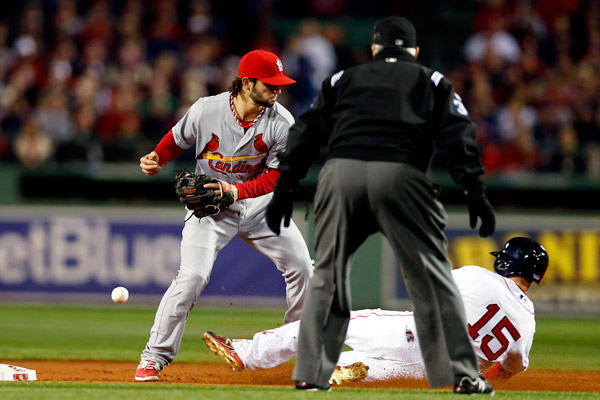
Many of the errors officials make happen because they
anticipate a play happening and make the call too early. We had two examples of this in the
World Series just finished (hooray for the Sox!).
In Game 1, umpire Dana DeMuth called “out” on a force play
at second base before he made sure that Cardinals shortstop Pete Kozma had
actually caught the ball. To his
credit, when he saw the ball on the ground, he got help from his partners and
crew chief John Hirschbeck overturned the call.
To be polite, let’s say the post-game press conference was a
well-scripted fiction. DeMuth spun
the situation with all his might to say that he saw the drop happening on the
exchange (taking the ball out of the glove to throw it) instead of saying he
made the call too early, and that he did the right thing by checking to see
whether his partners saw it the same way.
Of course the most important thing is to get the call right, which they
eventually did.
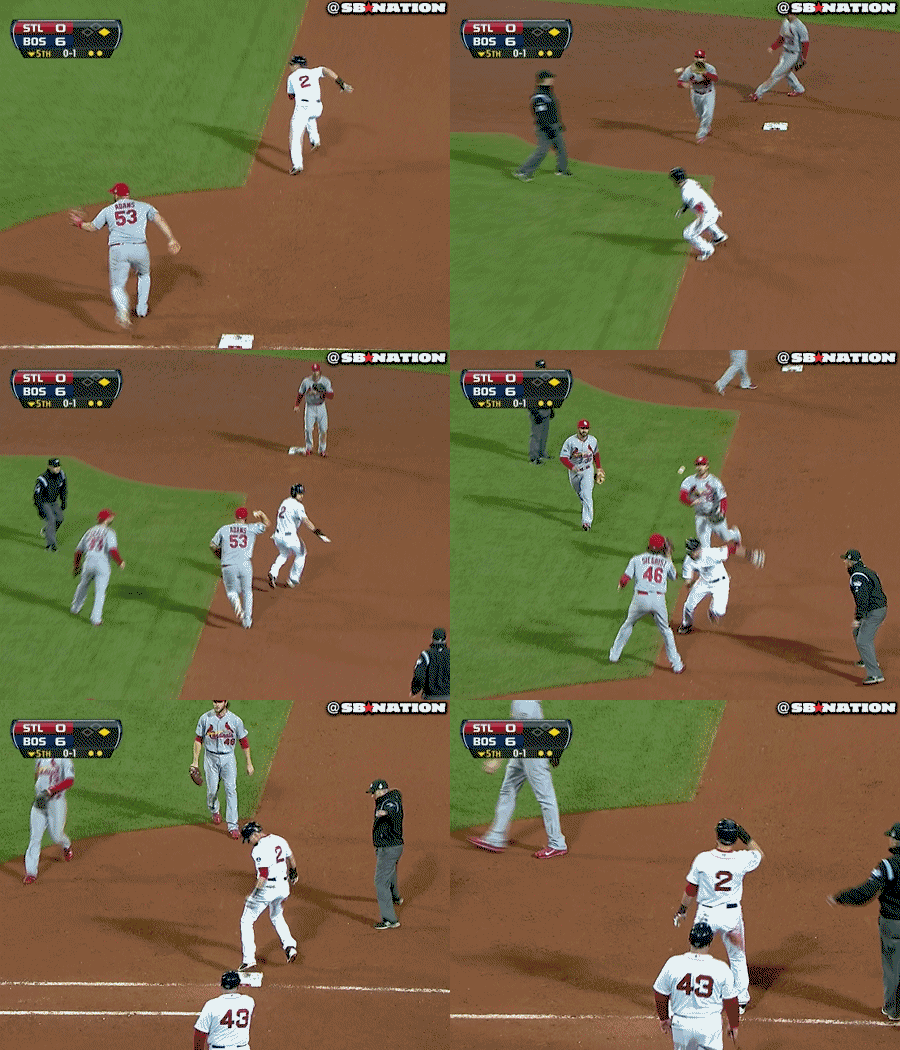
The official instructions to umpires are clear: “Do not come running with your arm up or down, denoting ‘out’ or ‘safe.’ Wait until the play is completed before making any arm motion.” In this situation, the absence of an “out” call sufficiently communicates that there was no tag.
Holding the call is something I remind myself about every game. What I lack in skating speed I try to
make up for with situational awareness, which is the ability to identify and
react to a situation as it develops.
Where situational awareness gets you in trouble is when unexpected
things happen, like the shortstop dropping the ball or an attacker with the
puck holding up at the blue line instead of bringing the puck over. If you’ve wound up for a bang-bang
offsides call when the puck is still on the blue line, you’ll look like a fool.
Like a lot of other things that happen in sports, there are life lessons there if you pay attention. Making decisions in haste is the way to make more wrong decisions. No wrong decisions in the puzzle lineup this weekend, though.
The Wall Street Journal has a real treat: “Choices”: a variety cryptic by Hex with a quite novel grid. Be warned it’s harder than most weekend Journal puzzles, but worth your effort. 31a and 8d are pretty obscure: trust the wordplay. The solution is posted elsewhere on the blog.
Hex also have their weekly straight cryptic in the National Post, solved and annotated for you by Falcon. I heard half a theme in there about music; it would have been nice for Hex to theme more of the clues.
An uncommon straight bar cryptic is Tom Toce’s latest, published in the new issue of Contingencies. “No Bells, No Whistles” would be the antithesis of the Mitchell Sunday, as I referee and The Other Doctor Mitchell rings in the handbell choir. Note a minor printer’s error in that puzzle: there should be another bar immediately under the square numbered 27.
This weekend’s New York Times puzzle (behind the paywall) is an acrostic by Hex, and the monthly bonus puzzle for subscribers is also up: it’s a Fred Piscop puzzle for National Novel Writing Month.
And catching up with Kevin Wald, here’s another small puzzle of his: themed as usual. Amazing how many puzzles he creates when there must be a lot of work going into each one.
Bonus puzzle: Rock fans should know that BEQ composed a straight crossword in memory of Lou Reed.
Nathan Curtis’s site had a few technical problems last weekend, but it’s working all right now. No new puzzles yet though. Xanthippe is feeling emboldened so she is busy creating another new one.
Thursday, October 3, 2013
Variety crosswords for better and for worse
The syndicated New York Times crossword usually lags the publication in the Times by three weeks, so I was wondering when this particular puzzle would showed up in the campus paper, reminding me to post something about it. It actually ran August 29 (Wordplay post with spoilers), so visit your library for a copy.
The best kind of twisted crosswords (the ones where something has to be done to some of the answers when entering them in the grid) are the kind where you’re absolutely sure you know a bunch of the answers, but can’t figure out how they go. Then there’s a clap of thunder and the trick appears in front of you. You race through all those entries you now know how to fill in, and all is right with the world. That puzzle was one of them.
Meanwhile, today’s NYT puzzle came close to meeting that standard. Deb blogs it (spoiler alert) at Wordplay, including an interview with the constructor, whom we learn is a Haverford alum (I wasn’t into crosswords when I was in college). We also learn that these kind of puzzles can make life difficult for both programmers and users of Across Lite and other crossword software. Finally, they noted a few entries that had never shown up in the NYT puzzle before. To me the reason for one of them was obvious: earlier editors would have quickly vetoed “sucks” in a context other than siphons or vacuum cleaners (I scold my teenage children for such usage too—it may not be profane but it’s a lazy vulgarity: one people ought to have more appropriate words in their vocabulary for.
Deb also had a nice post on the heuristic topic visited by my main post this week, and why we find these kinds of solutions (and things like fugues resolving) so rewarding. Go read it.
The ugly part: take Tuesday’s Times puzzle, please. Unusual symmetry in the grid made it pretty obvious there would be something different with the theme, the theme was left pretty out in the open, and the fill needed to make the theme work left a little to be desired. And if you’re one of the ones who do Harper’s too, it didn’t even feel novel. (I’m sure both constructors came up with their themes independently). So it met the fate of many NYT puzzles in my hands: do enough of it to complete the theme, then chuck it, the rest of the solve isn’t worth the time.
The best kind of twisted crosswords (the ones where something has to be done to some of the answers when entering them in the grid) are the kind where you’re absolutely sure you know a bunch of the answers, but can’t figure out how they go. Then there’s a clap of thunder and the trick appears in front of you. You race through all those entries you now know how to fill in, and all is right with the world. That puzzle was one of them.
Meanwhile, today’s NYT puzzle came close to meeting that standard. Deb blogs it (spoiler alert) at Wordplay, including an interview with the constructor, whom we learn is a Haverford alum (I wasn’t into crosswords when I was in college). We also learn that these kind of puzzles can make life difficult for both programmers and users of Across Lite and other crossword software. Finally, they noted a few entries that had never shown up in the NYT puzzle before. To me the reason for one of them was obvious: earlier editors would have quickly vetoed “sucks” in a context other than siphons or vacuum cleaners (I scold my teenage children for such usage too—it may not be profane but it’s a lazy vulgarity: one people ought to have more appropriate words in their vocabulary for.
Deb also had a nice post on the heuristic topic visited by my main post this week, and why we find these kinds of solutions (and things like fugues resolving) so rewarding. Go read it.
The ugly part: take Tuesday’s Times puzzle, please. Unusual symmetry in the grid made it pretty obvious there would be something different with the theme, the theme was left pretty out in the open, and the fill needed to make the theme work left a little to be desired. And if you’re one of the ones who do Harper’s too, it didn’t even feel novel. (I’m sure both constructors came up with their themes independently). So it met the fate of many NYT puzzles in my hands: do enough of it to complete the theme, then chuck it, the rest of the solve isn’t worth the time.
Wednesday, September 25, 2013
Less contrived than usual
Just a quick note to say I was impressed by the puzzle in last Friday’s New York Times (which I got around to solving today). The constructors were Mangesh Ghogre of Mumbai and Doug Peterson of the USA, for whom this is not their first collaboration.
I was attracted by the grid, which like a lot of NYT Fridays was something of a show-off piece (just 25 blacks and stacked 15s at the top and bottom). Usually, you need some pretty contrived entries to fill a grid like this, but the quality of the fill here was excellent from top to bottom, especially in the 15s and their crosses.
Deb Amlen was not quite as impressed, but spoke quite favorably at Wordplay (spoiler warning). If you get the puzzle in syndication, look for it three weeks from the original publication date, which would be October 11.
I was attracted by the grid, which like a lot of NYT Fridays was something of a show-off piece (just 25 blacks and stacked 15s at the top and bottom). Usually, you need some pretty contrived entries to fill a grid like this, but the quality of the fill here was excellent from top to bottom, especially in the 15s and their crosses.
Deb Amlen was not quite as impressed, but spoke quite favorably at Wordplay (spoiler warning). If you get the puzzle in syndication, look for it three weeks from the original publication date, which would be October 11.
Saturday, September 21, 2013
Parsing the question (Sunday brunch: September 22, 2013)

So if fencer X makes an attack against Y’s point in line, and finds Y’s blade, Y places point in line again while X continues the attack and both fencers hit, who gets the point? Take it one step at a time. Y’s first point in line establishes right of way, which X must take away. X does that, and then gets the right of way by doing so. OK so far? Once X gains right of way, X keeps it even when Y goes back to point in line because Y didn’t do anything to take it back. Touch for X.
Parse these puzzles out, and remember they’re for relaxation, not for torture.
The only new cryptic on our side of the pond this weekend is Hex’s in the National Post. Falcon has worked it out for you as usual, and reports his mind is in better “shape” for the experience
Want another cryptic? Try Xanthippe’s British puzzle called Girls Just Wanna Have Fun.
Kevin Wald has been kind enough to post his variety cryptic (a bonus puzzle) from the American Crossword Puzzle Tournament.
It’s a two-acrostic weekend. The Wall Street Journal puzzle is by Mike Shenk. After my first pass through the clues (either having no idea or too many ideas for most of them), I was resigning myself to this one being a real slog. But surprisingly, I wound up getting most of the quote from partials in it and from discovering a few words that were repeated several times in the quote. So on one level, I liked the puzzle because it made me approach the answer from a different direction, I also disliked it because of all the repetition making the quote so easy to find.
The New York Times acrostic (by Hex as usual) is also behind the paywall as usual. Deb Amlen blogs it as usual at Wordplay (spoiler warning). Note also that the straight crossword in today’s Times (by Mike Selinker) is a prize puzzle. See Wordplay for instructions on how to win one of their new 2014 calendars.
Nathan Curtis’s weekly variety puzzle isn’t up yet (I’ll post an update when it is), which is probably OK for those of you still working on last week’s Pathfinder. [UPDATE: Did you finish the Pathfinder? I did. Nathan now has another Snake Charmer for you to solve. Thanks, Nathan!]
Thursday, August 8, 2013
Lollapuzzoola
Lollapuzzoola 6 will be on Saturday, August 10, 2013 in New York City. If you’re the competitive crossword type, or you want to meet some of the constructors and your fellow solvers, show up with 25 bucks Saturday at 1157 Lexington Ave. If you can’t make it, there’s a solve-at-home division too.
Sunday, July 14, 2013
Tour de France (Sunday brunch: July 14, 2013)

Once you get to know the event and some of the personalities, your enjoyment of the Tour increases exponentially. There is a lot more to it than who will wear the yellow jersey in Paris: the effort of the leaders' teammates to set the pace, throw off opponents, and deliver their man to the finish; the opportunistic riders who go off in a breakaway and the tactical riding of the sprinters' teams to keep the break from getting too far ahead; and much more.
The scenery and the crowds also make the event. There are many familiar faces: human (commentators Phil Liggett and Paul Sherwen; The Devil, who shows up during the mountain stages), and non-human (the familiar curves of Alpe d'Huez).
Today is one of two "queen stages" of the Tour: days expected to be the toughest and most decisive. Today's stage finishes with the long lonely climb up Mont Ventoux, while Thursday the race climbs the Alpe not once but twice. I'll bet fans are already camping out there today in order to get the best viewing points. There'll be a quarter million lining the road there by Thursday, and they'll get a fabulous show. Check your local listings, so you can be there in spirit.
As frequently happens, acrostics show up together this weekend. The Wall Street Journal's acrostic (Java link) is by Mike Shenk. Not many comments posted so far, but the majority note it is fairly difficult. I don't think it had the polish of Hex's acrostics (of which there is one behind the New York Times paywall), but I liked the fill (aside from the one which obviously was the last one Shenk clued--J): a reggae artist, a backgammon game popular in the Navy, and a nice, happy pop song.
The new Harpers is out, with Richard Maltby's variety cryptic, but there are no recent posts over at Erica's blog. She must be busy with her video directing. Nathan Curtis also informs us he doesn't have much to say, but there is an Around the Bend puzzle for us this week.
There's a BEQ cryptic I missed last week (#553 if you're counting), and the regularly scheduled Hex cryptic in the National Post. For the latter, a little French will help, but I think there's not enough there to call it a themed puzzle.
And hooray, hooray: Xanthippe is now offering printer-friendly versions of her (British) cryptics, starting with her Opus 10. Go visit, solve, and comment. Xanthippe is eager to improve her work, and she's blogging about the constructing experience as well as sharing her puzzles with us.
Sunday, March 24, 2013
Some more words on four-letter words (Sunday brunch: March 23, 2013)
Read on: new puzzles at the bottom of the post!
Brendan Emmett Quigley also has an alter ego who works blue. Very blue. His Bawdy Crosswords are definitely in the "not safe for work" category, but they provide another dimension in constructing and solving. Take "Tunnel of Love" for example (repeat warning: NSFW). There's a visual double-entendre to the theme entries in that one as well as the wordplay.
Back to the usual weekend fare. Hex is in the kitchen for us, and the National Post takes a peek at them while they're working. The New York Times has a Hex acrostic (behind the paywall, Hex's comments and spoilers over at Wordplay).
And we have another chef and another course in our menu: Nathan Curtis offers a tasty mix at Tortiseshell Puzzles. His latest is a Rows Garden, which compares well to the Patrick Berry originals. He also constructs cryptics, like "What Do You Do With a B.A. in English?" Welcome, Nathan: we look forward to seeing more of your work every week.
A few months ago I commented on the subject of four-letter
words: the type you aren’t supposed to say on television. I didn’t intend to get back to the
subject so soon, but some recent reading and puzzles deserve comment.
In particular, the sports page of the Wall Street Journal
(yes, they really do have a sports page, though they continue to hold the line
against comics) had a feature on how broadcasters have to adjust their language
when they move from the locker room to the microphone. Dan Dakitch says he reads the newspaper out loud to himself
for ten minutes before going on the air just to hear himself speak without
swearing.
And last week, the Journal had a feature on comedians who
work clean, noting how many in the business know that obscenity can be a crutch
to lean on to get the audience’s attention, but eventually its shock value
wears off. It takes more work to
prepare a routine that doesn’t use the seven words George Carlin built his most
famous routine on, but real talents like Jerry Seinfeld and Bill Cosby do so
and you hardly realize it.
As I said before, crossword constructing is largely a
G-rated enterprise, with some notable exceptions like The Onion, which revels
in double entendre and toilet humor.
Mainstream setters rarely go near the line, let alone over it. When they do, it’s usually to
facilitate a particularly clever or playful clue. With the indirect way words are clued in cryptic crosswords,
such opportunities present themselves regularly. Hex had one in their variety cryptic this weekend at the
Wall Street Journal (solution below the fold, hint grid posted previously). The second
“n” clue prompted titters from the commenters who got there first. While the grins were fading, the solvers figured out that this puzzle is not as hard as you think
Brendan Emmett Quigley also has an alter ego who works blue. Very blue. His Bawdy Crosswords are definitely in the "not safe for work" category, but they provide another dimension in constructing and solving. Take "Tunnel of Love" for example (repeat warning: NSFW). There's a visual double-entendre to the theme entries in that one as well as the wordplay.
Back to the usual weekend fare. Hex is in the kitchen for us, and the National Post takes a peek at them while they're working. The New York Times has a Hex acrostic (behind the paywall, Hex's comments and spoilers over at Wordplay).
And we have another chef and another course in our menu: Nathan Curtis offers a tasty mix at Tortiseshell Puzzles. His latest is a Rows Garden, which compares well to the Patrick Berry originals. He also constructs cryptics, like "What Do You Do With a B.A. in English?" Welcome, Nathan: we look forward to seeing more of your work every week.
Saturday, December 29, 2012
Do you like snow too? (Sunday Brunch: December 30, 2012)
Bangle and Sabers are looking forward to the weekend's forecast snow almost as much as I'm looking forward to the Hex snowflake that will be on the lawn tomorrow morning in a Wall Street Journal hidden under some of that white stuff.
The New York Times has a Hex acrostic,which if pattern holds will escape the paywall in its Java form on Saturday (UPDATE: nope--they fixed the paywall). They've also posted a January "bonus" puzzle behind the paywall: another Fred Piscop creation. Is it a diagramless or something else? It's not tagged as diagramless, and Piscop did have a diagramless in last Sunday's Times.
Meanwhile, Deb Amlen is raving over Saturday's New York Times puzzle, in which Joe Krozel managed to construct a stack of five fifteen-letter words. The rest of the puzzle had to be compromised to make the stack work, but Joe's place in constructing history is assured.
And while there wasn't a The Nation puzzle this week, Hot and Trazom do have a new post in Word Salad. They decry the tendency of North American constructors to slavishly adhere to the [unwritten] rules, which they think stifles the opportunity to create some fun clues (I agree with that part) and also takes away an element of individuality from constructing (I disagree with that part: I can pick out a Hex puzzle from the way they use secondary definitions, and correctly identified them when The Nation held its puzzle auditions). So do you think Hot and Trazom are right? Go over and join the debate.
The New York Times has a Hex acrostic,
Meanwhile, Deb Amlen is raving over Saturday's New York Times puzzle, in which Joe Krozel managed to construct a stack of five fifteen-letter words. The rest of the puzzle had to be compromised to make the stack work, but Joe's place in constructing history is assured.
And while there wasn't a The Nation puzzle this week, Hot and Trazom do have a new post in Word Salad. They decry the tendency of North American constructors to slavishly adhere to the [unwritten] rules, which they think stifles the opportunity to create some fun clues (I agree with that part) and also takes away an element of individuality from constructing (I disagree with that part: I can pick out a Hex puzzle from the way they use secondary definitions, and correctly identified them when The Nation held its puzzle auditions). So do you think Hot and Trazom are right? Go over and join the debate.
Subscribe to:
Posts (Atom)