Quick post to catch up.
Kevin Wald (I can’t spell Ucaoimhu) is back with a good medium difficulty variety cryptic he set for the Washington Post’s Post Hunt puzzle contest. It’s called “Saturday? Unknown.”
We have a new Puns and Anagrams constructor in the New York Times today: Mark Diehl. Deb Amlen interviews him at Wordplay (spoiler warning). Deb also informs us that the P&A will now appear every 8 weeks, with Diehl and Mel Taub sharing construcing duties. Meanwhile, Hex’s cryptics will appear in the NYT less frequently: every 8 weeks.
Speaking of new constructors, Tom Toce has a guest puzzling for him in Contingencies. Jerry Levy didn’t crete a cryptic, but cryptic solvers will appreciate the kind of wordplay he uses. Will Shortz would appreciate it too: maybe we’ll see Jerry’s byline in the Times.
The Wall Street Journal puzzle is a Rows Garden by Patrick Berry. I found it easier than usual. I’ll post hints for the WSJ and the NYT solution shortly. If you enjoyed that, remember that Andrew Ries publishes a bi-weekly Rows Garden that’s every bit as good. Subscribe at www.ariespuzzles.com.
Stickler is taking a winter break (remember he’s in Australia) for R&R. Wish him well at www.australiancrosswords.com.au
Falcon reports that he weekly Hex cryptic in the National Post was on the stormy side. I haven’t gotten to the Globe and Mail cryptic yet.
Showing posts with label bar cryptic. Show all posts
Showing posts with label bar cryptic. Show all posts
Sunday, June 7, 2015

Saturday, November 2, 2013
Hold the whistle! (Sunday brunch: November 3, 2013)
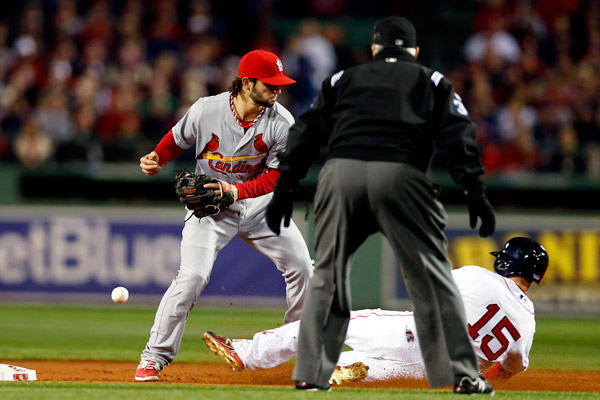
Many of the errors officials make happen because they
anticipate a play happening and make the call too early. We had two examples of this in the
World Series just finished (hooray for the Sox!).
In Game 1, umpire Dana DeMuth called “out” on a force play
at second base before he made sure that Cardinals shortstop Pete Kozma had
actually caught the ball. To his
credit, when he saw the ball on the ground, he got help from his partners and
crew chief John Hirschbeck overturned the call.
To be polite, let’s say the post-game press conference was a
well-scripted fiction. DeMuth spun
the situation with all his might to say that he saw the drop happening on the
exchange (taking the ball out of the glove to throw it) instead of saying he
made the call too early, and that he did the right thing by checking to see
whether his partners saw it the same way.
Of course the most important thing is to get the call right, which they
eventually did.
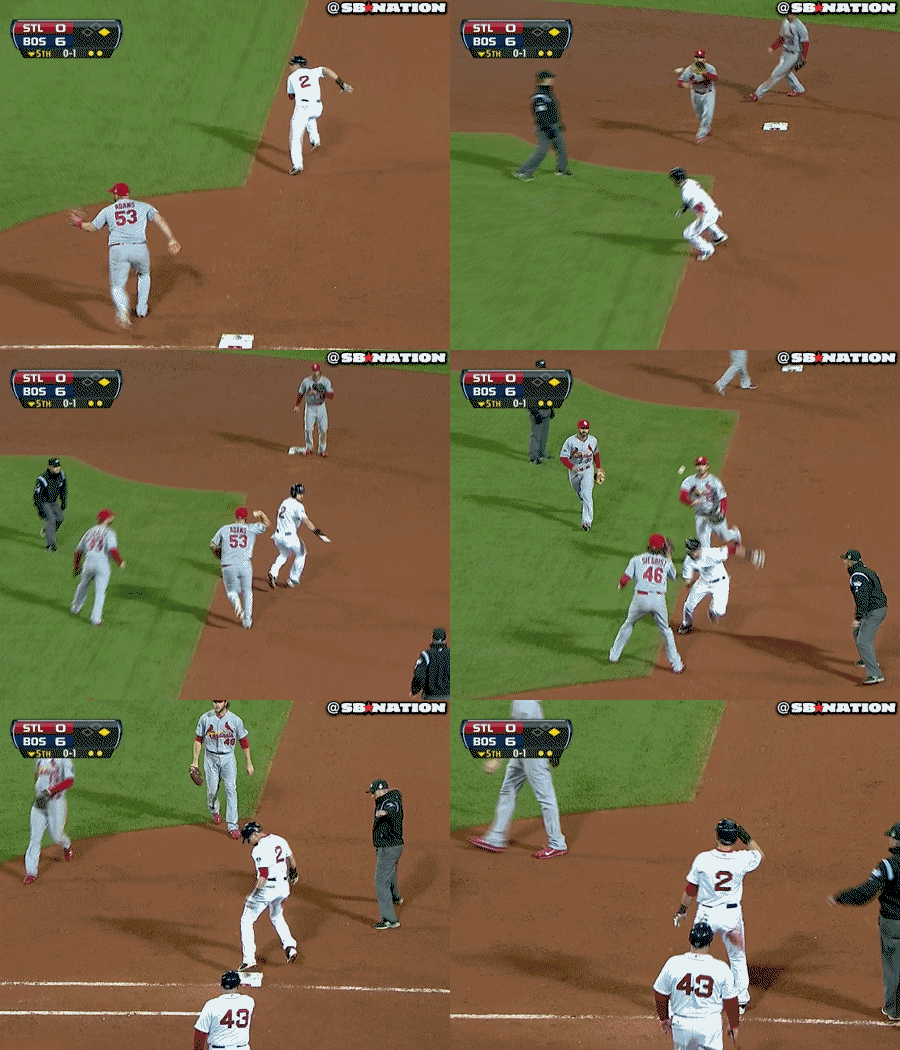
The official instructions to umpires are clear: “Do not come running with your arm up or down, denoting ‘out’ or ‘safe.’ Wait until the play is completed before making any arm motion.” In this situation, the absence of an “out” call sufficiently communicates that there was no tag.
Holding the call is something I remind myself about every game. What I lack in skating speed I try to
make up for with situational awareness, which is the ability to identify and
react to a situation as it develops.
Where situational awareness gets you in trouble is when unexpected
things happen, like the shortstop dropping the ball or an attacker with the
puck holding up at the blue line instead of bringing the puck over. If you’ve wound up for a bang-bang
offsides call when the puck is still on the blue line, you’ll look like a fool.
Like a lot of other things that happen in sports, there are life lessons there if you pay attention. Making decisions in haste is the way to make more wrong decisions. No wrong decisions in the puzzle lineup this weekend, though.
The Wall Street Journal has a real treat: “Choices”: a variety cryptic by Hex with a quite novel grid. Be warned it’s harder than most weekend Journal puzzles, but worth your effort. 31a and 8d are pretty obscure: trust the wordplay. The solution is posted elsewhere on the blog.
Hex also have their weekly straight cryptic in the National Post, solved and annotated for you by Falcon. I heard half a theme in there about music; it would have been nice for Hex to theme more of the clues.
An uncommon straight bar cryptic is Tom Toce’s latest, published in the new issue of Contingencies. “No Bells, No Whistles” would be the antithesis of the Mitchell Sunday, as I referee and The Other Doctor Mitchell rings in the handbell choir. Note a minor printer’s error in that puzzle: there should be another bar immediately under the square numbered 27.
This weekend’s New York Times puzzle (behind the paywall) is an acrostic by Hex, and the monthly bonus puzzle for subscribers is also up: it’s a Fred Piscop puzzle for National Novel Writing Month.
And catching up with Kevin Wald, here’s another small puzzle of his: themed as usual. Amazing how many puzzles he creates when there must be a lot of work going into each one.
Bonus puzzle: Rock fans should know that BEQ composed a straight crossword in memory of Lou Reed.
Nathan Curtis’s site had a few technical problems last weekend, but it’s working all right now. No new puzzles yet though. Xanthippe is feeling emboldened so she is busy creating another new one.
Thursday, September 26, 2013
“C” is for “congratulations” (Puzzle No. 3,296)
Hooray for Hot and Trazom! Today they published their 100th puzzle in The Nation.
In honor of the occasion, they created a special bar cryptic without any guide to where the answers go, other than showing you the location of all the Cs in the grid.
Not to scare you off though—this is actually a pretty easy(*) puzzle. So easy that when I saw it, I decided to try a harder version of it first, and it still was easy. As an extra aid to solvers, the clues are printed in the alphabetical order of their solutions. I did a quick cut, paste, and sort; to take the clues out of that order and into a more or less random order.
While I can’t post that challenge version here, I can suggest that you veteran solvers randomize the clues yourself. Print out a copy of the puzzle and take a pair of scissors to it until all the clues are on their own individual slips of paper.
You could even play a version of Crossword Golf this way. Pick up a clue slip and try to solve the clue and place the answer in the grid. If you can solve and place it the first time you look at it, count a birdie for yourself. If you can’t solve the clue the first time or if you can solve the clue but can’t figure out where to put the answer, put the clue aside. If you can figure out an answer just from the intersecting letters before you even look at the clue, count that answer as an eagle. After you’ve been through all the clues once, go through them one at a time for a second time. Any answer you place here counts as par. If you need to look at the clue for a third or fourth time, that’s bogey or double bogey.
*–by design: Hot and Trazom want their variety cryptics published here to be non-frustrating. That way, novice solvers will enjoy them and be encouraged to try out more variety puzzles. As mentioned here a few times in the past, I’m entirely on board with that
Link to puzzle: http://www.thenation.com/article/176330/puzzle-no-3296
Degree of difficulty (by standards of this weekly puzzle): very easy
Hozom’s comment: “Puzzle One Hundred” in which Hot and Trazom catch up on a variety of things including an update to their puzzle-solving instructions and volume 2 of their Puzzazz series.
Solution and annotation posted here Monday. Join us this weekend for a rules exam with your Sunday brunch.
In honor of the occasion, they created a special bar cryptic without any guide to where the answers go, other than showing you the location of all the Cs in the grid.
Not to scare you off though—this is actually a pretty easy(*) puzzle. So easy that when I saw it, I decided to try a harder version of it first, and it still was easy. As an extra aid to solvers, the clues are printed in the alphabetical order of their solutions. I did a quick cut, paste, and sort; to take the clues out of that order and into a more or less random order.
While I can’t post that challenge version here, I can suggest that you veteran solvers randomize the clues yourself. Print out a copy of the puzzle and take a pair of scissors to it until all the clues are on their own individual slips of paper.
You could even play a version of Crossword Golf this way. Pick up a clue slip and try to solve the clue and place the answer in the grid. If you can solve and place it the first time you look at it, count a birdie for yourself. If you can’t solve the clue the first time or if you can solve the clue but can’t figure out where to put the answer, put the clue aside. If you can figure out an answer just from the intersecting letters before you even look at the clue, count that answer as an eagle. After you’ve been through all the clues once, go through them one at a time for a second time. Any answer you place here counts as par. If you need to look at the clue for a third or fourth time, that’s bogey or double bogey.
*–by design: Hot and Trazom want their variety cryptics published here to be non-frustrating. That way, novice solvers will enjoy them and be encouraged to try out more variety puzzles. As mentioned here a few times in the past, I’m entirely on board with that
Link to puzzle: http://www.thenation.com/article/176330/puzzle-no-3296
Degree of difficulty (by standards of this weekly puzzle): very easy
Hozom’s comment: “Puzzle One Hundred” in which Hot and Trazom catch up on a variety of things including an update to their puzzle-solving instructions and volume 2 of their Puzzazz series.
Solution and annotation posted here Monday. Join us this weekend for a rules exam with your Sunday brunch.
Friday, September 6, 2013
Wall Street Journal hints: September 7, 2013
The Wall Street Journal has an excellent variety cryptic by Hex this weekend. I think it’s a lot easier than it looks. While there are no indications of where the answers are supposed to go, you can figure many of them out if you’re able to get both clues in each set.
If you do that, you’ll know which space within each word has the shaded letter, and which space in the intersecting word is the shaded letter; so you’ll be able to eliminate most of the possible locations and hopefully narrow your possibilities down to one. So if you get one of the ten letter words and the fourth letter is B, you can be pretty sure it’s going to go in the top row, and the first letter of the six-letter B answer will have to be B.
But in case you still have trouble, or want to confirm a guess, I’ll post below the fold a listing of the shaded letters in order from top to bottom, left to right (anyone notice they’re in proper crossword symmetry? Impressive!).
If you do that, you’ll know which space within each word has the shaded letter, and which space in the intersecting word is the shaded letter; so you’ll be able to eliminate most of the possible locations and hopefully narrow your possibilities down to one. So if you get one of the ten letter words and the fourth letter is B, you can be pretty sure it’s going to go in the top row, and the first letter of the six-letter B answer will have to be B.
But in case you still have trouble, or want to confirm a guess, I’ll post below the fold a listing of the shaded letters in order from top to bottom, left to right (anyone notice they’re in proper crossword symmetry? Impressive!).
Monday, May 20, 2013
Anyone have an A string? (Sunday Brunch: May 19, 2013)
Yeah, I realize it’s Monday brunch. I'm catching up. Sometimes I even have a breakfast burrito for dinner (though that's not necessarily because I didn't have breakfast).
Nathan Curtis's weekly variety crossword is a Snake Charmer.
Here are the week’s new puzzles.
The Wall Street Journal have a moderately difficult variety
cryptic by Hex called Pyramid Scheme. Groaner warning for the solution phrase
at the bottom of the puzzle, and props to Hex for the pyramid reference in the
first clue. If time permits, I might post a hint.
For some reason, I didn’t really like the grid of that
puzzle. The concept was fine:
acrosses are normal but downs either go diagonally left or diagonally right, in
straight lines where some puzzles of this shape might veer back and forth. But some of the acrosses were
unchecked, so while the first row had six letters, there were only four downs
starting in the row. Also, diagonals that didn’t spell out words didn’t have
heavy bars. I can see why, since
adding the bars would have made the puzzle much easier as well as spoiling the
symmetry of the blank grid.
It’s also the time of the month for a new Harpers (subscriber page): this one
referencing (at least in the title) Rogers and Hammerstein instead of Stephen
Sondheim). It’s called “June is
Busting Out All Over.” The clues
were not too difficult, but I’m still grappling with the unclued central
letter. For what it’s worth, Erica
doesn’t have her commentary on the May Maltby posted yet at Tacky Harpers Cryptic Clues. Post here or at her blog in in the meantime and I'll explain the solution.
The Hex straight cryptic in the National Post is themed on
some of the longer place names in Canada.
I can rattle off names like Swift Current (Saskatchewan) and Chicoutimi
(Quebec) since they’re home to teams in the major junior leagues of hockey. Some of the nicknames are pretty good too, like the Brandon (Manitoba) Wheat Kings, the Windsor Spitfires, and the Shawninigan Cataractes. The
best hockey players in Canada (and increasingly from the USA) don’t play college hockey: they go to the Ontario League, the Quebec League, and the Western League, while the second-tier players go to the NCAA. Players can be drafted by NHL teams once they turn 18, and some of them go to training camp and possibly play a few games for the NHL team before being returned to their junior team for the rest of the season.
The Times has an acrostic this week (behind the paywall). Deb Amlen has some comments on the puzzle from Hex over at Wordplay.
Nathan Curtis's weekly variety crossword is a Snake Charmer.
Sunday, March 24, 2013
Some more words on four-letter words (Sunday brunch: March 23, 2013)
Read on: new puzzles at the bottom of the post!
Brendan Emmett Quigley also has an alter ego who works blue. Very blue. His Bawdy Crosswords are definitely in the "not safe for work" category, but they provide another dimension in constructing and solving. Take "Tunnel of Love" for example (repeat warning: NSFW). There's a visual double-entendre to the theme entries in that one as well as the wordplay.
Back to the usual weekend fare. Hex is in the kitchen for us, and the National Post takes a peek at them while they're working. The New York Times has a Hex acrostic (behind the paywall, Hex's comments and spoilers over at Wordplay).
And we have another chef and another course in our menu: Nathan Curtis offers a tasty mix at Tortiseshell Puzzles. His latest is a Rows Garden, which compares well to the Patrick Berry originals. He also constructs cryptics, like "What Do You Do With a B.A. in English?" Welcome, Nathan: we look forward to seeing more of your work every week.
A few months ago I commented on the subject of four-letter
words: the type you aren’t supposed to say on television. I didn’t intend to get back to the
subject so soon, but some recent reading and puzzles deserve comment.
In particular, the sports page of the Wall Street Journal
(yes, they really do have a sports page, though they continue to hold the line
against comics) had a feature on how broadcasters have to adjust their language
when they move from the locker room to the microphone. Dan Dakitch says he reads the newspaper out loud to himself
for ten minutes before going on the air just to hear himself speak without
swearing.
And last week, the Journal had a feature on comedians who
work clean, noting how many in the business know that obscenity can be a crutch
to lean on to get the audience’s attention, but eventually its shock value
wears off. It takes more work to
prepare a routine that doesn’t use the seven words George Carlin built his most
famous routine on, but real talents like Jerry Seinfeld and Bill Cosby do so
and you hardly realize it.
As I said before, crossword constructing is largely a
G-rated enterprise, with some notable exceptions like The Onion, which revels
in double entendre and toilet humor.
Mainstream setters rarely go near the line, let alone over it. When they do, it’s usually to
facilitate a particularly clever or playful clue. With the indirect way words are clued in cryptic crosswords,
such opportunities present themselves regularly. Hex had one in their variety cryptic this weekend at the
Wall Street Journal (solution below the fold, hint grid posted previously). The second
“n” clue prompted titters from the commenters who got there first. While the grins were fading, the solvers figured out that this puzzle is not as hard as you think
Brendan Emmett Quigley also has an alter ego who works blue. Very blue. His Bawdy Crosswords are definitely in the "not safe for work" category, but they provide another dimension in constructing and solving. Take "Tunnel of Love" for example (repeat warning: NSFW). There's a visual double-entendre to the theme entries in that one as well as the wordplay.
Back to the usual weekend fare. Hex is in the kitchen for us, and the National Post takes a peek at them while they're working. The New York Times has a Hex acrostic (behind the paywall, Hex's comments and spoilers over at Wordplay).
And we have another chef and another course in our menu: Nathan Curtis offers a tasty mix at Tortiseshell Puzzles. His latest is a Rows Garden, which compares well to the Patrick Berry originals. He also constructs cryptics, like "What Do You Do With a B.A. in English?" Welcome, Nathan: we look forward to seeing more of your work every week.
Saturday, February 16, 2013
Expect the unexpected (Sunday brunch: February 17, 2013)
On average, the cryptics by Richard Maltby are the hardest that are regularly published in America. This was not an average week. First, after thoroughly beating his 1968 New York Magazine solvers up with "Vicious Circles" (which see), Stephen Sondheim took the week off and had Maltby fill in. The result was "Anesthetics." I got the gimmick pretty quickly, and finished solving in a day or so, which is pretty good for me.
Then yesterday, the new Harpers appeared, with a puzzle titled "Title Search." (puzzle available to subscribers only) I started in on it on a walk over to the library, got the top right corner right away, and instantly saw the theme. This one categorizes as a theme puzzle rather than a variety puzzle, which is Maltby's usual medium. I solved it by the time I got on the train home, in case you were one of the people on the platform wondering what that guy was doing blowing smoke from the muzzle of his pen.
Two easy wins? Sabers did even easier, winning his latest tournament with a pair of 15-2s, after a decent effort Thursday against much tougher competition.
Two easy wins? Sabers did even easier, winning his latest tournament with a pair of 15-2s, after a decent effort Thursday against much tougher competition.
There's a whole weekend left? What to solve? Start with the Hex cryptic in the New York Times (behind the paywall). Deb Amlen has commentary at Wordplay, and I'll post the solution later this weekend.
With one set of circles done, Patrick Berry kept me well rounded last night with "Section Eight": a different form of circular variety puzzle: instead of radial words, there are eight sectors: one letter comes out of each sector and the rest are rearranged each time you move inwards. A tough but very fair puzzle.
And of course, there's the weekly Hex cryptic in the National Post. Falcon asks us: "Where's the Theme?" (I think that was rhetorical.) I'm not so worried about a theme considering the unusual grid. Each of the 7- and 8-letter entries in the center are fully checked: rare in a block cryptic.
And of course, there's the weekly Hex cryptic in the National Post. Falcon asks us: "Where's the Theme?" (I think that was rhetorical.) I'm not so worried about a theme considering the unusual grid. Each of the 7- and 8-letter entries in the center are fully checked: rare in a block cryptic.
Tuesday, February 5, 2013
Project Sondheim update: six down
After solving the first couple of Stephen Sondheim puzzles, I thought I might be looking for another new puzzle project before the year was out. I'm not so sure now. There's quite a lot of variability in the difficulty of the puzzles. Here's what I've done so far, with links to the puzzles that were posted as part of New York Magazine's 40th anniversary feature.
1. [untitled], April 8, 1968. Fifteen unclued lights go with five theme words. Easy. The editors printed it under the title "New York Magazine Puzzle," aptly enough.
2. Dedicated Dodecahedron, April 15, 1968. A dodecahedron-shaped grid where each face was a five-letter word sharing its letters with a six letter word. Very easy as long as you can figure out the person to whom the puzzle was dedicated.
3. 3 Downs, April 22, 1968. 24 of the clues are anagrams of two words rather than the standard definition/wordplay construction. You have to use those words to determine a third word to go into the grid. Moderate difficulty: I recognized a few of the pairs which might not be familiar to younger people, and that helped a lot.
4. One Shy, April 29, 1968. A straight bar cryptic, with a hidden message you have to find and interpret. Easy.
5. Diametricode, May 6, 1968. I remember solving another of this type--might have been a Maltby. Fifteen of the answers must be enciphered before going in the grid, with the substitutions shown by the letters extending out from the grid. Hard.
6. Woodbabes, May 13, 1968. 24 of the lights are what I call visual puns, where the physical placement of the letters is indicated by the answer phrase. So if the clue led to "babe in the woods" the light would be "woodbabes." Sondheim gave enumerations for the lights, not the answers, which made this very hard.
And you thought that the term "snail mail" started with internet-era hipsters looking down on their old-fashioned elders? Think again.

1. [untitled], April 8, 1968. Fifteen unclued lights go with five theme words. Easy. The editors printed it under the title "New York Magazine Puzzle," aptly enough.
2. Dedicated Dodecahedron, April 15, 1968. A dodecahedron-shaped grid where each face was a five-letter word sharing its letters with a six letter word. Very easy as long as you can figure out the person to whom the puzzle was dedicated.
3. 3 Downs, April 22, 1968. 24 of the clues are anagrams of two words rather than the standard definition/wordplay construction. You have to use those words to determine a third word to go into the grid. Moderate difficulty: I recognized a few of the pairs which might not be familiar to younger people, and that helped a lot.
4. One Shy, April 29, 1968. A straight bar cryptic, with a hidden message you have to find and interpret. Easy.
5. Diametricode, May 6, 1968. I remember solving another of this type--might have been a Maltby. Fifteen of the answers must be enciphered before going in the grid, with the substitutions shown by the letters extending out from the grid. Hard.
6. Woodbabes, May 13, 1968. 24 of the lights are what I call visual puns, where the physical placement of the letters is indicated by the answer phrase. So if the clue led to "babe in the woods" the light would be "woodbabes." Sondheim gave enumerations for the lights, not the answers, which made this very hard.
And you thought that the term "snail mail" started with internet-era hipsters looking down on their old-fashioned elders? Think again.

Public service advertisement from the U.S. Postal Service
New York magazine: April 15, 1968
Saturday, January 12, 2013
Starting Here, Starting Now (Sunday brunch: January 13, 2013)
Thursday’s post about Richard Maltby and Stephen Sondheim
only scratched the surface of their contributions to cryptic crosswords and to
musical theatre. I kept exploring,
and discovered that while Sondheim’s book of New York magazine puzzles is long
out of print (this is the book with the dodecahedron on the cover), Sondheim’s first three puzzles are posted online for posterity. I'm going to try one of them this weekend.
Elsewhere around the puzzling scene, it’s one of those
two-acrostic weeks. The Times puzzle (by Hex as usual, with their comments over at the Wordplay blog) is behind the paywall, while the Wall Street Journal’s acrostic is a particularly
literary endeavor (update 1/13" I forgot to credit Mike Shenk for constructing that puzzle). Note that there've been issues with Java security, so you may need to reload the page or re-enable Java in order for the interactive version to work. But do so: that applet takes all the drudgery out of acrostics.
For cryptics, this week we’ve only got The Nation from Thursday (solution posted here Monday: hints always available in comments if you need them--and don't miss this week's installment of Word Salad)
and the National Post from Saturday, which this week has a mystery constructor. Solution and commentary on that puzzle is over at Falcon’s site. Harpers’ for
February wasn’t out yet, last I checked.
I spend a good chunk of my week going back over a Kevin Wald
puzzle: "I Scrambled Here" that I’d printed out a few months ago and found while cleaning up around the
house. This one has a four-stage
meta to taunt you, in case working out two-part clues or clues with anagrams
inside them isn’t hard enough already.
I’ve filled the grid and solved the first two metas, but there’s a final
anagram I haven’t got yet, along with a final bit of wordplay. Want to try and help? If you ask in the comments, I’ll give hints on the parts I’ve gotten so far. Then you might be able to figure out where I’ve gone wrong.
Thursday, December 27, 2012
Old Time Hockey
Some weeks, The Nation doesn't publish. And some weeks, both the Times and the Wall Street Journal publish acrostics or word puzzles instead of cryptic crosswords. So for weeks we don't have a puzzle from Hot and Trazom to feature on Thursdays, or when the Sunday brunch menu is not so appetizing, I'm launching a new feature called "Old Time Hockey." Those sacred words, made famous in the movie Slap Shot, have a special meaning to hockey players (and officials). Old time hockey is back to basics: no razzle-dazzle, no trash talk; just skating, shooting, and hitting (and some surreptitious holding and interference too).
We'll pick a puzzle from the archives of one publication or another, and solve it together. This week, I did Spoonerfest, by Hex, from the September 2003 issue of The Atlantic. This was definitely a tough one. Like some other variety cryptics Hex have created, and others in the NPL book that Hot and Trazom edited, one-third of the clues are altered, one-third of the answers have to have a matching alteration before they go into the grid, and the last one-third are normal. So as the title indicates, we have spoonerisms in this puzzle. None of them were particularly funny ones, but Hex were pretty sneaky: some of the clues you're sure at first are straight actually need to be altered.
If there are some old favorites you want to see in a future edition of this column, send me an e-mail.
We'll pick a puzzle from the archives of one publication or another, and solve it together. This week, I did Spoonerfest, by Hex, from the September 2003 issue of The Atlantic. This was definitely a tough one. Like some other variety cryptics Hex have created, and others in the NPL book that Hot and Trazom edited, one-third of the clues are altered, one-third of the answers have to have a matching alteration before they go into the grid, and the last one-third are normal. So as the title indicates, we have spoonerisms in this puzzle. None of them were particularly funny ones, but Hex were pretty sneaky: some of the clues you're sure at first are straight actually need to be altered.
If there are some old favorites you want to see in a future edition of this column, send me an e-mail.
Saturday, December 22, 2012
Christmas Eve (Sunday brunch: December 23, 2012)
(Welcome New York Times diagramless solvers: scroll down for your solution, then come back each week for cryptics and brunch, with sides of hockey and music.)
Last week, Hex shared some Christmas Eve traditions with us: we all have our holiday routines. Our church has its services Christmas Eve instead of Christmas Day. There is considerable singing involved: Bangle now one of the senior members of the children’s choir performing at the family service, Sabers with the youth singers on Sunday, and The Other Doctor Mitchell with the adult choir at the late service. Me, I bellow heartily from the pews.
Last week, Hex shared some Christmas Eve traditions with us: we all have our holiday routines. Our church has its services Christmas Eve instead of Christmas Day. There is considerable singing involved: Bangle now one of the senior members of the children’s choir performing at the family service, Sabers with the youth singers on Sunday, and The Other Doctor Mitchell with the adult choir at the late service. Me, I bellow heartily from the pews.
After we get home from services, there are usually some
last-minute preparations. I always
put on a recording of the Festival of Nine Lessons and Carols from King's College in Cambridge (check local listings for the streamcast in your area) while I assemble and wrap. Then
when all is ready, a dram of Glenmorangie with one ice cube. Maybe I’ll have enough time to solve
one of this week’s puzzles while I sip that malt.
Hex are like most of us in that they keep on singing, but
garble some of their carols. But
they’ve been nice enough to put them in cryptic form so all the intersecting
words can keep us in tune. Falcon conducts the chorus over at his blog.
When Patrick Berry makes a list, he always checks it twice:
every single item. His gift to
solvers is published in the Wall Street Journal (*). He’s fit two dozen candy canes in his grid. TODM thought it was exceptionally cute.
Nothing in the puzzle is too hard or obscure: you just need to get the first
answer or two placed and you’ll roll right along from there.
None of the clues are assigned to a specific space. If you’re not sure where to begin, look
first at the “canes” down the middle.
They’ll each have a string of five letters that will be checked by one
or two of the across answers. If
you find an uncommon string in the cane, look for it in an across (remember it
could be backwards). Once you have
the first of a pair of canes, you know where to put the second. If you can get that one, and find the
acrosses it checks, then you’ll be on your way to filling in the vertical
canes.
Once Christmas is over, it’s time to prepare for the new
year. Richard Maltby will help us
out that way with his Harpers’ cryptic.
I found this one something of a chore to solve: the theme answers
weren’t obvious, and they required some Googling or checks with The Other
Doctor Mitchell to verify that they really did fit the theme.
The New York Times variety puzzle this week (behind the
paywall) is a Fred Piscop diagramless.
I’ll update this post with the solution after I get my copy, since I
love the traffic-building effect.
Deb Amlen has comments (and spoilers) at Wordplay.
*--if you have trouble viewing or printing the Wall Street Journal puzzle, go to http://blogs.wsj.com/puzzle/ and click the PDF link.
New York Times variety puzzle solution (diagramless
12/23/12) is posted below the fold.
Thursday, November 29, 2012
Bar exam II (Puzzle No. 3,263)
Years ago, there was a series of beer ads about the Utica Club Bar Exam. Three identical mugs, one filled with Utica Club, the other two with some other beer. If you could tell which of them was the Utica Club, you passed.
Cryptic solvers get a bar exam of their own this week, since Hot and Trazom have given us a bar-style puzzle. There are two main sub-species of cryptic crosswords: block-style and bar-style, so named obviously because in the latter, words are separated by black bars instead of blocks.
From the constructor's perspective, the two types present different constraints and different challenges. Bar-style is challenging because nearly every letter has to be checked. It's tough to fill a bar-style grid without resorting to obscure or crossword-ese words. On the other hand, block-style is constrained by the rotational symmetry that is convention in English-language crosswords. Novice constructors often do asymmetric grids as their first puzzles (though sometimes constructors do asymmetric grids to enhance the theme of a puzzle).
For the solver, bar-style cryptics usually mean variety puzzles: the kind where some answers are unclued (like this week's puzzle) or you might have to alter answers before they will fit into the grid. You usually can't do that with a block cryptic: with so many unchecked letters, there might be several way to make the alteration work.
More to the point, bar-style cryptics are usually more difficult than their block cousins. But this bar puzzle is not a stumper: it is solvable for the intermediate-level puzzler, but challenging enough to give you a sense of accomplishment when you're through. And like many variety cryptics, there's a kicker: a little extra reward. Crossword bloggers like Matt Gaffney call it a "meta."
The tag line on the beer ads: once you passed the bar exam, you could try a case! So take this exam, pass it, and then try this month's Richard Maltby puzzle in Harper's, or some of Hex's bar-style puzzles for the Wall Street Journal (we're due for one soon, I think).
Link to puzzle: http://www.thenation.com/article/171481/puzzle-3263
Degree of difficulty: Pretty easy, even the unclued answers.
Hozom's comment: The Finishing Steps, in which Hot and Trazom give us an acronym for something we solvers sometimes feel: IGIBIDGI. They talk about the difference between filling the grid, which is enough for many, and truly solving the puzzle by cracking the wordplay of each clue. I definitely fall in the latter category (see entry 3,250 for example). Skipping the wordplay sometimes means missing out on the most clever parts of the puzzle, while working out the finishing steps hones your solving skill and loads the memory bank with little tricks and hints you might see again in a future.
I'd like to hear a little from them about the differences between constructing bar-style puzzles and constructing block-style, since they've had considerable experience with both. How hard is it to avoid getting caught up in the meta and keep focus on a satisfying grid that doesn't rely on bad entries to make it work?
Solution and annotation posted Monday.
Cryptic solvers get a bar exam of their own this week, since Hot and Trazom have given us a bar-style puzzle. There are two main sub-species of cryptic crosswords: block-style and bar-style, so named obviously because in the latter, words are separated by black bars instead of blocks.
From the constructor's perspective, the two types present different constraints and different challenges. Bar-style is challenging because nearly every letter has to be checked. It's tough to fill a bar-style grid without resorting to obscure or crossword-ese words. On the other hand, block-style is constrained by the rotational symmetry that is convention in English-language crosswords. Novice constructors often do asymmetric grids as their first puzzles (though sometimes constructors do asymmetric grids to enhance the theme of a puzzle).
For the solver, bar-style cryptics usually mean variety puzzles: the kind where some answers are unclued (like this week's puzzle) or you might have to alter answers before they will fit into the grid. You usually can't do that with a block cryptic: with so many unchecked letters, there might be several way to make the alteration work.
More to the point, bar-style cryptics are usually more difficult than their block cousins. But this bar puzzle is not a stumper: it is solvable for the intermediate-level puzzler, but challenging enough to give you a sense of accomplishment when you're through. And like many variety cryptics, there's a kicker: a little extra reward. Crossword bloggers like Matt Gaffney call it a "meta."
The tag line on the beer ads: once you passed the bar exam, you could try a case! So take this exam, pass it, and then try this month's Richard Maltby puzzle in Harper's, or some of Hex's bar-style puzzles for the Wall Street Journal (we're due for one soon, I think).
Link to puzzle: http://www.thenation.com/article/171481/puzzle-3263
Degree of difficulty: Pretty easy, even the unclued answers.
Hozom's comment: The Finishing Steps, in which Hot and Trazom give us an acronym for something we solvers sometimes feel: IGIBIDGI. They talk about the difference between filling the grid, which is enough for many, and truly solving the puzzle by cracking the wordplay of each clue. I definitely fall in the latter category (see entry 3,250 for example). Skipping the wordplay sometimes means missing out on the most clever parts of the puzzle, while working out the finishing steps hones your solving skill and loads the memory bank with little tricks and hints you might see again in a future.
I'd like to hear a little from them about the differences between constructing bar-style puzzles and constructing block-style, since they've had considerable experience with both. How hard is it to avoid getting caught up in the meta and keep focus on a satisfying grid that doesn't rely on bad entries to make it work?
Solution and annotation posted Monday.
Friday, November 23, 2012
Harper's grid
The December issue of Harpers is out: both on paper and on the web. Richard Maltby's variety cryptic has a holiday theme, and some red and green rows. I found that when I printed it out, the colored rows were very dark, so here's a blank grid with lighter shading. The solution will be posted along with Sunday brunch.


Saturday, October 20, 2012
Harpers solution (Sunday brunch: October 21, 2012)
It's a two-acrostic weekend this weekend: Mike Shenk in the Wall Street Journal and Hex in the New York Times.
Fortunately for cryptic solvers, the Harper's crossword by Richard Maltby landed in mailboxes and libraries this week. As noted last month, their online edition seems to lag the print version, curious as that is. A solution for you is below the fold. There are three unclued answers that fit a theme, but I don't think that's enough to hang a "variety cryptic" label on it, so I didn't.
Watch for the National Post Cryptic over at Falcon's blog.
Want more puzzles? Click over to this week's The Nation post and get to know Mark Halpin. He's got Sondheim-themed cryptics and some National Puzzlers' League creations to keep you busy.
Fortunately for cryptic solvers, the Harper's crossword by Richard Maltby landed in mailboxes and libraries this week. As noted last month, their online edition seems to lag the print version, curious as that is. A solution for you is below the fold. There are three unclued answers that fit a theme, but I don't think that's enough to hang a "variety cryptic" label on it, so I didn't.
Watch for the National Post Cryptic over at Falcon's blog.
Want more puzzles? Click over to this week's The Nation post and get to know Mark Halpin. He's got Sondheim-themed cryptics and some National Puzzlers' League creations to keep you busy.
Subscribe to:
Posts (Atom)