Showing posts with label Nathan Curtis. Show all posts

Saturday, July 5, 2014

Long weekend (Sunday brunch: July 6, 2014)

Joey has the right idea for
 a long, restful weekend
Early edition of Sunday brunch for this long weekend.  Good thing too, since there are plenty of new cryptics to keep you busy.  We start in the New York Times (behind the paywall).  Richard Silvestri is the constructor.  Look for the solution here.

North of the border, it was Canada Day Tuesday, but neither Fraser Simpson nor Hex marked the event with their weekend puzzles for the Globe and Mail and the National Post respectively.  And in case you missed it, there was a new The Nation cryptic (and a cluing challenge) Thursday.

Multiple variety cryptics too this weekend.  The change tracker I was using to follow Kevin Wald’s page doesn’t seem to have worked too well, so I missed a few recent puzzles.  I’ll post links over the next few weeks to catch up, starting with 6/28, which logically (of course Kevin does things logically) was posted last weekend.  Great puzzle, and not as difficult to finish as some of Kevin’s other cryptics.  Give it a try.

Tom Toce has his bi-monthly variety cryptic in Contingencies.  It’s a Double Trouble, where there are two grids and each clue is actually two clues, one for each grid.  You have to figure out which one. Note there are a couple of errors in the grids: there should be a bar to the left of square 19, so the enumeration of 17a is (5), and the square at the bottom left corner should be numbered 27.

In other puzzling pastimes, the Wall Street Journal has a Rows Garden by Patrick Berry.  Medium difficulty.  If you’re feeling creative, you can also add to the comment thread for the Friday non-puzzle.

Nathan Curtis is back!  He’s been preoccupied with BAPHL, which went off in Boston last weekend, so there hasn’t been time for any new puzzles.  With that done, he’s posted a new mini Rows Garden.

Sunday, March 23, 2014

Whistle in the pocket (Sunday brunch: March 23, 2014)

[oops, didn’t check the am/pm in posting time--that’ll teach me to blog after a playoff doubleheader]

It’s not something in the book, but a lesson passed on to novice refs in training camp: take off your whistle and put it in your pocket when there’s a scuffle and you’re going in to separate the players.  Depending on who’s teaching that part of the seminar, you’ll be advised there are other times to put your whistle in your pocket.  A lot of guys ignore that advice; it’s a bother to always be taking off and putting on your whistle.  But I’ve made it a habit. 

Why do you put the whistle in your pocket?  Read on after the weekend’s puzzles.  

Last week, my post and Nathan’s look to have crossed in the mail.  So there are two of his puzzles to commend to you: last week’s was a Pathfinder (good one!) and this week Nathan offers his first Split Ends (a puzzle type not to be confused with the “Split Ends” puzzles Will Sortz constructs for the New York Times).

The Wall Street Journal puzzle this weekend is “Omission Statement,” a variety cryptic by Hex.  This one is on the easy side, and even includes an acrostic final answer, so it’s definitely worth a try.  By contrast, the weekly Hex puzzle in the National Post is harder than usual.  I liked the grid, which included a dozen nine- and ten-letter words. Falcon will help you though it if you need. 

The Fraser Simpson cryptic in the Globe and Mail (printable, Java) is at its usual (hard) level of difficulty.       

The NYT has a Hex acrostic this week (behind the paywall).

Good news!  Erica has survived the bedbugs and posted her assessment of the tackiness of this month’s Harpers.  

Back to hockey.  Why do you put the whistle in your pocket?  Because of the metal clamp that holds it on your fingers.  If you get hit on the whistle, it’s a good way to sprain or break your fingers (I’ve broken seven, but none of them because of the whistle).  Yesterday proved the point.

It was a playoff game, a good one, though we had a lot of icings.  When there’s an icing call, the lead official blows the whistle when the puck crosses the goal line, skates to the puck, and skates it the length of the rink back to the trail official at the face-off dot.  It’s a time when we want to show off our best skating skills, and for me it’s the time when I can remind myself to pay attention to the things I learned in the power skating lessons I had a few seasons ago. 

On one of those situations, in the second period, I had just crossed the blue line and angled across towards the opposite circle when a red team player coming the other way angled across towards his bench.  We didn’t have a head-on collision, but he ran right into my whistle hand.  We then collided hip to hip pretty hard and both of us went down.  But I was ready, and since my whistle was in my pocket, neither the hand nor the whistle was injured.

NHL linesman Tim Nowak had a similar situation in a game I was watching on TV last week.  A player ran into him during a stoppage, and he went down.  He needed several stitches to close a gash in his whistle hand, but he was back out there soon enough.  Tim’s a good linesman, a veteran now.  A native of the Buffalo area, he’s a proud product of the USA Hockey Officiating program and gives back to his fellow officials.  I had the opportunity to skate with him and hear him speak at the last district camp I attended.  The occupational hazards of being a ref are there for all of us. 

Friday, March 14, 2014

Broadcast Network (Puzzle No. 3,317)

A little while ago, we learned that Nathan Curtis and some of our other favorite constructors were involved in a new project, which turned out to be a quarterly puzzle magazine edited by Will Shortz.  Now the first issue of Will Shortz’s Wordplay is now out. What’s it like?  Find out after the break.

Link to puzzlehttp://www.thenation.com/article/178790/puzzle-no-3317

Degree of difficulty (by standards of this weekly puzzle): easy to moderate, and very consistent.

Hozom’s comment: “Chez Henri,” in which Hot realizes his dream of opening a Bay Area cryptic restaurant.  Reviewer’s note: the groaning you hear isn’t just from the large portions!

I think the best way to describe the new Wordplay puzzle magazine from Penny Press is to compare it to a television channel.  In the 1960s, TV for most people was the three major networks.  Cable TV was mainly for people who wanted better reception or not to have to fuss with an antenna.  The networks showed a little bit of everything: Laugh-in, a college football game on Saturday afternoon, soap operas mid-day, and the evening news.  Then we started seeing new and more focused channels: ESPN, HBO, MTV.  Today there are channels for everything from home remodeling to Tejano music to game show reruns.

So it is with puzzles.  Thirty years ago, we had the newspaper crossword plus some syndicated variety puzzle like Jumble or a cryptogram.  If you wanted variety, there were print magazines at the supermarket checkout lane.  For harder puzzles, there were magazines and books at bookstores. 

Then came the internet, which has been fabulous for us solvers.  We can congregate at sites for our favorite types of puzzles, and constructors have a place to go to seek out an audience.  Now we’re getting into app world and push content; we don’t ever have to go without our preferred puzzles. 

Penny Press is the broadcast company that’s trying to thrive in the 500 channel age.  Checkout lane magazines of easy crosswords and word searches are their bread and butter, and they’re the dominant player in that market.  But they also do specialty puzzles: The Other Doctor Mitchell is an avid consumer of their logic puzzles. 

Wordplay fits the Penny Press model to a T.  They understand solvers, and that they derive satisfaction from finishing puzzles and feeling they’re smarter because they’re able to get the right answers.  So they tend to stay away from difficult puzzles or ones that are intimidating at the beginning, just like the other editors who have to publish for a broader market, like Mike Shenk with the WSJ weekend puzzles

What that means is that the variety and cryptic crosswords in Wordplay are interspersed among other quick word games of the type Willz is good at coming up with.  Those are good for a quick two or three-minute break from whatever else you’re doing, or to pick up and solve while you’re waiting in line for something.  Nathan’s Pathfinder is probably the hardest puzzle in the magazine.  

Another benchmark: the Fraser Simpson cryptic is easier than his Globe and Mail puzzles, and is in pure US cluing form rather than the part-British approach of his weekly puzzles.  (The other cryptic in the magazine is by Jeffrey Harris.) 

Other names you’ll recognize (most but not all the puzzles are credited) include Patrick Berry, Brendan Emmett Quigley, Foggy Brume, and Mark Halpin.  There are also some new constructors working in forms you’ll recognize, like a Rows Garden by Joon Pahk.  Anthologies like this one are valuable for giving these people some cash and a wider audience for their puzzles.  Kudos to Will Shortz for convincing the big names to join the cast and for recognizing some emerging talent. 

The presentation is like other Penny Press magazines: comfortably-sized grids on good quality newsprint paper.  Since it’s newsprint, you will have to choose pen or pencil carefully, and it won’t take too much erasing. Games Magazine is better in this department.  There are about 60 puzzles in a 64-page magazine for $3.99 ($18.97 for an annual subscription: 6 issues per year).  For the whole thing, that’s a good value, but if you see the word games and logic art pages as filler, less so.

So like the people who watch military history 24/7, solvers who want just variety crosswords will change the channel.  Those whose idea of variety extends more broadly will be satisfied but not thrilled with this magazine.  But that’s OK since those are fairly small slivers of the population.  Like the big TV networks, Penny Press is trying to build an audience out of people who are just tuning in to whatever is on now plus those who are looking for a particular show to meet their interest. 


For the typical reader of this blog, it’s worth having a copy of Wordplay.  It’ll be ideal for airplane trips or on the nightstand for when you want a light and fairly easy diversion.  If you discover some new favorites, and constructors get a breakout from it, even better. 

Penny Press says the best place to find Wordplay will be at larger bookstores, but to make sure you get your copy, subscribe.

Saturday, February 15, 2014

I hate shootouts (Sunday brunch: February 16, 2014)


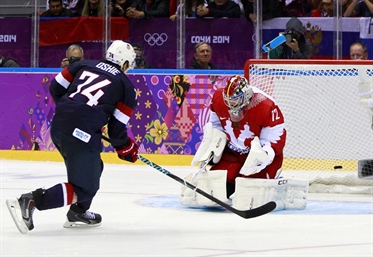
Game winner by T.J. Oshie.
Why’d they have to mess with a perfectly good  tie game?  After finally getting out of Boston where I had been stranded at the airport, I got to watch the end of the USA-Russia game.  Appropriately enough, it was at the rink, where Bangle and The Other Doctor Mitchell were practicing.  USA adapted well to the larger surface, especially in the forecheck, but couldn’t get the gamewinner, despite a power play at the end of the third period.   

They played a mostly-cautious overtime (only five minutes—it will be ten minutes in the playoff rounds), and then went to a shootout.  (“game winning shots” in IIHF parlance).  Cue my refrain: “I hate shootouts.”  I hate them in soccer as well as hockey, even though the team I coached won one on the way to our championship. It’s a team game, so it should be decided by the same skills and teamwork the rest of the game entails.  And when two teams have played evenly for 60 minutes or more, they deserve recognition.

I reminded the skating parents and other onlookers that IIHF rules for shootouts are different from NHL rules: particularly in letting shooters go again if the game is not decided on the first three attempts.  T.J. Oshie kept shooting for USA, which I think was a great coaching call, since Sergei Bobrovsky’s greatest weakness is not his glove hand or his ability to butterfly, but between his ears.  Sending the same shooter who beat him earlier may have helped shake his confidence, and sending Oshie back even after missing a couple of attempts send “Bob” a message that Coach Bylsma thought Oshie would get the job done.  

When it went to a shootout, and then to sudden-death, I was figuring Russia to win, with talent like Alex Ovechkin, Ilya Kovalchuk, and Pavel Datsyuk.  But Jonathan Quick was just good enough to give Oshie another opportunity to win the game.  Great outcome, but I would have been just as happy with a well-earned tie.  

This weekend’s puzzles definitely will have you working overtime: especially the Wall Street Journal, where they’ve brought us something new by Patrick Berry.  It’s called “Way Stations.”  Don’t feel bad if you have to print out another copy after messing up the first.  If you’ve done the Pathfinders by Nathan Curtis, you’ll have a leg up here.

Speaking of Nathan, he’s back with a new Snake Charmer, and with news of his recent activities, which include creating a puzzle hunt for the National Museum of Math and constructing for a new print magazine of variety puzzles edited by the ubiquitous Will Shortz.  19 bucks for six issues with 50 puzzles each.  With Nathan, Patrick, BEQ and Trip Payne in the lineup, the quality of the puzzles ought to be great. 

More news on big puzzle projects: the Cryptic All-Stars have put their book to bed and sent out PDFs of the print edition, along with a note that they’re still working on the e-book edition.  At the rate new puzzles are coming out, I’m gonna need a bigger clipboard.  Congratulations, everyone; I’ll post a review next week.  

The New York Times puzzle this weekend (behind the paywall) is a diagramless by Fred Piscop.  Deb says it’s easy, and she’s not a big fan of variety crosswords, so this might be a good one for those of you who’ve never tried a diagramless before.  Blizzard permitting, I’ll post the solution here tomorrow: note it will be bumped under this post, so scroll down to find it.  

Meanwhile, cryptic solvers can go one-on-one with Hex (National Post) and with Fraser Simpson (Globe and Mail: Java/print).  Falcon reports that Hex constructed a Valentine’s theme; we’ll hope Emily and Henry were cluing sweet nothings to each other as they worked on the puzzle.    

Saturday, November 23, 2013

Positively speaking (Sunday brunch: November 24, 2013)

It happens a lot in a hockey game: a winger gaining the puck along the boards and skating over the blue line with the defense in pursuit.  If you’re the ref, you’re watching the play closely, maybe thinking: “don’t hook, don’t hook, keep skating, don’t hook” because the natural inclination of the players is to try and go for the puck as soon as they think it’s in reach.  Then that leaves us officials with a marginal call one way or the other: was it a clean play for the puck or was it hooking or holding?

This time, the defender tipped the puck off the winger’s stick and down into the corner, giving her teammates time to get back into position while the two chased the puck.  Smart hockey. 

After the game, I spotted the player and said: “you’re number 15?”  She nodded.  I continued: “the play where you were chasing the puck carrier and tipped the puck down into the corner?  Good idea.”  I added that I had been a defenseman in my playing days and one of the most satisfying parts of the game was learning tricks like that.  It’s best to play defense with your skates and your brain first. 

And in that same vein, I’ve learned that it’s best to officiate with positive reinforcement first rather than starting from a hostile or antagonistic position with the players.  You don’t want to be like NFL umpire Roy Ellison, who’s been given a week off after he lost his temper and cursed at Washington lineman Trent Williams.  Even though Williams (who himself is black) reportedly directed a racial slur at Ellison, Ellison’s actions reflected poorly on the league and on our profession.  

On the field or online, it’s always best to conduct yourself as though you’re miked up and other people will hear everything you say.

Puzzle-wise, it's definitely a weekend for variety.  The New York Times puzzle (behind the paywall) is a diagramless by Paula Gamache.  Look for the solution here Sunday afternoon.

This week’s puzzle from Nathan Curtis is a cool new hexagonal Pathfinder.  Give it a try and share your thoughts on it with Nathan.

The Wall Street Journal has a Patrick Berry Rows Garden for us this weekend.  If you’re having trouble with it, I have the enumerations for you in an earlier post.  If you’re stuck on the last dark bloom, just trust the force, Luke.  One thing I noticed about this puzzle was that the row answers were all about the same length, so there wasn’t much interlock between the left and right halves of the puzzle, making it harder.  If you you have a couple of longer (13-14 letter) answers in consecutive rows, then the one you get can help you with the intersecting blooms, which in turn help with the long answer in the next row.  But nearly all these were 10s and 11s.  

Don’t expect a Thanksgiving theme in this weekend’s National Post puzzle by Hex.  The NP is a Canadian paper, and Falcon and our other neighbors to the north celebrated Thanksgiving a month ago.  I found part of it easy and part hard.

If you want a suitably themed cryptic to solve while the turkey is in the oven, try this 2008 puzzle by Ucaoimhu.

LizR’s promised Doctor Who extravaganza isn’t up yet.   I’ll keep an eye out.  If you’re a fan of the show, this might be your perfect introduction to Brit cryptics, since you’ll get more answers from definitions and intersecting letters.  When you get them, you can then try to sort out the wordplay.

Finally, when you’re ready to put down your pencil, enjoy this article about constructing in the old days.

Saturday, November 9, 2013

The dog whistle (Sunday brunch: November 10, 2013)

The oddball in my whistle collection is my original no-pea Fox 40.  This was designed by a Canadian basketball referee whose whistle jammed at an inopportune moment, so he vowed to make a whistle that didn’t need a ball inside it to generate a distinctive and strong tone.

It has three air chambers to blend three frequencies (like a train whistle), and since you don’t have to blow hard in order to make the pea swirl around the chamber, it’s a very easy-blowing whistle.  So I got it for those times when you have a chest cold or when you’re on an open rink on an icy-cold morning, and it hurts to take a deep breath.

Well one evening I got stuck in traffic on my way to a summer-league bantam game.  While sitting and waiting, I decided it would be a fine time to re-tape my regular whistle.  But when I got to the rink and went inside to dress, I left the whistle in my car.  Fortunately, I had the Fox 40 as a spare, so I went out with it.  Not long after the game started, I heard some funny sounds coming from one of the benches.  At a stoppage I went over, and one of them explained that they’d heard my “dog whistle” and were responding to it.  We had a good laugh over it, and ever since then, I’ve called it the dog whistle.

The reason is it’s a much higher and thinner sound than an Acme, and though it’s a Canadian product, the original Fox 40 never caught on with hockey officials, and some of the old-timers despise it.  Basketball refs love it though, and I’ve seen (and heard) it used in the NFL and professional soccer too.  Nowadays I only use mine for cross-ice mite games where we have two games going on at the same time on the two halves of the rink.  Then the players and coaches won’t be as confused by the whistles coming from the other side.

Definitely a weekend for variety.  The Wall Street Journal weekend puzzle is a Seven Sages by Patrick Berry.  These can be tough until you get a solid toehold in an area.  I find the best way to do that is to find where you have two consecutive answers figured out, then determine which letters those answers share.  If there’s only two letters shared, they have to go in the spaces joining those two words.  Use the directional information with the clues to figure out which way those two letters go, and then complete the words.  From there, you can build on one word at a time.  Don’t forget that you can use the outside quote to guess at some more letters and confirm a suspicion you might have about some of the answers.

Nathan Curtis did get a puzzle posted last week: it’s a type called a Belt Line introduced by Patrick Berry.  Never a bad idea to pick up on one of Patrick’s ideas.  Then he was early with this week’s puzzle: another Pathfinder.  I think this is going to be Nathan’s forte.

Meanwhile the New York Times puzzle (behind the paywall) is a Split Decisions.  Debate below: should we call this a crossword or a non-crossword?

This is supposed to be a cryptic blog, so fortunately we have cryptics this weekend too.  Hex can always be counted on; so can my blogging ally Falcon, who solves and annotates the National Post cryptic.  Go to him for Qs and As.

Go to Xanthippe for a new British-style cryptic called “Bottoms Up” and another lovely picture.  Anyone recognize that lady?  Hit the comments there and tell our friends across the pond where you’ve found her.  That puzzle reminded me of a fairly easy Mark Halpin variety cryptic I solved this week called “Here’s to the Ladies that Lunch.”  For those not up on their Sondheim, that’s the title from a song in Company.

More puzzles from the NPL convention are finding their way online.  Mark Halpin collaborated on a Texas-sized Extravaganza called “A Matter of Con Science.”  Solving that ought to provide a graduate-level education in puzzling.

Saturday, October 19, 2013

Left-handed cronuts (Sunday brunch: October 20, 2013)

I had a split doubleheader last Sunday: you heard about the morning game, and the afternoon game was better in several ways.  Next age group up, the ice felt a little less dead, the coaches had a better grasp of things, and a decent partner: not only is he pretty focused and conscientious for a high school kid, he’s also left-handed, which is rare among referees.

Because of my bad shoulder (the injury that got me into refereeing), I keep my whistle on my right hand and signal with my left.  When you’re signaling a delayed penalty, your arm should be right against the earhole of your helmet, and I can’t raise my right arm that high.  In other sports, this doesn't matter too much, but in hockey, you have to pass the puck to your partner after you pick it up and he establishes the face-off location.

Now stop and think of what would happen if I skated up to my partner holding the puck in my left (non-whistle) hand while he was holding his right (non-whistle) hand out to receive it.  We’d crash into each other, one of us would probably end up on our butt, and everyone in the rink would have a laugh at our expense.  So in most cases, before I pick up the puck for my partner, my whistle goes into my pocket, and I hold the puck in my right hand so we can pass right to right.  When I work with Joe, we get to pass left to left, and I appreciate every one of those passes.

So even though it was just another day at the rink, gamewise, I was feeling pretty good after the second game: a blend of tired and satisfied.  This is the rink on the way down to the city, and just down the road is a gigantic Korean supermarket.  We needed more chopsticks (Bangle likes to use them for rice, and I find them very convenient for cheese curls (no orange powder clinging to my fingers) and I felt like getting some noodles and dumplings, so I went down there after the game.

In the mini-mall there is a pastry shop, of French and Indochinese influence.  The perfect place for a light post-game snack, and they had a batch of cronuts there.  Now I’d heard of cronuts and how they were the big thing in New York; now I could see what all the hype was about.

A cronut is a pastry made out of croissant pastry, cut and fried like a donut.  That would be pretty good for starters, but a cronut needs more: specifically some kind of cream filling (in this case lemon) and a bit of compllentary flavoring on the outside.

Verdict?  Darned good.  Decadent but not deadly.  Over the top, but not overpowering.  A fine reward for two hours plus of skating.

Puzzles?  Yes.  This week they were just as tasty.

It’s a two-acrostic weekend.  Mike Shenk has a seasonally-appropriate puzzle in the Wall Street Journal: pretty easy, especially if you know it’s themed and Shenk is a good constructor.  Hex have their regular acrostic in the New York Times (paywall) and commentary on Deb Amlen’s blog (spoiler warning)

Want cryptics?  There’s Hex in the National Post with a puzzle less easy than usual; and Xanthippe with her brit-cryptic with a nice central answer.  And we learn that Nathan Curtis 1--merits having Kevin Wald construct a birthday puzzle in his honor and 2--is remarkably humble about the honor.  You know you’re someone in puzzledom if you can get such a fine constructor to come to your potluck.  Hooray for both of you.

Nathan didn’t let the honor go to his head: he kept up with his commitment (hint: someone give him a regular gig) and provides us with a Snake Charmer this weekend (very easy, I thought).

We should also note that Puzzazz has updated their app for iOS 7.  I had a long wait for the train this week during which it was a real pleasure to have cryptics I could pull up and solve on my Pod.  The latest edition of Puzzazz is a significant improvement: saving you taps and time by bringing you back to where you left off instead of making you find and open the virtual book.  And the Touchwrite feature is feeling more and more natural: to the point where this Luddite is ready to dispense with a keyboard.

Sunday, September 29, 2013

Don’t overthink the test (Sunday brunch: September 29, 2013)

It was a few weeks ago now, but I’m still steamed at myself over how I did on my closed-book rules exam this year.  I haven’t gotten my score yet (I’m sure I passed), but I blew three questions because I broke my cardinal rule of rules exams: “don’t overthink the test.”

What do I mean by that?  Here’s an example.  There was a question that asked whether the teams switch ends before overtime.  In almost every league or tournament, overtime (or lack thereof) rules are set by the organizing authorities, and very rarely coincide with what is in the rulebook (which explicitly grants local governing bodies the authority to set overtime rules).  It’s a habit of mine that whenever I work a tournament, or in a league I haven’t worked before, I check what the OT procedures are, because they’re all different.  While they’re all different about how long OT is or how many players are on ice or what do do if the game is still tied after OT, nobody changes ends.  And if you put me at center ice after three periods of a tied game, I’d always put teams on the same sides they were in the third period.

But the exam question included the words “game to be played to completion.”  Ignoring lessons learned from past exams and all the OT games I’ve ever worked, I let those particular words take over my brain.  I thought about multiple OT (which I’ve never had a league do even in playoffs), thought about the epic Stanley Cup games I’ve watched, and answered “change ends.”  Idiot.  In USA rules, nobody changes ends even for multiple OT.

I was so sure I [fouled] up that question that as soon as I turned in the exam I opened my rulebook to confirm I was wrong.  Of course I should have simply corrected my answer before turning in the exam but I stubbornly clung to my brilliant piece of logic instead.  Idiotic.  Brilliant, but idiotic.  Rest assured I will never change ends for OT in a real game though.

Want to see the rest of a typical rules exam?  Click here (Georgia Ice Hockey Officials Association).
Want some puzzlers not related to hockey, plus some fun videos?  Read on.


There’s some really fun fill in the weekend’s Wall Street Journal puzzle: a Patrick Berry Rows Garden. I guessed 2B right but turned out to be wrong with the reference to a hit song: the song I was thinking about was recorded in 1966, not 1961, but the folks I mentioned it to all had pleasant memories of the wrong song, so I’ll embed a video of it anyway.  The other answer I really liked is at the end.

The New York Times variety puzzle (behind the paywall) is another Ring Toss by Mark Halpern.  Deb Amlen (spoiler alert) was glad to see it, and I like all of Halpern’s work.  We saw one of these about a year ago.  I’ve posted some hints below the fold, and the solution will be up shortly.

The National Post cryptic by Hex was a little harder than usual, but still not more than a “moderate.”  Much anagramming and a nice pair of complimentary 14s in the middle.  Falcon has the solution and annotation for you.

Nathan Curtis apologizes for a late post of his Spiral, as well as for two easy puzzles in a row, but I don’t think he needs to apologize for offering us interesting stuff to solve even if it is late in the weekend instead of early.

Back to the WSJ after the fold, since a spoiler is below.  The New York Times hint is there too.

Sunday, September 15, 2013

Moon pie (Sunday brunch: September 15, 2013)

Actually, I’m making Belgian waffles Sunday morning, not marshmallow-graham cracker sandwiches, but you know you lead a blessed life when the answer to the question “how do you spell the name of that city anyway?” is right there on the wrapper of the snack you’re eating while you work on a puzzle between segments of referee training camp (about which more below the puzzles).

The puzzle was Patrick Berry’s “Border Crossing” in the Wall Street Journal and the answer was a particular city in Tennessee (which itself is a spelling challenge--how about a puzzle with hard-to-spell place names like Poughkeepsie, Rensselaer, and Cynwyd?).  My knowledge of useful facts (and my appreciation of junk food in moderation) is such that when I hear the name of said Tennessee city, my first thought is “moon pie.”

So besides the aforementioned WSJ puzzle, for which both solution and hint grid are now posted, there are lots of other good puzzles to work on this weekend (but please, only one moon pie per day).

Hex have cryptics in both the New York Times (behind the paywall) and the National Post.  In the interest of traffic, the NYT solution is now posted to the blog, while Falcon will solve and annotate the National Post cryptic: a puzzle themed to Fashion Week.

The October Harpers with Richard Maltby’s latest puzzle is out.  It’s called “Alphabetical Inserts” in which 26 of the answers are modified before entry.  You can figure out the rest of the modification, but I won’t help since it’s a prize puzzle.

Nathan Curtis’s Pathfinder is a tribute to a great poet now deceased.

I like the title of Xanthippe’s puzzle this week: “London Underground is Not a Political Movement” (though it’s decidedly a movement movement).  Even if you don’t solve Brit cryptics, go over for the beautiful picture at the top of the blog this week.

How was camp?  I had to go to Lehigh this year, since I have other commitments for the day the Philadelphia camp is scheduled.  So I didn’t see many of my regular partners.  The program also wasn’t as all-encompassing as last year’s in Philadelphia.  But the on-ice session was more productive.  We did a lot more advanced stuff than just dropping pucks.  It included edge exercises, drills where we skated on one foot to improve our balance and edge awareness, a bump-out drill, and an altercation drill in which instructor and ex-NHLer Harry Dumas called out your humble blogger as an example for everyone (yes, a good example).

Most of the guys just stayed quiet and immediately jumped into the fray to try and separate the instructors who were playing at fighting, which is the wrong thing to do in a bunch of ways.  But this is one place where my particularly vocal approach to the job helps.  First, as the instructors were spinning around looking for an opportunity to throw a “punch,” I yelled at my partner to stay out.  Linesmen shouldn’t intervene in an altercation while the players’ arms are still free, because they’d be at risk of getting punched out themselves, and keeping you and your partner safe is always the first priority.

Next, as the players got into a clinch and we could move in, I called out “I’ve got red! You get black!”  This matters since you want one official on each combatant.  If you both go for the same guy, you end up controlling him while giving his opponent an opportunity to take a few more free whacks (nailing you or your partner in the process).  Finally, once we got their arms wrapped up, I talked to the players to tell them the fight was over and we’re skating them to the penalty bench.  Most of the time, the players stop fighting as soon as they know both they and their opponent have been neutralized.

So instead of watching the players in a hockey fight and debating who won it, watch the officiating crew sometime to see the teamwork and leverage they use to defuse a dangerous situation.

Saturday, August 31, 2013

Old Sconset Golf (Sunday brunch: September 1, 2013)

Hole #6 is a very short par 4.  I birdied it Monday thanks to an ugly
approach shot that still rolled to five feet from the hole.
One more travel-related post before the summer ends, and another Siasconset peculiarity.

The Old Siasconset Golf Club is said to be the oldest non-municipal public golf course in the nation, though it hasn’t been in continuous operation all that time.  It opened in 1894, and some parts of the original course remain.  Sabers and I get a few rounds on it every summer.

This may be the closest any of us can come today to the golfing experience of a century ago.  No carts, a simple clubhouse, and a golf links in its natural state.

The routing has changed over the years as a result of land sales and such circumstances, but the oddity of three par-3s of 200 yards or more, a couple of par-4s under 300, and a dogleg par-5 where the short shot is the one off the tee speak to this course’s time.  Meanwhile, the winds make every hole play differently from day to day.  From the tee of #8 Saturday with the wind at my back and a firm fairway with very short grass, I hit a three-iron about 250 yards.  Monday, the wind was in the other direction, knocking down my four-iron to where it barely cleared the red tees 120 yards out.

I imagine it’s like Muirfield with long rough waving at you and the wind blowing a different direction every hole.  On paper, it should be an easy course; but if you insist on playing the way you would at home, she will not bend.  The firm conditions and tight lies gave me fits at first, causing me to leave approaches long and chips short, but Monday I resolved to listen to the course.  I kept the ball in the fairway (most of the time), played bump-and-runs, and had a much more successful day.

I suppose you could make an analogy here: American cryptics are the kind of golf courses where yardages are marked on sprinkler heads and you expect balls to stay on the green when they land there. This course and its Scottish counterparts are like British cryptics (and some The Nation puzzles): the clubs, the balls, and the rules are the same as on our side of the ocean, but the land is naturally uneven and yes, sometimes unfair.  You need creativity to conquer it, as well as a sound golf/puzzling game.  

If it’s too rainy for golf and you don’t have a jigsaw puzzle to work on, you could do some of these crosswords:

The New York Times puzzle (behind the paywall) is a themed diagramless by Joe Fagliano.  If you need the solution, it’s posted here.

The Wall Street Journal has a novel variety puzzle by Patrick Berry (who else?) called Belt Line.  Some found it hard, others found it easy.  The starting points of the horizontal belts are shown on the grid, but you’re on your own for the verticals and for all the enumerations.  I didn’t get much of a start from the horizontals (you can place the first and last words in each belt using the given start points), but I had a lot of the verticals, so I eventually just took the plunge and put a few of the verticals where I thought they belonged.  I had to erase a couple of the initial guesses, but it was enough to get a couple more horizontal words, and it was really enjoyable to see the grid fill up from there.  If you’re still stuck, a hint grid is posted, along with enumerations.

Hex’s block cryptic in the National Post is blogged by Falcon.  I didn’t see the theme, but I found it more difficult than the usual National Post cryptic.  Falcon wrestled with it too, and in the process found the theme.

Xanthippe has taken the week off after leaving us with such riches the past month.

Nathan Curtis’s weekly variety puzzle should be up later today.  [update: and here it is...  It’s a puzzle type I haven’t seen before: another variation on the Marching Bands called “Four Winds.”  The good thing about this is that the answers in the spirals are clued in random order, making this more of a challenge than the average Marching Bands.  Drop over and send some encouragement if you liked it.]

Your humble blogger.

Saturday, August 17, 2013

Mike Shenk (Sunday brunch: August 18, 2013)

Since Mike Shenk constructed the variety puzzles in both the New York Times and the Wall Street Journal this weekend, let’s give him his due.  Mike is the puzzle editor for the WSJ, and has done a great job there, providing the Java program.  Before that he was one of the editors of Games magazine. He’s known in the NPL as Manx.  Hot looks up to him, which is pretty high praise.

Mike is one of the founders of Puzzability: a content producer that has created puzzles appearing in places ranging from the New York Times op-ed page to Snapple bottle caps.  While they do some straight crosswords along with a lot of non-crossword puzzles, Puzzability doesn’t do many cryptics.  See a sample of their work here, and there are weekly word ladders (very nicely presented) and other puzzles at the Puzzability site.

Mike’s approach is that the value of a puzzle is in solving it: he doesn’t need to seek validation in humiliating people.  That’s good for business, I’m sure.  Clients’ customers feel good about themselves when they get the answer and associate their success with the client’s brand.  He can make puzzles for us tougher customers too though.

Shenk’s New York Times puzzle (behind the paywall) is a “Set Pieces.”  It’s a collection of anagrams rather than a crossword, and is actually a publication of a puzzle that debuted (or at least was play-tested) at the NPL con this summer (the one that Ucaoimhu set that impressive trio of cryptics for).

The Wall Street Journal puzzle is a “Marching Bands.”  Look below the fold for a hint grid, but you really shouldn’t need it, it’s an easy puzzle  Even though it was quick to do (solving was almost as fast as downloading), I enjoyed it: the quality of the fill is excellent.

Those of us who are traveling this weekend, will also have a new Harper’s puzzle (subscriber link) by Richard Maltby, but alas, Erica has not updated her Harper’s blog since May.

And of course there’s the weekly Hex cryptic in the National Post (maybe Falcon ran off and joined the circus?) and Nathan Curtis’s variety puzzle, which he calls “Whirlwind.”  The grid is similar to a Marching Bands.

Xanthippe has four(!) new Brit-cryptics for us, but no PDFs though: you’ll need to copy and print the grid and then view the clues in your browser.

Wall Street Journal hint grid below the fold.

Saturday, August 10, 2013

Linked without comment (Sunday brunch: August 11, 2013)


Have an orgasm instead of doing a crossword, it's better for your brain, says scientist (Telegraph)
The sexual climax gives the whole brain a good workout, rather than just one area of it, Professor Barry Komisaruk [Rutgers] said. ... “Mental exercises (such as crosswords and Sudoku) increase brain activity but only in relatively localised regions. Orgasm activates the whole.”

Well, maybe one comment: a crossword in bed after more physical pursuits would be a lot healthier than the traditional cigarette, and pose less of a fire risk too.

So cuddle up with your special someone and solve puzzles together this weekend.

The Wall Street Journal has a variety cryptic by Hex called “Jigsaw.”  It’s not difficult, and as usual with Hex, the payoff when you complete the puzzle is lovely.  Bring colored pencils.  If you get stuck (and I don’t think you will), there is a hint grid posted, as well as the solution.

The rest of the weekend WSJ is worth your time too.  They have quietly bulked up the lifestyle sections of their Friday and Saturday editions (called Arena, Off Duty, and Review, respectively), assembled a solid collection of writers, and given them space to write on interesting topics like the back story behind “Midnight Train to Georgia,” things to see in Kraków, and classic desk toys.


Hex are on a healthy diet for the summer, heavy on fruit and vegetables (though there’s a little ham and shellfish and a drink as well).  They hid their shopping list in the acrosses (all of them!) of their weekly cryptic in the National Post.  Falcon will be a little late with the solution.

The third Hex of the weekend is an acrostic, behind the paywall of the New York Times as usual.

The quarterly variety cryptic by Mark Halpin, “Factions,” is out.  I enjoyed this one, especially after I figured out the identity of one of the competing factions (acrosses versus downs) and I got the connection.    

Nathan Curtis’s weekly variety crossword is an Around the Bend that is a little harder than his previous one.

Xanthippe created a Sunday-size British puzzle, but alas no PDF.  It has minimal Dr. Who content, though the title might suggest otherwise.  


Sunday, August 4, 2013

Linesmen should be seen and not heard (Sunday brunch: August 4, 2013)

Temporary post: internet access is spotty, full post with links to follow.


My first games of the State Games of America went pretty well.  Since three of my assignments are as linesman and only the first was as referee, and all the games I worked last season were as referee, I was a little concerned about remembering the division of labor and my proper skating lanes.


The National Post cryptic by Hex has a linguistic theme.

The New York Times has a Fred Piscop Puns and Anagrams behind the paywall.  Look for a solution posted here tomorrow.

The Wall Street Journal has a Rows Garden by Patrick Berry which is one of the easiest Rows Gardens I’ve ever done.  I got a decent number of the acrosses on the first go through, some of the blooms snapped into place, and that resolved more acrosses.  I was down to one row before putting the puzzle down and got it the next time I picked it up. 

Nathan Curtis had a bit of a hiccup with his planned post, so he gives us a quick and deceivingly tricky variety crossword with a simple minimally-intersecting grid.  The puzzle is in fitting the answers into the grid.

Xanthippe has a new Sunday-size brit-cryptic, but no PDF yet.

I was remiss in not noticing some new Kevin Wald variety cryptics: not on his regular page but on the convention cryptics page.  The 2013 puzzles were unveiled in Austin.  They are definitely hard, but not the hardest I’ve seen from him.

“I'm going to put the puck on this side of the dot because the ice on that side is still wet.”

Saturday, July 20, 2013

Training camp (Sunday brunch: July 21, 2013)

Wouldn't you like to be in a nice cool ice rink on a very hot weekend?

The State Games of America are just two weeks away now, so the Mitchell participants are working themselves into top form.  Sabers is at his training camp, doing fencing-related activities eight to twelve hours a day.  Bangle and The Other Doctor Mitchell are at the rink most of the day: two to three hours of skating each day and an off-ice class.

They all have some additional competition prior to State Games: a home fencing tournament and the Lehigh Valley Sportsfest this weekend and Skate Wilmington next weekend.  Me?  I get to write the checks and do the laundry.  I'll do two puzzles a day too.

This weekend's puzzles start with a Section Eight by Patrick Berry in the Wall Street Journal.  I posted some hints earlier in case you get stuck.  Don't resort to them too soon.  If you get some of the ring 1 sections completed and figure out a few of the middle ring words, you can get an approximate location and direction for those middle rings.  Then the rest of the ring 1 sector will give you a letter bank for the rest of the middle ring word.

The New York Times variety puzzle (behind the paywall) is a diagramless by Fred Piscop.  Deb Amlen calls it “sensible.”  I'll be back with a solution after I get my copy.  Update: the solution is posted.

Nathan Curtis has a Pathfinder up for us this week.  I like these puzzles a lot.  When they're constructed well, one answer leads to another and it's a challenging but smooth solve.

Falcon reports that the Hex cryptic at the National Post got him up on his feet.

Xanthippe has another new British cryptic: xii if you're counting.

Finally, we say "thank you" to Aries, who is laying down the pencil after creating 117 Rows Gardens.  That's enough for a couple of books: it would be great if he could find a publisher for them (maybe Puzazz?)
Danger!  Saber fencer!


Sunday, July 14, 2013

Tour de France (Sunday brunch: July 14, 2013)

For many years July in our house means watching the Tour de France.  The recent doping scandals and revelations tarnish the individuals involved, but they don't detract from the drama of the event itself.

Once you get to know the event and some of the personalities, your enjoyment of the Tour increases exponentially.  There is a lot more to it than who will wear the yellow jersey in Paris: the effort of the leaders' teammates to set the pace, throw off opponents, and deliver their man to the finish; the opportunistic riders who go off in a breakaway and the tactical riding of the sprinters' teams to keep the break from getting too far ahead; and much more.

The scenery and the crowds also make the event.  There are many familiar faces: human (commentators Phil Liggett and Paul Sherwen; The Devil, who shows up during the mountain stages), and non-human (the familiar curves of Alpe d'Huez).

Today is one of two "queen stages" of the Tour: days expected to be the toughest and most decisive.  Today's stage finishes with the long lonely climb up Mont Ventoux, while Thursday the race climbs the Alpe not once but twice.  I'll bet fans are already camping out there today in order to get the best viewing points.  There'll be a quarter million lining the road there by Thursday, and they'll get a fabulous show.  Check your local listings, so you can be there in spirit.

As frequently happens, acrostics show up together this weekend.  The Wall Street Journal's acrostic (Java link) is by Mike Shenk.  Not many comments posted so far, but the majority note it is fairly difficult.  I don't think it had the polish of Hex's acrostics (of which there is one behind the New York Times paywall), but I liked the fill (aside from the one which obviously was the last one Shenk clued--J): a reggae artist, a backgammon game popular in the Navy, and a nice, happy pop song.

The new Harpers is out, with Richard Maltby's variety cryptic, but there are no recent posts over at Erica's blog.  She must be busy with her video directing.  Nathan Curtis also informs us he doesn't have much to say, but there is an Around the Bend puzzle for us this week.

There's a BEQ cryptic I missed last week (#553 if you're counting), and the regularly scheduled Hex cryptic in the National Post.  For the latter, a little French will help, but I think there's not enough there to call it a themed puzzle.

And hooray, hooray: Xanthippe is now offering printer-friendly versions of her (British) cryptics, starting with her Opus 10.  Go visit, solve, and comment.  Xanthippe is eager to improve her work, and she's blogging about the constructing experience as well as sharing her puzzles with us.  


Saturday, July 6, 2013

Variety (Sunday brunch: July 7, 2013)


Sabers at Nationals
This is a weekend for variety crosswords.  The Wall Street Journal has a Patrick Berry Beginnings and Ends puzzle.  I'll post the solution elsewhere on the blog, but you probably won't need it: the first commenters say it's easy.

The New York Times has a Marching Bands by BEQ behind the paywall.  Is this the first time they've run one of these? Definitely not the straitlaced puzzle selection of old.  Add your comments to those of Deb Amlen at Wordplay.

Update: I've added a hint grid below the fold.  If you're having trouble with the NYT puzzle, the hint grid shows where the band words start and end.

Puzzazz brings us the June installment of their Year of Puzzles: a bit late due to the NYT rollout there.  They promise to catch up with an extra puzzle this month.  The current installment is set in Washington DC.  The variety part?  Some of the clues are in the form of flags.

Of course there's also the weekly variety puzzle by Nathan Curtis: a Rows Garden this week.  Nathan says he's pretty happy with how this turned out.  Agree?  Drop a comment on the post

There's a new issue of Contingencies out: Tom Toce shares his first cryptic acrostic with us there.  Variety squared!  There may be some clues that the actuaries will get first, but I'll bet we cryptic fans will get the last laugh on that one.  There's a neat story about the quote: I'll share it Monday along with the solution to The Nation No. 3,288.

After all that, a straight block cryptic will feel like a change of pace.  Falcon is back and blogging the Hex cryptic in the National Post, with an air show theme this week.

And Xanthippe has her weekly cryptic for those of you who like the British style.  She says she's trying to hew more closely to the rules, so us American solvers might have more of a shot at it.  Unfortunately, there's not a printer-friendly version posted.  I've asked for one and will keep you apprised of progress.


Sunday, June 30, 2013

Off to nationals (Sunday brunch: June 30, 2013)

Trip number two starts today.  A couple of months ago, Sabers punched his ticket to the US Fencing national championship in Columbus.  This was his last year in the Y14 category so it gets harder from here, and we'll take the opportunity to get the Nationals experience.

Puzzles this weekend are easy.  So easy that I'm going to offer folks a tougher version of Hex's WSJ cryptic.  That puzzle, "Fireworks" is just 11 by 11, and since the special squares are marked and enumerations are given, you'll get the theme really fast.  I won't fault Hex for making something that easy: their last opus (just two weeks ago!) was pretty hard for a WSJ puzzle, and this makes a nice entry point for those who've never tried a variety cryptic because they're too intimidating.

Nathan Curtis posted a nice Snake Charmer that is a little different than usual in that the words form two overlapping loops rather than a single loop that goes back on itself.  You'll get what I mean when you see that the starting points of one set of words are marked with numbers and the others are marked with letters.

If you didn't see the comment from the June 21 entry here, Xanthippe let us know that she has posted some crossWHOrds and other puzzles in that vein.  They're in the British style, so expect emphasis on the "play" part of wordplay.  Go cross swords with her at crossswords.wordpress.com.  While the site is lovely, unfortunately, the puzzles aren't very printer-friendly.

The Sunday Times variety puzzle is an acrostic by Hex.  Meanwhile, Deb reports (spoilers) that Friday's Times puzzle by Joe Krozel broke the record for fewest words in a grid, though some will grumble at the aesthetics of the result.

If you use Puzzazz, there's an update for you: they now make the New York Times puzzles available for solving in the app.   You have to subscribe to the NYT puzzle site: enter your login info and the puzzles will download to your device automatically so you can solve on the go.  That ought to drive some more subscriptions and also some more Puzzazz downloads.

Friday, June 28, 2013

All-in

Double issue of The Nation last week, so no new puzzle this week.  Also no new posts at Word Salad.

At Sunday brunch last weekend, I mentioned that Nathan Curtis’s latest deserved its own post.  Called “A Curtain Call for Borbonicus and Bodley,” Nathan composed it as a warm-up for this year’s MIT Mystery Hunt.  Hunts are gaining popularity, and have been put on in several different cities.  Teams of solvers have to get through a variety of different puzzles (word puzzles and non-word puzzles, many absolutely unique) and travel around the campus or city to get clues and eventually find the finish line.  From what some have said about the experience, you'd better be prepared for an all-nighter or two.  

What I find about the “hunt” puzzles I’ve tried is that they need your undivided attention.  Some of them have no rules, but knowing the theme and some of the previous answers will point you towards a solution.  It’s not the kind of pastime I can put on the clipboard and devote a few minutes to before bedtime.  Not all of us have the time or inclination for such intense events, but Nathan’s warm-up will give you an idea of whether this is a kind of recreation you’ll find enjoyable.  

So go over and meet Borbonicus and Bodley.  Even if you don’t go all-in and attempt to solve the whole thing, there are a few puzzles that work well on a stand-alone basis, including the cryptic “What Do You Do With a B.A. in English?” which Nathan posted a few months ago and a very clever variety crossword in the labyrinth style (Anyone know who originated it?  Most of what I’ve seen are from Mike Shenk.) Blinky, that Inky, Pinky, and Clyde will help you with.  There are also puns to groan at.

Monday, June 24, 2013

Plan C (Sunday brunch June 23, 2013)

Sometimes you just need to have a backup plan to your backup plan.  I thought we were all set.  On the way back to the hotel after my mother's birthday party Saturday, I spotted an IHOP right next to the parkway on-ramp.  We'd sleep in, stop there for brunch, and get right on the way home.

We pulled in Sunday morning.  A few people outside, but it didn't look crowded inside.  Perfect.  We got out of the car, walked up, and one of the outside people, who was in an IHOP uniform, told us the restaurant wasn't open yet: the grand opening would be Tuesday.  Plan B was the other IHOP on US 1.  Drive over there, see a dozen people outside waiting for a table.  At that point, nobody wanted to wait, so we grabbed bagels and coffee and got up the road.  We made another stop three hours later, and there was no question what we'd order: pancakes, eggs, bacon, biscuits, french toast.  If at first you don't succeed, try, try again.

Puzzles were (mostly) easier this weekend.

The New York Times has a straight cryptic by Rosalie Moskovitch.  The solution is below the fold.  Deb Amlen was on her vacation, so Thomas Gaffney has comment at Wordplay.  I was not all that impressed.

The Wall Street Journal has a Spell Weaver variety crossword by Mike Shenk.  They added bars to the grid, sacrificing aesthetics in the interest of making it easier for solvers to figure out where to put the answers.  Interestingly, I got most of the lower half before making much in the way of inroads on the upper half.  Usually I start with a bunch of answers scattered through the grid.

Falcon is still on vacation, so he has a temporary post for the National Post puzzle.  You'll be seeing stars after you finish it, and it's not because it's difficult.  Seeing as how Falcon gave me my first crossword blogging gig, I'll put a quick solution up in the comments there as soon as I find my copy of the puzzle

Nathan Curtis's latest deserves its own post, so I'll blog on that Thursday.


Saturday, June 15, 2013

Bonus hockey (Sunday brunch: June 16, 2013)

I think it was Bill Pidto who coined the phrase "bonus hockey" for NHL overtime, but it's caught on in the Mitchell household.  The Stanley Cup final is extraordinarily intense: if you doubt me, just watch the linesmen.  They throw extra intensity into their signals, even the washouts (the swinging of the arms when there's no offside as the puck enters the zone or is turned around at the blue line), and the faceoffs get put down a little harder.  The guys who are there know they earned their way by solid work through the playoffs, and want to show Toronto that they made the right choice.

Overtime in the Stanley Cup is even more intense, and if you watch closely, you'll see players seeing what they need to do and trying to will their bodies to get to the puck or to take out an opponent, but cruelly, it just isn't there.

Want to feel a little of that?  It's crunch time for solvers: will you have to work overtime to solve this weekend's cryptics?  Will you get them done by Sunday night?

The July Harpers is out, with a Richard Maltby puzzle.  Emily may still be busy with her video series, but she should have the solution and annotation to the June puzzle over at tackyharperscrypticclues.blogspot.com.

The Wall Street Journal weekend puzzle is a Hex variety cryptic called "Loose Ends."  It's tough: definitely the hardest weekend puzzle I've seen in the Journal in a long while, if ever.  Each of the answers has had its last letter relocated to somewhere else in the light, so you can't necessarily use intersecting words to help you.  My approach was to pencil in the unmodified answers anyway, and then I could figure out what letters were possible at a particular intersection.  If you rule out everything but one letter, you can fill in at least one half of the light.  The solution is below the fold.

The regular straight cryptic by Hex is in the National Post.  Falcon is back from vacation with solution and annotation.  He's also posted last week's puzzle in case you didn't get a copy elsewhere.

The Times has a Hex acrostic behind the paywall.  Deb Amlen has Hex's comments (and spoilers) at Wordplay.  It's a Father's Day quote from an expert on parenthood.  I look down on the site where his house used to be every morning as I ride the train into town.

The weekly Nathan Curtis variety puzzle is a Snake Charmer.  Nathan thinks it's a harder one.